




A rod of length is sliding such that one of its ends is always in contact with a vertical wall and its other end is always in contact with a horizontal surface. Just after the rod is released from rest, the magnitude of acceleration of end points of the rod is a and b respectively. The angular acceleration of rod at this instant will be:
A. \[\dfrac{{a + b}}{l}\]
B. $\dfrac{{\sqrt {\left| {{a^{^2}} - {b^2}} \right|} }}{l}$
C. $\dfrac{{\sqrt {{a^2} + {b^2}} }}{l}$
D. None of these
Answer
 Verified
585.6k+ views
Hint:As the rod is released from rest, one end will move downward along the wall and the other point will move along ground, away from the wall. Using parallelogram law of vector addition, find the acceleration of the rod. Using formula $a = \alpha r$
$a = $ liner acceleration
r= radius or length of body which is performing rotational motion
$\alpha = $ Angular acceleration
Complete step-by-step solution:
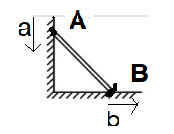
As we can see
$
{{\vec a}_A} = - a\hat j \\
{{\vec a}_B} = b\hat i \\
$
Applying parallelogram law of vector addition
\[\left| {{{\vec a}_{AB}}} \right| = \sqrt {{{\left| {{{\vec a}_A}} \right|}^2} + {{\left| {{{\vec a}_B}} \right|}^2} + 2 \times \left| {{{\vec a}_A}} \right| \times \left| {{{\vec a}_B}} \right|\cos \theta } \]
Here $\theta = {90^ \circ }$ so $\cos \theta = 0$
\[\left| {{{\vec a}_{AB}}} \right| = \sqrt {{{\left| {{{\vec a}_A}} \right|}^2} + {{\left| {{{\vec a}_B}} \right|}^2}} \]
And we know
$
{{\vec a}_A} = - a\hat j \\
{{\vec a}_B} = b\hat i \\
$
On further putting values
$\therefore \left| {{{\vec a}_{AB}}} \right| = \sqrt {{a^2} + {b^2}} $
Using formula $a = \alpha r$
$\therefore \left| {{{\vec a}_{AB}}} \right| = \alpha l$
$\therefore \alpha = \dfrac{{\sqrt {{a^2} + {b^2}} }}{l}$
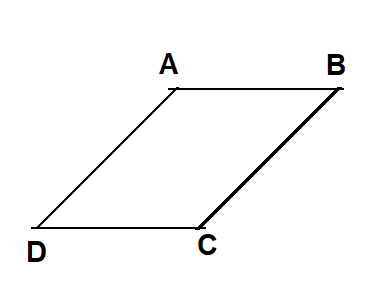
Note:- The difference between triangular law of vector addition and parallelogram law of vector addition is that, in parallelogram law of vector addition both the vectors are placed at same origin and the resultant is the diagonal vector. Whereas, in triangle law of vector addition two vectors are in same order and the resultant is in reverse order.
In Parallelogram law of vector additionThe difference between triangular law of vector addition and parallelogram law of vector addition is that, in parallelogram law of vector addition both the vectors are placed at same origin and the resultant is the diagonal vector. Whereas, in triangle law of vector addition two vectors are in same order and the resultant is in reverse order.
In Parallelogram law of vector addition
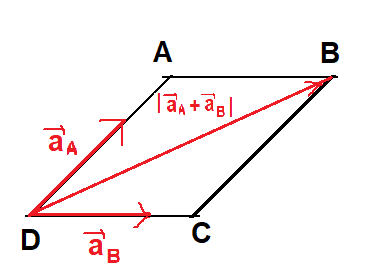
In Triangle law of vector addition
$a = $ liner acceleration
r= radius or length of body which is performing rotational motion
$\alpha = $ Angular acceleration
Complete step-by-step solution:
As we can see
$
{{\vec a}_A} = - a\hat j \\
{{\vec a}_B} = b\hat i \\
$
Applying parallelogram law of vector addition
\[\left| {{{\vec a}_{AB}}} \right| = \sqrt {{{\left| {{{\vec a}_A}} \right|}^2} + {{\left| {{{\vec a}_B}} \right|}^2} + 2 \times \left| {{{\vec a}_A}} \right| \times \left| {{{\vec a}_B}} \right|\cos \theta } \]
Here $\theta = {90^ \circ }$ so $\cos \theta = 0$
\[\left| {{{\vec a}_{AB}}} \right| = \sqrt {{{\left| {{{\vec a}_A}} \right|}^2} + {{\left| {{{\vec a}_B}} \right|}^2}} \]
And we know
$
{{\vec a}_A} = - a\hat j \\
{{\vec a}_B} = b\hat i \\
$
On further putting values
$\therefore \left| {{{\vec a}_{AB}}} \right| = \sqrt {{a^2} + {b^2}} $
Using formula $a = \alpha r$
$\therefore \left| {{{\vec a}_{AB}}} \right| = \alpha l$
$\therefore \alpha = \dfrac{{\sqrt {{a^2} + {b^2}} }}{l}$
Note:- The difference between triangular law of vector addition and parallelogram law of vector addition is that, in parallelogram law of vector addition both the vectors are placed at same origin and the resultant is the diagonal vector. Whereas, in triangle law of vector addition two vectors are in same order and the resultant is in reverse order.
In Parallelogram law of vector additionThe difference between triangular law of vector addition and parallelogram law of vector addition is that, in parallelogram law of vector addition both the vectors are placed at same origin and the resultant is the diagonal vector. Whereas, in triangle law of vector addition two vectors are in same order and the resultant is in reverse order.
In Parallelogram law of vector addition
In Triangle law of vector addition
Recently Updated Pages
Master Class 12 Economics: Engaging Questions & Answers for Success

Master Class 12 Physics: Engaging Questions & Answers for Success
Master Class 12 English: Engaging Questions & Answers for Success
Master Class 12 Social Science: Engaging Questions & Answers for Success
Master Class 12 Maths: Engaging Questions & Answers for Success
Master Class 12 Business Studies: Engaging Questions & Answers for Success
Trending doubts
Which are the Top 10 Largest Countries of the World?
What are the major means of transport Explain each class 12 social science CBSE
Draw a labelled sketch of the human eye class 12 physics CBSE
What is a transformer Explain the principle construction class 12 physics CBSE
Why cannot DNA pass through cell membranes class 12 biology CBSE
Differentiate between insitu conservation and exsitu class 12 biology CBSE