




A rod of length 10cm lies along the principal axis of concave mirror of focal length 10cm in such a way that its end closer to the pole is 20cm away from the mirror. The length of image is
(A) 15cm
(B) $ 2\cdot 5 $ cm
(C) 5cm
(D) 10cm
Answer
 Verified
601.2k+ views
Hint : Use the mirror formula for concave mirror which is given by
$ \dfrac{\text{1}}{\text{v}}+\dfrac{\text{1}}{\text{u}}=\dfrac{1}{\text{f}} $
Here, v is the distance of the image.
u is distance of object.
f is focal length.
Put all the values in the given question and we can find the distance of the image. To find the size of image is given by the differences between the image distance of B and image distance of A.
Complete step by step answer
We have, the object lies horizontally on the principal axis.
Let a rod be given by AB.
Length of rod (object) is given by 10cm
Here, C is the centre of curvature.
C= 2(focal length)=2(10)=20cm
Since, one end of the rod is 20cm from the pole. So, end A is placed at the centre of curvature.
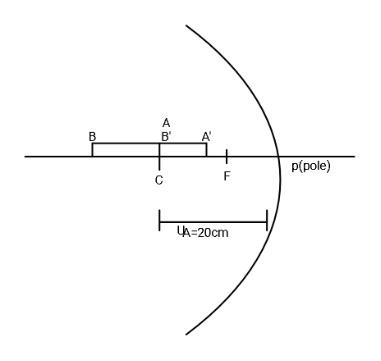
A’ is the image of end A of rod.
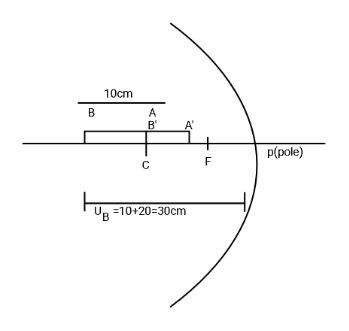
B’ is an image of end B of rod, which is also present at the Centre of curvature.
Consider the end A of rod, which is at 20cm away from the pole,
$ {{u}_{{{A}_{{}}}}}=-20cm $
Focal length of concave mirror $ =-10 $ cm [for concave mirror focal length is negative]
Image distance of end A of rod. $ \dfrac{\text{1}}{{{\text{v}}_{\text{A}}}}+\dfrac{1}{{{\text{u}}_{\text{A}}}}=\dfrac{1}{\text{f}} $
$ \dfrac{\text{1}}{{{\text{v}}_{\text{A}}}}-\dfrac{1}{20}=\dfrac{-1}{10} $
$ \dfrac{1}{{{v}_{A}}}=\dfrac{-1}{10}+\dfrac{1}{20}=\dfrac{-2+1}{20}=\dfrac{-1}{20} $
$ {{\text{v}}_{\text{A}}}=-20cm $ This is the distance of the image of end A of rod.
Consider the end of B rod.
Since the length of rod is 10 cm and distance of end A of rod is 20cm, distance of end B from pole is $ =\text{1}0+\text{2}0=\text{ 3}0 $ cm.
$ \dfrac{\text{1}}{{{\text{v}}_{\text{B}}}}+\dfrac{1}{{{\text{u}}_{\text{B}}}}=\dfrac{1}{\text{f}} $
$ \dfrac{1}{{{\text{v}}_{\text{B}}}}-\dfrac{1}{30}=\dfrac{-1}{10} $
$ \dfrac{1}{{{\text{v}}_{\text{B}}}}=\dfrac{-1}{10}+\dfrac{1}{30}=\dfrac{-3+1}{30}=\dfrac{-2}{30} $
$ {{\text{v}}_{\text{B}}}=-15cm $ This is the distance of image of end B of rod from the pole.
To find size of the image:
= image distance of $ \text{A}- $ image distance of B
$ =\left| {{\text{v}}_{\text{A}}}-{{\text{v}}_{\text{B}}} \right| $
$ =\left| 20-15 \right| $
= 5cm.
Hence, the size of the image is 5cm.
Option (C) is the correct answer.
Note
The distance measured in the direction of incident of light is taken as positive and the distance measured in a direction opposite to the direction of incident are taken as negative.
$ \dfrac{\text{1}}{\text{v}}+\dfrac{\text{1}}{\text{u}}=\dfrac{1}{\text{f}} $
Here, v is the distance of the image.
u is distance of object.
f is focal length.
Put all the values in the given question and we can find the distance of the image. To find the size of image is given by the differences between the image distance of B and image distance of A.
Complete step by step answer
We have, the object lies horizontally on the principal axis.
Let a rod be given by AB.
Length of rod (object) is given by 10cm
Here, C is the centre of curvature.
C= 2(focal length)=2(10)=20cm
Since, one end of the rod is 20cm from the pole. So, end A is placed at the centre of curvature.
A’ is the image of end A of rod.
B’ is an image of end B of rod, which is also present at the Centre of curvature.
Consider the end A of rod, which is at 20cm away from the pole,
$ {{u}_{{{A}_{{}}}}}=-20cm $
Focal length of concave mirror $ =-10 $ cm [for concave mirror focal length is negative]
Image distance of end A of rod. $ \dfrac{\text{1}}{{{\text{v}}_{\text{A}}}}+\dfrac{1}{{{\text{u}}_{\text{A}}}}=\dfrac{1}{\text{f}} $
$ \dfrac{\text{1}}{{{\text{v}}_{\text{A}}}}-\dfrac{1}{20}=\dfrac{-1}{10} $
$ \dfrac{1}{{{v}_{A}}}=\dfrac{-1}{10}+\dfrac{1}{20}=\dfrac{-2+1}{20}=\dfrac{-1}{20} $
$ {{\text{v}}_{\text{A}}}=-20cm $ This is the distance of the image of end A of rod.
Consider the end of B rod.
Since the length of rod is 10 cm and distance of end A of rod is 20cm, distance of end B from pole is $ =\text{1}0+\text{2}0=\text{ 3}0 $ cm.
$ \dfrac{\text{1}}{{{\text{v}}_{\text{B}}}}+\dfrac{1}{{{\text{u}}_{\text{B}}}}=\dfrac{1}{\text{f}} $
$ \dfrac{1}{{{\text{v}}_{\text{B}}}}-\dfrac{1}{30}=\dfrac{-1}{10} $
$ \dfrac{1}{{{\text{v}}_{\text{B}}}}=\dfrac{-1}{10}+\dfrac{1}{30}=\dfrac{-3+1}{30}=\dfrac{-2}{30} $
$ {{\text{v}}_{\text{B}}}=-15cm $ This is the distance of image of end B of rod from the pole.
To find size of the image:
= image distance of $ \text{A}- $ image distance of B
$ =\left| {{\text{v}}_{\text{A}}}-{{\text{v}}_{\text{B}}} \right| $
$ =\left| 20-15 \right| $
= 5cm.
Hence, the size of the image is 5cm.
Option (C) is the correct answer.
Note
The distance measured in the direction of incident of light is taken as positive and the distance measured in a direction opposite to the direction of incident are taken as negative.
Recently Updated Pages
Basicity of sulphurous acid and sulphuric acid are

Master Class 12 Economics: Engaging Questions & Answers for Success
Master Class 12 Biology: Engaging Questions & Answers for Success
Master Class 11 English: Engaging Questions & Answers for Success
Master Class 11 Physics: Engaging Questions & Answers for Success
Master Class 11 Computer Science: Engaging Questions & Answers for Success
Trending doubts
Draw a labelled sketch of the human eye class 12 physics CBSE
Why is the cell called the structural and functional class 12 biology CBSE
Draw ray diagrams each showing i myopic eye and ii class 12 physics CBSE
Which are the Top 10 Largest Countries of the World?
Differentiate between homogeneous and heterogeneous class 12 chemistry CBSE
Which is the correct genotypic ratio of mendel dihybrid class 12 biology CBSE