




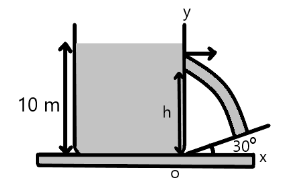
A rectangular tank of height $$10\,m$$ filled with water, is placed near the bottom of a plane inclined at an angle $30^\circ $ with horizontal. At height $h$ from the bottom a small hole is made (as shown in figure) such that the stream coming out from holestrikes the inclined plane normally. Calculate $h$
Answer
 Verified
599.4k+ views
Hint:Here, we have to calculate the value of $h$, that is, the height at which the hole is made. For this, we will first calculate the time $t$ at which the water stream strikes the inclined plane. The formula used for calculating the value time t is given below.
Formula used:
Here we will use the formula which is given below
$v = u + at$
Here, $v$ is the final velocity, $u$ is the initial velocity, $a$ is the acceleration and $t$ is the time taken.
Complete step by step answer:
According to the given question, the value of the velocity will be
$v = \sqrt {2g\left( {10 - h} \right)} $
Here, $v$ is the velocity, $g$ is the acceleration due to gravity and $h$ is the height of the container.
Now, the component of the velocity parallel to the plane will be $v\,\cos 30^\circ $ and the component of the velocity perpendicular to the plane will be $v\,\sin 30^\circ $.When the stream strikes the plane after time $t$. Therefore, the formula of the velocity is given by
$v = u + at$
$ \Rightarrow \,0 = v\cos 30^\circ - gt$
$ \Rightarrow \,t = \dfrac{{v\cos 30^\circ }}{{g\sin 30^\circ }}$
$ \Rightarrow \,t = \dfrac{{v\cot 30^\circ }}{g}$
Now, the wave along the x-axis is represented by the following formula
$x = vt$
$ \Rightarrow \,x = \dfrac{{{v^2}\cot 30^\circ }}{g} = \sqrt 3 y$
$ \Rightarrow \,\dfrac{{{v^2}\cot 30^\circ }}{g} = \sqrt 3 \left( {h - \dfrac{1}{2}g{t^2}} \right)$
$ \Rightarrow \,\dfrac{{\sqrt 3 {v^2}}}{g} = \sqrt 3 \left( {h - \dfrac{1}{2}g{t^2}} \right)$
$ \Rightarrow \,\dfrac{{\sqrt 3 {v^2}}}{g} = \sqrt 3 \left( {h - \dfrac{1}{2}g\dfrac{{{v^2}{{\cot }^2}30^\circ }}{{{g^2}}}} \right)$
$ \Rightarrow \,\dfrac{{{v^2}}}{g} = \left( {h - \dfrac{3}{2}\dfrac{{{v^2}}}{g}} \right)$
$ \Rightarrow \,h = \dfrac{{{v^2}}}{g} + \dfrac{{3{v^2}}}{{2g}}$
$ \Rightarrow \,h = \dfrac{{5{v^2}}}{{2g}}$
$ \Rightarrow \,h = \dfrac{5}{{2g}} \times 2g\left( {10 - h} \right)$
$ \Rightarrow \,h = 5\left( {10 - h} \right)$
$ \Rightarrow \,h + 5h = 50$
$ \Rightarrow \,6h = 50$
$ \therefore \,h = 8.33\,m$
Therefore, the height $h$ will be $8.33\,m$.
Note:The value of the velocity $v = \sqrt {2g\left( {10 - h} \right)} $ is of the water stream that is flowing out of the tank. Also, remember that here final velocity is not given, that is why, we have taken $v = 0$. Also, $v\sin 30^\circ $ is the component of velocity in x-direction and $\sin 30^\circ $ is the component of velocity along y-direction.
Formula used:
Here we will use the formula which is given below
$v = u + at$
Here, $v$ is the final velocity, $u$ is the initial velocity, $a$ is the acceleration and $t$ is the time taken.
Complete step by step answer:
According to the given question, the value of the velocity will be
$v = \sqrt {2g\left( {10 - h} \right)} $
Here, $v$ is the velocity, $g$ is the acceleration due to gravity and $h$ is the height of the container.
Now, the component of the velocity parallel to the plane will be $v\,\cos 30^\circ $ and the component of the velocity perpendicular to the plane will be $v\,\sin 30^\circ $.When the stream strikes the plane after time $t$. Therefore, the formula of the velocity is given by
$v = u + at$
$ \Rightarrow \,0 = v\cos 30^\circ - gt$
$ \Rightarrow \,t = \dfrac{{v\cos 30^\circ }}{{g\sin 30^\circ }}$
$ \Rightarrow \,t = \dfrac{{v\cot 30^\circ }}{g}$
Now, the wave along the x-axis is represented by the following formula
$x = vt$
$ \Rightarrow \,x = \dfrac{{{v^2}\cot 30^\circ }}{g} = \sqrt 3 y$
$ \Rightarrow \,\dfrac{{{v^2}\cot 30^\circ }}{g} = \sqrt 3 \left( {h - \dfrac{1}{2}g{t^2}} \right)$
$ \Rightarrow \,\dfrac{{\sqrt 3 {v^2}}}{g} = \sqrt 3 \left( {h - \dfrac{1}{2}g{t^2}} \right)$
$ \Rightarrow \,\dfrac{{\sqrt 3 {v^2}}}{g} = \sqrt 3 \left( {h - \dfrac{1}{2}g\dfrac{{{v^2}{{\cot }^2}30^\circ }}{{{g^2}}}} \right)$
$ \Rightarrow \,\dfrac{{{v^2}}}{g} = \left( {h - \dfrac{3}{2}\dfrac{{{v^2}}}{g}} \right)$
$ \Rightarrow \,h = \dfrac{{{v^2}}}{g} + \dfrac{{3{v^2}}}{{2g}}$
$ \Rightarrow \,h = \dfrac{{5{v^2}}}{{2g}}$
$ \Rightarrow \,h = \dfrac{5}{{2g}} \times 2g\left( {10 - h} \right)$
$ \Rightarrow \,h = 5\left( {10 - h} \right)$
$ \Rightarrow \,h + 5h = 50$
$ \Rightarrow \,6h = 50$
$ \therefore \,h = 8.33\,m$
Therefore, the height $h$ will be $8.33\,m$.
Note:The value of the velocity $v = \sqrt {2g\left( {10 - h} \right)} $ is of the water stream that is flowing out of the tank. Also, remember that here final velocity is not given, that is why, we have taken $v = 0$. Also, $v\sin 30^\circ $ is the component of velocity in x-direction and $\sin 30^\circ $ is the component of velocity along y-direction.
Recently Updated Pages
Master Class 11 English: Engaging Questions & Answers for Success

Master Class 11 Physics: Engaging Questions & Answers for Success
Master Class 11 Computer Science: Engaging Questions & Answers for Success
Master Class 11 Chemistry: Engaging Questions & Answers for Success
Master Class 11 Social Science: Engaging Questions & Answers for Success
Master Class 11 Accountancy: Engaging Questions & Answers for Success
Trending doubts
Difference Between Prokaryotic Cells and Eukaryotic Cells
Two of the body parts which do not appear in MRI are class 11 biology CBSE
One Metric ton is equal to kg A 10000 B 1000 C 100 class 11 physics CBSE
10 examples of friction in our daily life
Draw a diagram of nephron and explain its structur class 11 biology CBSE
Draw a diagram of a plant cell and label at least eight class 11 biology CBSE