




What is a periderm? How does periderm formation take place in the dicot stems?
Answer
 Verified
639k+ views
Hint: In the bark, there are some tissues located outside the cortex of the stem. In this region, three layers of tissues are found and are formed to replace the existing epidermis.
The periderm refers to the collective term used for phellogen, phellem, and phelloderm in a dicot plant stem and is a component of secondary growth that is formed towards the surface of the stem.
Complete answer:
Formation of periderm – When a dicot stem continues to increase in girth or thickness due to the activity of vascular cambium, the outer cortical and epidermis layers get broken because of pressure from the inner newly formed cells. The broken layers are replaced and new protective layers are provided with the help of meristematic tissues lying outside the cortex region of the stem. These meristematic tissues are called cork cambium or phellogen that develops usually in the cortex region.
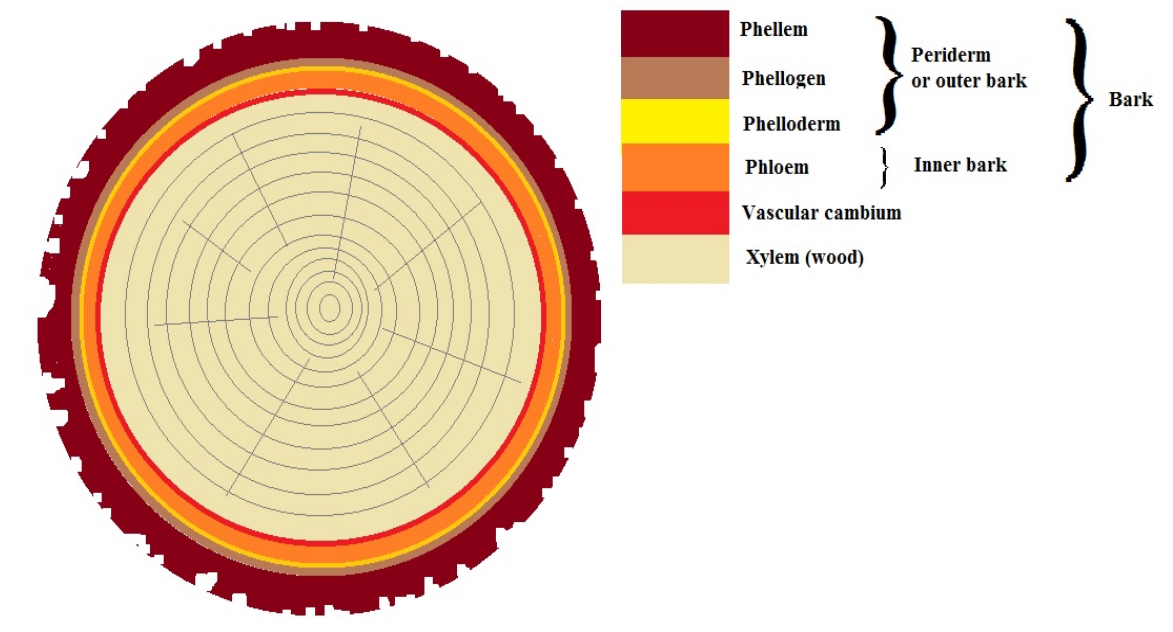
Phellogen is a couple of layers thick and the cells in this region are nearly rectangular and thin-walled. Phellogen cuts off cells on both outer and inner sides and towards the outer side, the cells differentiate into cork or phellem while towards the inner side, the cells differentiate into the secondary cortex or phelloderm.
The three layers of periderm have been indicated in the diagram below –
Note:
1. Suberin is a water-resistant material and due to its deposition in the cell walls of cells in phellem or cork, it is impervious to the water.
2. The bark is a broad term that includes all the tissues of periderm, cortex, and phloem and thus all the tissue located to the outer side of vascular cambium are included in Bark. It can be of two types based on the sequence of formation. If formed early in the season then it is called early bark and if formed later then it is termed as hard bark or late bark.
The periderm refers to the collective term used for phellogen, phellem, and phelloderm in a dicot plant stem and is a component of secondary growth that is formed towards the surface of the stem.
Complete answer:
Formation of periderm – When a dicot stem continues to increase in girth or thickness due to the activity of vascular cambium, the outer cortical and epidermis layers get broken because of pressure from the inner newly formed cells. The broken layers are replaced and new protective layers are provided with the help of meristematic tissues lying outside the cortex region of the stem. These meristematic tissues are called cork cambium or phellogen that develops usually in the cortex region.
Phellogen is a couple of layers thick and the cells in this region are nearly rectangular and thin-walled. Phellogen cuts off cells on both outer and inner sides and towards the outer side, the cells differentiate into cork or phellem while towards the inner side, the cells differentiate into the secondary cortex or phelloderm.
The three layers of periderm have been indicated in the diagram below –
Note:
1. Suberin is a water-resistant material and due to its deposition in the cell walls of cells in phellem or cork, it is impervious to the water.
2. The bark is a broad term that includes all the tissues of periderm, cortex, and phloem and thus all the tissue located to the outer side of vascular cambium are included in Bark. It can be of two types based on the sequence of formation. If formed early in the season then it is called early bark and if formed later then it is termed as hard bark or late bark.
Recently Updated Pages
Master Class 11 English: Engaging Questions & Answers for Success

Master Class 11 Social Science: Engaging Questions & Answers for Success
Master Class 11 Maths: Engaging Questions & Answers for Success
Master Class 11 Biology: Engaging Questions & Answers for Success
Master Class 11 Physics: Engaging Questions & Answers for Success
Master Class 11 Chemistry: Engaging Questions & Answers for Success
Trending doubts
One Metric ton is equal to kg A 10000 B 1000 C 100 class 11 physics CBSE
Difference Between Prokaryotic Cells and Eukaryotic Cells
Two of the body parts which do not appear in MRI are class 11 biology CBSE
Find the value of the expression given below sin 30circ class 11 maths CBSE
Draw a diagram of a plant cell and label at least eight class 11 biology CBSE
10 examples of friction in our daily life