




A rectangular plate of dimensions 10 cm $\times$ 8 cm and thickness 3 mm is placed with its largest face flat on the surface of water. If the surface tension of water is 0.07 N/m, the downward pull on the plate due to surface tension, assuming zero angle of contact is:
A. 0.025 N/m
B. 0.0144 N/m
C. 0.0125 N/m
D. 0.072 N/m
Answer
 Verified
620.7k+ views
Hint: Surface tension: It is the property of liquid by the virtue of which the surface of the liquid acts as a stretched membrane. In other words, the surface wants to minimize its area and hence when a body is kept on a liquid, liquid exerts a force on the touching boundary of the liquid and the body. Due to this reason, if an object is placed on the surface of fluid, due to stretching, the object will experience some force.
Formula used:
$F = Tl$
Complete step by step answer:
As shown in the figure, the block is kept on the fluid. Due to property of surface tension, the block will experience some force which is given by formula:
$F = Tl$
Here, T is the surface tension and ‘l’ is the length of the block which is in contact with the fluid.
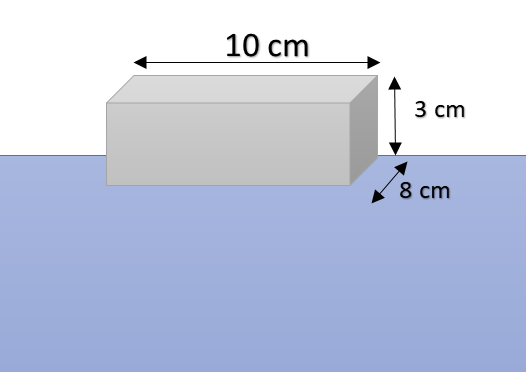
Now, given T = 0.07 N/m and perimeter of largest face or the face in contact with the fluid is:
$l = 2(8+10) = 36 cm$
Hence, the force the block will experience will be$F = Tl$;
$F = 0.07 \times 0.36 = 0.0252 = 2.5 \times 10^{-2} N$
Hence, option A. is correct.
Additional information:
Angle of contact- It is the angle which the fluid makes with the surface of the tube when in contact. It depends both on the fluid and nature of the tube or container. For example- a cold water and glass container has an angle of contact of 0 degree.
Note:
Students must not get confused about the up-thrust due to buoyancy as the block isn’t immersed in the liquid. It is just kept over the surface. So we have to consider only surface tension. If the block is immersed in the liquid, then we have to consider both the forces.
Formula used:
$F = Tl$
Complete step by step answer:
As shown in the figure, the block is kept on the fluid. Due to property of surface tension, the block will experience some force which is given by formula:
$F = Tl$
Here, T is the surface tension and ‘l’ is the length of the block which is in contact with the fluid.
Now, given T = 0.07 N/m and perimeter of largest face or the face in contact with the fluid is:
$l = 2(8+10) = 36 cm$
Hence, the force the block will experience will be$F = Tl$;
$F = 0.07 \times 0.36 = 0.0252 = 2.5 \times 10^{-2} N$
Hence, option A. is correct.
Additional information:
Angle of contact- It is the angle which the fluid makes with the surface of the tube when in contact. It depends both on the fluid and nature of the tube or container. For example- a cold water and glass container has an angle of contact of 0 degree.
Note:
Students must not get confused about the up-thrust due to buoyancy as the block isn’t immersed in the liquid. It is just kept over the surface. So we have to consider only surface tension. If the block is immersed in the liquid, then we have to consider both the forces.
Recently Updated Pages
Master Class 11 English: Engaging Questions & Answers for Success

Master Class 11 Social Science: Engaging Questions & Answers for Success
Master Class 11 Maths: Engaging Questions & Answers for Success
Master Class 11 Biology: Engaging Questions & Answers for Success
Master Class 11 Physics: Engaging Questions & Answers for Success
Master Class 11 Chemistry: Engaging Questions & Answers for Success
Trending doubts
Find the value of the expression given below sin 30circ class 11 maths CBSE
Difference between physical and chemical change class 11 chemistry CBSE
Draw a diagram of a plant cell and label at least eight class 11 biology CBSE
Draw a diagram showing the external features of fish class 11 biology CBSE
10 examples of law on inertia in our daily life
Draw a diagram of nephron and explain its structur class 11 biology CBSE