




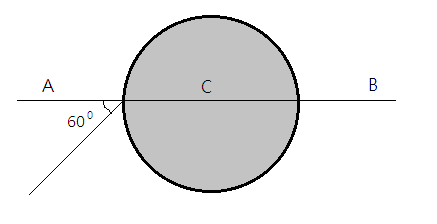
A ray of light falls on a transparent sphere with center at C is shown in Fig. The ray emerges from the sphere parallel to line AB. The refractive index of the sphere is
A. $\sqrt 2 $
B. $\sqrt 3 $
C. $$\dfrac{3}{2}$$
D. $$\dfrac{1}{2}$$
Answer
 Verified
637.5k+ views
Hint: We can solve this equation using Snell’s law. Snell’s law states that the ratio of the sine of the incident angle and the angle of transmission is equal to the ratio of the refractive index of the material at surface. Calculate the angle of refraction and then use the formula of Snell’s law to find the refractive index.
Complete step by step answer:
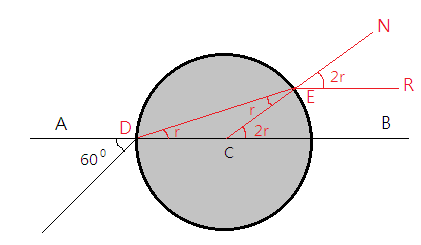
We need to find the angle of refraction and then we can apply Snell’s law to calculate the value of the refractive index. In order to find the angle of refraction, we need to trace the ray as it enters the transparent surface and then leaves the surface. Let us draw an appropriate diagram for that:
From Snell’s law we know that;
$$\sin i = \mu \sin r$$ --equation $$A$$
Here $$i$$ is the angle of incidence and $$r$$ is the angle of refraction.
C is the centre of the circle. Perpendicular to any point on the circle will pass through the centre. Thus, the normal at E, CN is a perpendicular to this circle.
We need to find the angles; $$\angle EDC,\,\angle CED,\,\angle BCE$$ in order to apply Snell’s law at various points.
CE and DC are the radius of the circle and CE, DC are the sides of $$\vartriangle DCE$$ and we know that the angles opposite of equal sides are equal. Therefore, we can have
$$\angle EDC = \angle CED = r$$ --equation $$1$$
Here, $$r$$ is the angle of refraction.
From exterior angle theorem, we have
$$\angle BCE = 2r$$ --equation $$2$$
Now, applying Snell’s law at point E, we have
$$\mu \sin r = \sin 2r$$
$$\mu = \dfrac{{\sin 2r}}{{\sin r}}$$ --equation $$3$$
using equation $$A$$ we know that
$$\sin 2r = \sin i$$
And angle $$i = {60^ \circ }$$
Therefore, we have $$r = {30^ \circ }$$
Applying this value in equation $$3$$ , we get
$$\mu = \dfrac{{\sin (2 \times {{30}^ \circ })}}{{\sin ({{30}^ \circ })}}$$
$$ \Rightarrow \mu = \dfrac{{\sin {{60}^ \circ }}}{{\sin {{30}^ \circ }}}$$
$$ \Rightarrow \mu = \sqrt 3 $$
Therefore, the refractive index of the sphere is $$\sqrt 3 $$
So, the correct answer is “Option B”.
Note:
Snell’s law states that the ratio of the sine of the incident angle and the angle of transmission is equal to the ratio of the refractive index of the material at surface.
It is easy to solve the question after drawing the diagram.
Also, remember that we need to use some trigonometric equations in this problem.
Complete step by step answer:
We need to find the angle of refraction and then we can apply Snell’s law to calculate the value of the refractive index. In order to find the angle of refraction, we need to trace the ray as it enters the transparent surface and then leaves the surface. Let us draw an appropriate diagram for that:
From Snell’s law we know that;
$$\sin i = \mu \sin r$$ --equation $$A$$
Here $$i$$ is the angle of incidence and $$r$$ is the angle of refraction.
C is the centre of the circle. Perpendicular to any point on the circle will pass through the centre. Thus, the normal at E, CN is a perpendicular to this circle.
We need to find the angles; $$\angle EDC,\,\angle CED,\,\angle BCE$$ in order to apply Snell’s law at various points.
CE and DC are the radius of the circle and CE, DC are the sides of $$\vartriangle DCE$$ and we know that the angles opposite of equal sides are equal. Therefore, we can have
$$\angle EDC = \angle CED = r$$ --equation $$1$$
Here, $$r$$ is the angle of refraction.
From exterior angle theorem, we have
$$\angle BCE = 2r$$ --equation $$2$$
Now, applying Snell’s law at point E, we have
$$\mu \sin r = \sin 2r$$
$$\mu = \dfrac{{\sin 2r}}{{\sin r}}$$ --equation $$3$$
using equation $$A$$ we know that
$$\sin 2r = \sin i$$
And angle $$i = {60^ \circ }$$
Therefore, we have $$r = {30^ \circ }$$
Applying this value in equation $$3$$ , we get
$$\mu = \dfrac{{\sin (2 \times {{30}^ \circ })}}{{\sin ({{30}^ \circ })}}$$
$$ \Rightarrow \mu = \dfrac{{\sin {{60}^ \circ }}}{{\sin {{30}^ \circ }}}$$
$$ \Rightarrow \mu = \sqrt 3 $$
Therefore, the refractive index of the sphere is $$\sqrt 3 $$
So, the correct answer is “Option B”.
Note:
Snell’s law states that the ratio of the sine of the incident angle and the angle of transmission is equal to the ratio of the refractive index of the material at surface.
It is easy to solve the question after drawing the diagram.
Also, remember that we need to use some trigonometric equations in this problem.
Recently Updated Pages
Which of the following graphs shows the variation of class 12 physics CBSE

Draw a labelled diagram of the human male reproductive class 12 biology CBSE
Describe the experiment to compare the emf of two cells class 12 physics CBSE
What is standard hydrogen electrode
What is conventional current and electric current class 12 physics CBSE
2Bromopentane is treated with an alcoholic KOH solution class 12 chemistry CBSE
Trending doubts
Draw a labelled sketch of the human eye class 12 physics CBSE
Which are the Top 10 Largest Countries of the World?
Differentiate between homogeneous and heterogeneous class 12 chemistry CBSE
Draw ray diagrams each showing i myopic eye and ii class 12 physics CBSE
Which is the correct genotypic ratio of mendel dihybrid class 12 biology CBSE
What is the Full Form of PVC, PET, HDPE, LDPE, PP and PS ?