




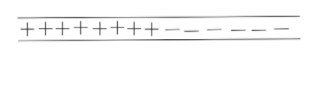
A plastic rod of length $1.0{\text{ }}m$carries uniform positive charge $ + 4{\text{ }}\mu C$ on half of its length and uniform negative charge $ - 4{\text{ }}\mu C$ on the remaining half of its length. Find the magnitude of its net dipole moment in $\mu C - m$.
Answer
 Verified
533.7k+ views
Hint:A configuration of two charges of equal magnitude but opposite direction separated at a small distance is known as dipole. In the given every value of the variable is given. Hence, we will just use the formula of dipole moment to find the answer.
Formula used:
$p = q \times 2l$
The variables are-
$p = $ dipole moment
$q = $ magnitude of charge
$2l = $ separation of charges.
Complete step-by-step solution:
A system of two charges of equal magnitude but different direction at a small distance is known as dipole.
Dipole moment is defined as the product of either charge and the distance of separation between both the charges.
So the formula is,
$p = q \times 2l - - - - \left( 1 \right)$
The variables are-
$p = $ dipole moment
$q = $ magnitude of charge
$2l = $ separation of charges.
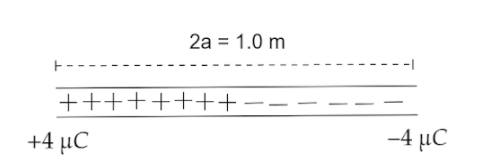
The values given in the question are-
$q = 4{\text{ }}\mu C$, $2l = 1{\text{ }}m$
Substituting the values in equation $\left( 1 \right)$ we get,
$p = 4 \times 1 = 4$
So, the dipole moment is $4{\text{ }}\mu C - m$.
Additional information:
The electric potential due to an electric dipole at any given point is given by the formula,
$V = \dfrac{1}{{4\pi \varepsilon }}\dfrac{{p\cos \theta }}{{\left( {{r^2} - {a^2}{{\cos }^2}\theta } \right)}}$ where, $V = $potential, $r = $ distance of the point whose potential is to be found from the center of the dipole, $a = $ half of the separation of charges in a dipole and $\theta = $ the angle between dipole axis and the point for which potential is to be found.
Note:The direction of dipole moment is from negative charge to positive charge. The dipole moment is generally a vector quantity but as the question has not assigned any direction, there is no need to mention that. The force experienced by a dipole in a uniform electric field is $0$.
Formula used:
$p = q \times 2l$
The variables are-
$p = $ dipole moment
$q = $ magnitude of charge
$2l = $ separation of charges.
Complete step-by-step solution:
A system of two charges of equal magnitude but different direction at a small distance is known as dipole.
Dipole moment is defined as the product of either charge and the distance of separation between both the charges.
So the formula is,
$p = q \times 2l - - - - \left( 1 \right)$
The variables are-
$p = $ dipole moment
$q = $ magnitude of charge
$2l = $ separation of charges.
The values given in the question are-
$q = 4{\text{ }}\mu C$, $2l = 1{\text{ }}m$
Substituting the values in equation $\left( 1 \right)$ we get,
$p = 4 \times 1 = 4$
So, the dipole moment is $4{\text{ }}\mu C - m$.
Additional information:
The electric potential due to an electric dipole at any given point is given by the formula,
$V = \dfrac{1}{{4\pi \varepsilon }}\dfrac{{p\cos \theta }}{{\left( {{r^2} - {a^2}{{\cos }^2}\theta } \right)}}$ where, $V = $potential, $r = $ distance of the point whose potential is to be found from the center of the dipole, $a = $ half of the separation of charges in a dipole and $\theta = $ the angle between dipole axis and the point for which potential is to be found.
Note:The direction of dipole moment is from negative charge to positive charge. The dipole moment is generally a vector quantity but as the question has not assigned any direction, there is no need to mention that. The force experienced by a dipole in a uniform electric field is $0$.
Recently Updated Pages
Master Class 12 Business Studies: Engaging Questions & Answers for Success

Master Class 12 Biology: Engaging Questions & Answers for Success
Master Class 12 Chemistry: Engaging Questions & Answers for Success
Class 12 Question and Answer - Your Ultimate Solutions Guide
Master Class 11 Social Science: Engaging Questions & Answers for Success
Master Class 11 English: Engaging Questions & Answers for Success
Trending doubts
Which are the Top 10 Largest Countries of the World?
Draw a labelled sketch of the human eye class 12 physics CBSE
Differentiate between homogeneous and heterogeneous class 12 chemistry CBSE
Sulphuric acid is known as the king of acids State class 12 chemistry CBSE
Why is the cell called the structural and functional class 12 biology CBSE
Which is the correct genotypic ratio of mendel dihybrid class 12 biology CBSE