




A Plano convex lens of refractive index ${\mu _1}$ and focal length ${{\rm{f}}_1}$ is kept in contact with another Plano concave lens of refractive index ${\mu _2}$ and focal length ${{\rm{f}}_2}$. If the radius of curvature of their spherical faces is R each and ${{\rm{f}}_2} = 2{{\rm{f}}_2}$ , then ${\mu _1}$ and ${\mu _2}$ are related as:
A. ${\mu _1} + {\mu _2} = 3$
B. $2{\mu _1} - {\mu _2} = 1$
C. $2{\mu _2} - {\mu _2} = 1$
D. $3{\mu _2} - {\mu _2} = 1$
Answer
 Verified
603.6k+ views
Hint: A lens is a piece of transparent material bounded by two refracting surfaces out of which at least one curved i.e. concave and convex lens. A lens maker’s formula giving the relationship between the focal length $\left( {\rm{f}} \right)$of the lens, refractive material of the lens $\left( {\rm{n}} \right)$and the radii of curvature of surfaces (${{\rm{R}}_1}$ and ${{\rm{R}}_2}$) is known as lens maker ‘s formula.
Formula used:
$\dfrac{1}{{\rm{f}}} = \left( {{\rm{n - 1}}} \right)\left( {\dfrac{1}{{{{\rm{R}}_1}}} - \dfrac{1}{{{{\rm{R}}_2}}}} \right)$
Complete step by step answer:
By using the lens maker’s formula for Plano-convex and Plano concave;
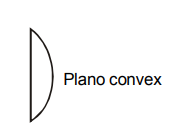
$\dfrac{1}{{{{\rm{f}}_1}}} = \left( {{\mu _1} - 1} \right)\left[ {\dfrac{1}{\infty } - \dfrac{1}{{ - {\rm{R}}}}} \right]...........(1)$
Where f is the focal length, μ is the refractive index, and R is the radius of the curvature.
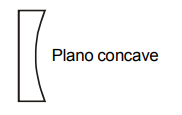
$\dfrac{1}{{{{\rm{f}}_2}}} = \left( {{\mu _2} - 1} \right)\left[ {\dfrac{1}{\infty } - \dfrac{1}{{{\rm{ + R}}}}} \right]...........(2)$
$ \Rightarrow {{\rm{f}}_1} = \dfrac{{\rm{R}}}{{{\mu _1} - 1}}$
And ${{\rm{f}}_2} = \dfrac{{\rm{R}}}{{{\mu _2} - 1}}$
Now given $\left| {{{\rm{f}}_1}} \right| = 2\left| {{{\rm{f}}_2}} \right|$
$\dfrac{{\rm{R}}}{{{\mu _1} - 1}} = \dfrac{{2{\rm{R}}}}{{{\mu _2} - 1}}$
$\therefore {\mu _2} - 1 = 2{\mu _1} - 2$
$ \Rightarrow 2{\mu _1} - {\mu _2} = 1$
Hence the correct option is (C).
Additional information:
From the lens maker’s formula, we can observe that the focal length of a lens is inversely proportional to the refractive index of the medium of the lens. Hence the net refractive index of the lens decreases when it is dipped in a denser medium than air, hence focal length increases.
Note:
The focal length of the Plano concave and convex lens is equal to the radius of curvature. When the object is placed at infinity, then the focal length of the lens is equal to the image distance. The image distance is the distance between the thin lenses to the image. The focal length is the characteristic of a thin lens, and its specifics the distance at which parallel rays come to a focus.
Formula used:
$\dfrac{1}{{\rm{f}}} = \left( {{\rm{n - 1}}} \right)\left( {\dfrac{1}{{{{\rm{R}}_1}}} - \dfrac{1}{{{{\rm{R}}_2}}}} \right)$
Complete step by step answer:
By using the lens maker’s formula for Plano-convex and Plano concave;
$\dfrac{1}{{{{\rm{f}}_1}}} = \left( {{\mu _1} - 1} \right)\left[ {\dfrac{1}{\infty } - \dfrac{1}{{ - {\rm{R}}}}} \right]...........(1)$
Where f is the focal length, μ is the refractive index, and R is the radius of the curvature.
$\dfrac{1}{{{{\rm{f}}_2}}} = \left( {{\mu _2} - 1} \right)\left[ {\dfrac{1}{\infty } - \dfrac{1}{{{\rm{ + R}}}}} \right]...........(2)$
$ \Rightarrow {{\rm{f}}_1} = \dfrac{{\rm{R}}}{{{\mu _1} - 1}}$
And ${{\rm{f}}_2} = \dfrac{{\rm{R}}}{{{\mu _2} - 1}}$
Now given $\left| {{{\rm{f}}_1}} \right| = 2\left| {{{\rm{f}}_2}} \right|$
$\dfrac{{\rm{R}}}{{{\mu _1} - 1}} = \dfrac{{2{\rm{R}}}}{{{\mu _2} - 1}}$
$\therefore {\mu _2} - 1 = 2{\mu _1} - 2$
$ \Rightarrow 2{\mu _1} - {\mu _2} = 1$
Hence the correct option is (C).
Additional information:
From the lens maker’s formula, we can observe that the focal length of a lens is inversely proportional to the refractive index of the medium of the lens. Hence the net refractive index of the lens decreases when it is dipped in a denser medium than air, hence focal length increases.
Note:
The focal length of the Plano concave and convex lens is equal to the radius of curvature. When the object is placed at infinity, then the focal length of the lens is equal to the image distance. The image distance is the distance between the thin lenses to the image. The focal length is the characteristic of a thin lens, and its specifics the distance at which parallel rays come to a focus.
Recently Updated Pages
Master Class 12 Social Science: Engaging Questions & Answers for Success

Master Class 12 Physics: Engaging Questions & Answers for Success
Master Class 12 Maths: Engaging Questions & Answers for Success
Master Class 12 Economics: Engaging Questions & Answers for Success
Master Class 12 Chemistry: Engaging Questions & Answers for Success
Master Class 12 Business Studies: Engaging Questions & Answers for Success
Trending doubts
Which are the Top 10 Largest Countries of the World?
Draw a labelled sketch of the human eye class 12 physics CBSE
Explain the structure of megasporangium class 12 biology CBSE
What are the major means of transport Explain each class 12 social science CBSE
How many chromosomes are found in human ovum a 46 b class 12 biology CBSE
The diagram of the section of a maize grain is given class 12 biology CBSE