




A pentagonal pyramid has 6 faces, 6 vertices and 10 edges. Find its Euler characteristic.
(a) 1
(b) 2
(c) 3
(d) 4
Answer
 Verified
672.3k+ views
Hint: For finding the Euler characteristic use the formula that Euler characteristic is equal to the sum of the number of edges subtracted from the sum of the number of faces and the vertices. Just put the number of faces, vertices and edges in the formula as it is given in the question to get the answer to the above question.
Complete step-by-step answer:
Let us start the solution by knowing the structural property of a pyramid and drawing a representative diagram of it. In general the word pyramid refers to the ancient monuments built by the Egyptians to preserve the mummies but in fact the word pyramid refers to a polyhedron which consists of a polygon as its base and the triangles forming its side faces. The side faces meet at a single point called the apex of the pyramid. The side faces of the Pyramid are also called its lateral faces.
Now let us draw a representative structure of a pentagonal pyramid to get a better idea of its structural properties.
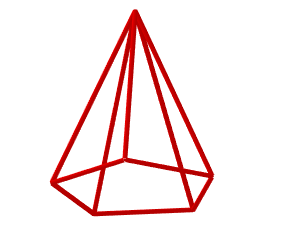
Now we know that the Euler characteristic is equal to the sum of the number of edges subtracted from the sum of the number of faces and the vertices. According to the question, the number of faces is 6, the number of vertices is also 6 and there are 10 edges.
E=V+F-E=6+6-10=2.
Therefore, the answer to the above question is option (b).
Note: Remember that Euler characteristic value is used to define the structural properties of the three dimensional figures. For example: you know the number of faces, edges and vertices of a three dimensional structure and you need to draw it, so you will find the Euler characteristic and if the value of E is 2 you will conclude that it is a polyhedron and draw accordingly.
Complete step-by-step answer:
Let us start the solution by knowing the structural property of a pyramid and drawing a representative diagram of it. In general the word pyramid refers to the ancient monuments built by the Egyptians to preserve the mummies but in fact the word pyramid refers to a polyhedron which consists of a polygon as its base and the triangles forming its side faces. The side faces meet at a single point called the apex of the pyramid. The side faces of the Pyramid are also called its lateral faces.
Now let us draw a representative structure of a pentagonal pyramid to get a better idea of its structural properties.
Now we know that the Euler characteristic is equal to the sum of the number of edges subtracted from the sum of the number of faces and the vertices. According to the question, the number of faces is 6, the number of vertices is also 6 and there are 10 edges.
E=V+F-E=6+6-10=2.
Therefore, the answer to the above question is option (b).
Note: Remember that Euler characteristic value is used to define the structural properties of the three dimensional figures. For example: you know the number of faces, edges and vertices of a three dimensional structure and you need to draw it, so you will find the Euler characteristic and if the value of E is 2 you will conclude that it is a polyhedron and draw accordingly.
Recently Updated Pages
Master Class 10 Computer Science: Engaging Questions & Answers for Success

Master Class 12 Physics: Engaging Questions & Answers for Success
Master Class 12 Social Science: Engaging Questions & Answers for Success
Master Class 12 English: Engaging Questions & Answers for Success
Master Class 12 Maths: Engaging Questions & Answers for Success
Master Class 12 Business Studies: Engaging Questions & Answers for Success
Trending doubts
Fill the blanks with the suitable prepositions 1 The class 9 english CBSE
Difference Between Plant Cell and Animal Cell
What is the full form of pH?
What is the Full Form of ICSE / ISC ?
What is pollution? How many types of pollution? Define it
On an outline map of India show its neighbouring c class 9 social science CBSE