




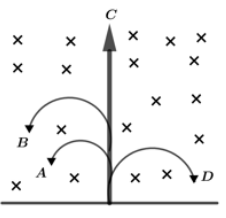
A neutron, a proton, an electron and alpha particle enter a region of the constant magnetic field with equal velocities. The magnetic field is along the inward normal to the plane of the paper, the tracks of the particle are labelled in figure, the electron follows track __ and alpha particle follows track____
A. A, C
B. C, A
C. D, B
D. B, D
Answer
 Verified
564k+ views
Hint:We will use the concept of magnetic force formula which determines the trajectory of a charged particle moving inside the magnetic field. And also neutron particles have no charge whereas protons and electrons have positive and negative charge whereas alpha particles have positive charge.
Complete step by step answer:
Firstly we need to understand the magnetic force formula which is given as,
$\overrightarrow F = q(\overrightarrow v \times \overrightarrow {B)} $
where $F$ is the force, $v$ is velocity and $B$ is magnetic field.
We have given that $\overrightarrow v $ and $\overrightarrow B $ are perpendicular to each other since magnetic field is in downward direction so term $(\overrightarrow v \times \overrightarrow {B)} $ will be simply as $vB\sin {90^ \circ }$ which results
$F = qvB$. And Force will be in direction right to the initial point if charge is negative and left to the initial point if charge is positive. Using Fleming Right hand rule.
Now, Let us check for electron, since electron has a negative charge so force will act in right to the initial point so best path is described by D. $F = - qvB$. For alpha particles, since alpha particle and proton both have positive charge so their path must be in left but as we know greater the charge greater the deflection and we know that alpha particle has greater charge than proton so path must be followed by B. $F = + 2qvB$.
Hence, the correct option is C.
Note:Fleming right hand rule states “point index finger in the direction of magnetic field and thumb in the direction of velocity of particle then middle finger gives us the direction of force”. Here, the neutron has no charge so force on the neutron will be zero so its path is shown by C (no deflection).
Complete step by step answer:
Firstly we need to understand the magnetic force formula which is given as,
$\overrightarrow F = q(\overrightarrow v \times \overrightarrow {B)} $
where $F$ is the force, $v$ is velocity and $B$ is magnetic field.
We have given that $\overrightarrow v $ and $\overrightarrow B $ are perpendicular to each other since magnetic field is in downward direction so term $(\overrightarrow v \times \overrightarrow {B)} $ will be simply as $vB\sin {90^ \circ }$ which results
$F = qvB$. And Force will be in direction right to the initial point if charge is negative and left to the initial point if charge is positive. Using Fleming Right hand rule.
Now, Let us check for electron, since electron has a negative charge so force will act in right to the initial point so best path is described by D. $F = - qvB$. For alpha particles, since alpha particle and proton both have positive charge so their path must be in left but as we know greater the charge greater the deflection and we know that alpha particle has greater charge than proton so path must be followed by B. $F = + 2qvB$.
Hence, the correct option is C.
Note:Fleming right hand rule states “point index finger in the direction of magnetic field and thumb in the direction of velocity of particle then middle finger gives us the direction of force”. Here, the neutron has no charge so force on the neutron will be zero so its path is shown by C (no deflection).
Recently Updated Pages
Master Class 12 Business Studies: Engaging Questions & Answers for Success

Master Class 12 Chemistry: Engaging Questions & Answers for Success
Master Class 12 Biology: Engaging Questions & Answers for Success
Class 12 Question and Answer - Your Ultimate Solutions Guide
Master Class 11 English: Engaging Questions & Answers for Success
Master Class 11 Social Science: Engaging Questions & Answers for Success
Trending doubts
Which are the Top 10 Largest Countries of the World?
Draw a labelled sketch of the human eye class 12 physics CBSE
Differentiate between homogeneous and heterogeneous class 12 chemistry CBSE
Differentiate between Pyramid of energy and pyramid class 12 biology CBSE
Why is the cell called the structural and functional class 12 biology CBSE
Draw the diagram of the pyramid of energy Explain In class 12 biology CBSE