




When a mixture of benzene and cyclohexanol is oxidized with 2-ethylanthraquinone, the product is:
A. Ethanol
B. Hydrogen peroxide
C. Anthracene
D. None of these
Answer
 Verified
566.4k+ views
Hint: 2-Ethylanthraquinone is one of the organic compound which is a derivative of anthraquinone which are organic compound represented by the molecular formula${{C}_{14}}{{H}_{8}}{{O}_{2}}$. It is pale yellow in color and exists in solid form.
Complete step-by-step answer: 2-Ethylanthraquinone is prepared from the reaction of phthalic anhydride with ethyl benzene where phthalic anhydride is represented by ${{C}_{4}}{{H}_{4}}{{(CO)}_{2}}O$and ethyl benzene is ${{C}_{6}}{{H}_{5}}Et$gives 2-Ethylanthraquinone represented by ${{C}_{6}}{{H}_{4}}{{(CO)}_{2}}{{C}_{6}}{{H}_{3}}Et$.
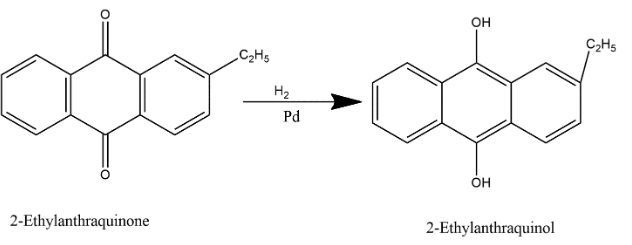
When 2-ethylanthraquinone dissolved in a mixture of benzene and cyclohexanol is oxidized the product formed can be explained by the following mechanism:
In step 1, 2-ethylanthraquinone is dissolved in benzene and hydrogen gas is passed through the solution in the presence of palladium represented by symbol Pd catalyst and in this process reduction takes place i.e. 2-ethylanthraquinone is reduced to 2-ethylanthraquinone.
In the second step, 2-ethylanthraquinol is dissolved in mixture of benzene and cyclohexanol and when air is passed through it i.e. we supply oxygen here then oxygenation process occurs which oxidized back it to 2-ethylanthraquinone and hydrogen peroxide as shown below:
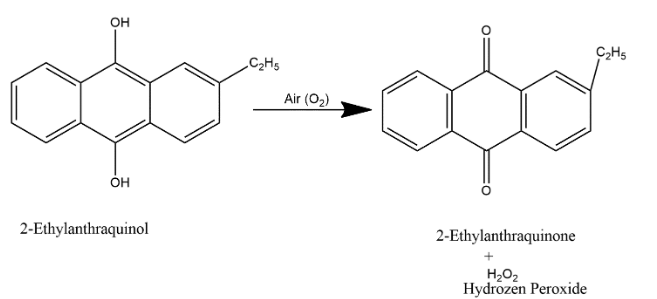
Here two products are formed 2-ethylanthraquinone and hydrogen peroxide, hence we can say that option B is the correct answer as one of the products is hydrogen peroxide.
Note: 2-ethylanthraquinone are quinone derivatives which are a type of organic compounds which can be formally derived from aromatic compounds which results in the formation of double bonded or fully conjugated cyclic diene structures.
Complete step-by-step answer: 2-Ethylanthraquinone is prepared from the reaction of phthalic anhydride with ethyl benzene where phthalic anhydride is represented by ${{C}_{4}}{{H}_{4}}{{(CO)}_{2}}O$and ethyl benzene is ${{C}_{6}}{{H}_{5}}Et$gives 2-Ethylanthraquinone represented by ${{C}_{6}}{{H}_{4}}{{(CO)}_{2}}{{C}_{6}}{{H}_{3}}Et$.
When 2-ethylanthraquinone dissolved in a mixture of benzene and cyclohexanol is oxidized the product formed can be explained by the following mechanism:
In step 1, 2-ethylanthraquinone is dissolved in benzene and hydrogen gas is passed through the solution in the presence of palladium represented by symbol Pd catalyst and in this process reduction takes place i.e. 2-ethylanthraquinone is reduced to 2-ethylanthraquinone.
In the second step, 2-ethylanthraquinol is dissolved in mixture of benzene and cyclohexanol and when air is passed through it i.e. we supply oxygen here then oxygenation process occurs which oxidized back it to 2-ethylanthraquinone and hydrogen peroxide as shown below:
Here two products are formed 2-ethylanthraquinone and hydrogen peroxide, hence we can say that option B is the correct answer as one of the products is hydrogen peroxide.
Note: 2-ethylanthraquinone are quinone derivatives which are a type of organic compounds which can be formally derived from aromatic compounds which results in the formation of double bonded or fully conjugated cyclic diene structures.
Recently Updated Pages
Master Class 12 Business Studies: Engaging Questions & Answers for Success

Master Class 12 Biology: Engaging Questions & Answers for Success
Master Class 12 Chemistry: Engaging Questions & Answers for Success
Class 12 Question and Answer - Your Ultimate Solutions Guide
Master Class 11 Social Science: Engaging Questions & Answers for Success
Master Class 11 English: Engaging Questions & Answers for Success
Trending doubts
Which is more stable and why class 12 chemistry CBSE
Which are the Top 10 Largest Countries of the World?
Draw a labelled sketch of the human eye class 12 physics CBSE
Differentiate between homogeneous and heterogeneous class 12 chemistry CBSE
What are the major means of transport Explain each class 12 social science CBSE
Sulphuric acid is known as the king of acids State class 12 chemistry CBSE