




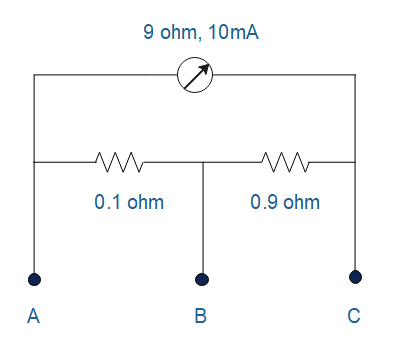
A millimetre of range \[10\text{ }mA\]and resistance\[~9\Omega \] is joined in a circuit as shown in figure. The meter gives full-scale deflection for current I when $A$and $B$are used as its terminals. If current enters at$A$ and leaves at$B$ ($C$ is left isolated), the value of $I$ is
$\begin{align}
& \text{A}\text{. 100mA} \\
& \text{B}\text{. 900mA} \\
& \text{C}\text{. 1A} \\
& \text{D}\text{. 1}\text{.1A} \\
\end{align}$
Answer
 Verified
595.8k+ views
Hint: C is isolated i.e. no current flows from branch C. Use Kirchhoff’s current law to calculate current in each of the branches and then Kirchhoff’s voltage law to calculate voltage in each of the terminals. Using KCL, find current in each of the branches. This is how you will get voltage in each of the branches.
Formula used:
$V=IR$
Where,
$\begin{align}
& V=\text{Voltage} \\
& I=\text{ Current} \\
& R=\text{ Resistance} \\
\end{align}$
Complete step by step answer:
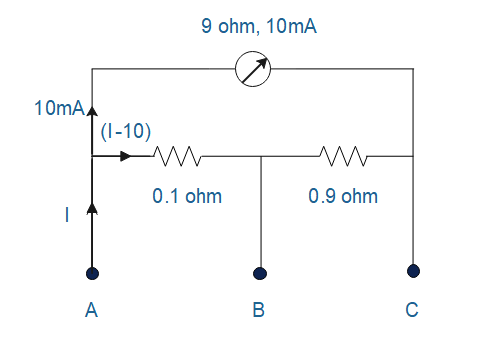
In the question it is given that the meter gives full-scale deflection for current $I$when $A\text{ and B}$are used as its terminals. \[C\]is isolated.
Branch \[C\]is detached now.
Let$I$be the current flowing through \[A\]branch, shown in figure. If$I$be the current entering through A and $10mA$is the current flowing through $9\Omega $ then remaining current flowing through $0.1\Omega $is$(I-10)$.
Since $C$is isolated therefore the circuit will look as follows
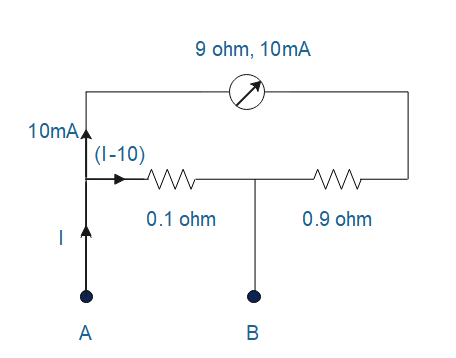
From the figure we can say that resistance$9\Omega $and $0.9\Omega $are in series now and series combinations of these two resistance are in parallel with$0.1\Omega $resistance.
We know that if two branches are in parallel then potential in both the branches is the same.
Therefore we can write as
\[\begin{align}
& \text{(9+0}\text{.9)}\times 10\times {{10}^{-3}}=0.1\times (I-10mA) \\
& 990mA=I-10 \\
& I=1000mA \\
& I=1A \\
\end{align}\]
If current enters at$A$ and leaves at$B$ ($C$ is left isolated), the value of $I$ is$1A$.
Answer-(C)
Note: In this question it is given that C is isolated. It means that C is detachable and we need to detach it. So no current will flow through branch C. Since C is inactive therefore $9\Omega $and$0.9\Omega $become in series and total resistance is$9.9\Omega $. In this question we have used both Kirchhoff’s law i.e. KCL and KCL. First we have used KCL and then KVL. In this type of question, you cannot use ohm's law. Using only ohm’s law will not give a desirable result. KCL is also known as conservation of charge and KVL is known as conservation of energy.
Formula used:
$V=IR$
Where,
$\begin{align}
& V=\text{Voltage} \\
& I=\text{ Current} \\
& R=\text{ Resistance} \\
\end{align}$
Complete step by step answer:
In the question it is given that the meter gives full-scale deflection for current $I$when $A\text{ and B}$are used as its terminals. \[C\]is isolated.
Branch \[C\]is detached now.
Let$I$be the current flowing through \[A\]branch, shown in figure. If$I$be the current entering through A and $10mA$is the current flowing through $9\Omega $ then remaining current flowing through $0.1\Omega $is$(I-10)$.
Since $C$is isolated therefore the circuit will look as follows
From the figure we can say that resistance$9\Omega $and $0.9\Omega $are in series now and series combinations of these two resistance are in parallel with$0.1\Omega $resistance.
We know that if two branches are in parallel then potential in both the branches is the same.
Therefore we can write as
\[\begin{align}
& \text{(9+0}\text{.9)}\times 10\times {{10}^{-3}}=0.1\times (I-10mA) \\
& 990mA=I-10 \\
& I=1000mA \\
& I=1A \\
\end{align}\]
If current enters at$A$ and leaves at$B$ ($C$ is left isolated), the value of $I$ is$1A$.
Answer-(C)
Note: In this question it is given that C is isolated. It means that C is detachable and we need to detach it. So no current will flow through branch C. Since C is inactive therefore $9\Omega $and$0.9\Omega $become in series and total resistance is$9.9\Omega $. In this question we have used both Kirchhoff’s law i.e. KCL and KCL. First we have used KCL and then KVL. In this type of question, you cannot use ohm's law. Using only ohm’s law will not give a desirable result. KCL is also known as conservation of charge and KVL is known as conservation of energy.
Recently Updated Pages
Master Class 12 Economics: Engaging Questions & Answers for Success

Master Class 12 Physics: Engaging Questions & Answers for Success
Master Class 12 English: Engaging Questions & Answers for Success
Master Class 12 Social Science: Engaging Questions & Answers for Success
Master Class 12 Maths: Engaging Questions & Answers for Success
Master Class 12 Business Studies: Engaging Questions & Answers for Success
Trending doubts
Why cannot DNA pass through cell membranes class 12 biology CBSE
Differentiate between insitu conservation and exsitu class 12 biology CBSE
Draw a neat and well labeled diagram of TS of ovary class 12 biology CBSE
In a human foetus the limbs and digits develop after class 12 biology CBSE
AABbCc genotype forms how many types of gametes a 4 class 12 biology CBSE
The correct structure of ethylenediaminetetraacetic class 12 chemistry CBSE