



A man goes \[10m\]towards north, and then \[20m\]towards east then displacement is
A.\[22.5m\]
B.\[25m\]
C.\[25.5m\]
D.\[30m\]
Answer
 Verified
605.7k+ views
Hint: Displacement is always defined as the linear path travelled by man from initial point to final point. Displacement is always a shortest linear path travelled by body. Distance is defined as the actual path travelled it can be calculated by simply adding the original path travelled by the body.
Complete answer:
As we know that North is always in upward direction, South in downward direction, East in left direction and west in right direction.
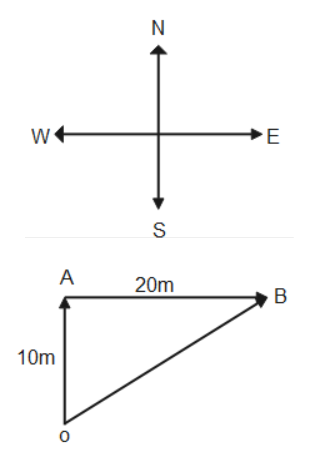
In the given question man first moves \[10m\]towards north along OA in upwards direction and then it moves \[20m\]towards east along AB in the right direction. So they move in a perpendicular direction.
Initial point of motion is O and final point of motion is B.
As we know that Displacement is defined as the linear path travelled between initial point and final point of the motion. So in this figure displacement is represented by length OB.
Since OA and AB are perpendicular to each other so magnitude of displacement OB can be calculated by Pythagora's theorem applied in right angle triangle ABC.
According to Pythagoras theorem,
\[{{(Hypotenuse)}^{2}}={{(Base)}^{2}}+{{(Perpendicular)}^{2}}\]
\[\begin{align}
& {{(OB)}^{2}}={{(OA)}^{2}}+{{(AB)}^{2}} \\
& {{(OB)}^{2}}={{(10)}^{2}}+{{(20)}^{2}} \\
& {{(OB)}^{2}}=100+400 \\
& {{(OB)}^{2}}=500 \\
& OB=10\sqrt{5}m \\
\end{align}\]
Magnitude of displacement of man is \[10\sqrt{5}m\]\[=22.36m\approx 22.5m\].
Correct Option is A.
Additional Information:
If given vector quantities are not perpendicular to each other then magnitude of resultant vector is calculated by vector method. \[R=\sqrt{{{A}^{2}}+{{B}^{2}}+2ABCos\theta }\] .
\[\theta \]is the angle between two vectors.
Magnitude of Resultant is represented by R.
Note:
When given two vectors are in perpendicular direction the magnitude of resultant can be obtained by Pythagoras theorem. When two vectors are not perpendicular to each other then resultant magnitude is calculated by using analytical method of vector addition by law of triangle or by law of parallelogram.
Complete answer:
As we know that North is always in upward direction, South in downward direction, East in left direction and west in right direction.
In the given question man first moves \[10m\]towards north along OA in upwards direction and then it moves \[20m\]towards east along AB in the right direction. So they move in a perpendicular direction.
Initial point of motion is O and final point of motion is B.
As we know that Displacement is defined as the linear path travelled between initial point and final point of the motion. So in this figure displacement is represented by length OB.
Since OA and AB are perpendicular to each other so magnitude of displacement OB can be calculated by Pythagora's theorem applied in right angle triangle ABC.
According to Pythagoras theorem,
\[{{(Hypotenuse)}^{2}}={{(Base)}^{2}}+{{(Perpendicular)}^{2}}\]
\[\begin{align}
& {{(OB)}^{2}}={{(OA)}^{2}}+{{(AB)}^{2}} \\
& {{(OB)}^{2}}={{(10)}^{2}}+{{(20)}^{2}} \\
& {{(OB)}^{2}}=100+400 \\
& {{(OB)}^{2}}=500 \\
& OB=10\sqrt{5}m \\
\end{align}\]
Magnitude of displacement of man is \[10\sqrt{5}m\]\[=22.36m\approx 22.5m\].
Correct Option is A.
Additional Information:
If given vector quantities are not perpendicular to each other then magnitude of resultant vector is calculated by vector method. \[R=\sqrt{{{A}^{2}}+{{B}^{2}}+2ABCos\theta }\] .
\[\theta \]is the angle between two vectors.
Magnitude of Resultant is represented by R.
Note:
When given two vectors are in perpendicular direction the magnitude of resultant can be obtained by Pythagoras theorem. When two vectors are not perpendicular to each other then resultant magnitude is calculated by using analytical method of vector addition by law of triangle or by law of parallelogram.
Recently Updated Pages
Write any three differences between metals and nonmetals class 10 social science CBSE

Amit standing on a horizontal plane finds a bird flying class 10 maths CBSE
Two circles of radii 5 cm and 3 cm intersect at two class 10 maths CBSE
Solve the following i John and Jivanti together have class 10 maths CBSE
What is the relation between orthocenter circumcentre class 10 maths CBSE
Two plane mirrors are inclined at 70circ A ray incident class 10 physics CBSE
Trending doubts
Explain the Treaty of Vienna of 1815 class 10 social science CBSE
Which country is known as "The land of Fire and Ice"?
1 GB equals how many MB?
10 examples of evaporation in daily life with explanations
What is the full form of POSCO class 10 social science CBSE
Which is the hottest planet in the Solar system A Earth class 10 social science CBSE