




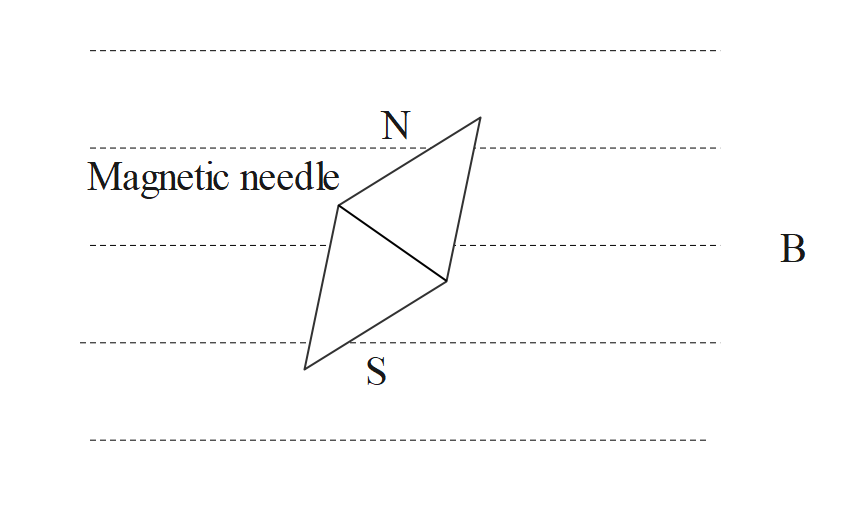
A magnetic needle has magnetic moment of $6.67\times {{10}^{-2}}A{{m}^{2}}$and moment of inertia $7.5\times {{10}^{-6}}kg{{m}^{2}}$. It performs 10 complete oscillations in 6.70s. What is the magnitude of the magnetic field?
$\begin{align}
& 1)0.2T \\
& b)0.05T \\
& c)0.08T \\
& d)0.01T \\
\end{align}$
Answer
 Verified
585.6k+ views
Hint: Let us first find out the time period of the magnetic needle from given information. Next, using the relation between time period, magnetic moment, moment of inertia and magnetic field, we know all the terms except the value of magnetic field. Using one formula, we can find the magnetic field easily.
Formula used: $T=2\pi \sqrt{\dfrac{I}{MB}}$
Complete step by step answer:
Let’s us first write down the given quantities,
$\begin{align}
& I=7.5\times {{10}^{-6}}kg{{m}^{2}} \\
& M=6.67\times {{10}^{-2}}A{{m}^{2}} \\
\end{align}$
Now, let’s calculate the time period,
For 10 oscillations, time taken is 6.70s
For 1 oscillation, time taken is
$\Rightarrow t=\dfrac{6.70}{10}=0.67s$
As we now know all the values, we can substitute them in the formula of time period,
$\begin{align}
& T=2\pi \sqrt{\dfrac{I}{MB}} \\
& \Rightarrow 0.67=2\pi \sqrt{\dfrac{7.5\times {{10}^{-6}}}{6.67\times {{10}^{-2}}\times B}} \\
& \Rightarrow B=\dfrac{4{{\pi }^{2}}\times 7.5\times {{10}^{-6}}}{{{(0.67)}^{2}}\times 6.67\times {{10}^{-2}}} \\
& \Rightarrow B=0.01T \\
\end{align}$
So, the correct answer is “Option D”.
Additional Information: The magnetic moment of a body in any given magnetic field is the determination of its tendency to get arranged through a magnetic field. A magnet has two poles, north pole and south pole. Magnetic moment then can be defined as the magnetic strength and orientation of a magnet or other object that produces a magnetic field. In an electron, the magnetic moment of an electron is determined by its intrinsic properties of spin and electric charge. Moment of inertia is a quantity that is used to express the body’s tendency to resist angular acceleration, which is the sum of products of mass of each particle in the body with the square of its distance from the axis of rotation. Inertia is caused when some local field is present around the object.
Note: In the above question, we were given the time taken by the body for ten oscillations. We usually take this as the time period of the magnetic needle. But, the time period of the needle is the number of rotations per unit second. Therefore, we divided the given time by ten seconds to get the time taken for one rotation.
Formula used: $T=2\pi \sqrt{\dfrac{I}{MB}}$
Complete step by step answer:
Let’s us first write down the given quantities,
$\begin{align}
& I=7.5\times {{10}^{-6}}kg{{m}^{2}} \\
& M=6.67\times {{10}^{-2}}A{{m}^{2}} \\
\end{align}$
Now, let’s calculate the time period,
For 10 oscillations, time taken is 6.70s
For 1 oscillation, time taken is
$\Rightarrow t=\dfrac{6.70}{10}=0.67s$
As we now know all the values, we can substitute them in the formula of time period,
$\begin{align}
& T=2\pi \sqrt{\dfrac{I}{MB}} \\
& \Rightarrow 0.67=2\pi \sqrt{\dfrac{7.5\times {{10}^{-6}}}{6.67\times {{10}^{-2}}\times B}} \\
& \Rightarrow B=\dfrac{4{{\pi }^{2}}\times 7.5\times {{10}^{-6}}}{{{(0.67)}^{2}}\times 6.67\times {{10}^{-2}}} \\
& \Rightarrow B=0.01T \\
\end{align}$
So, the correct answer is “Option D”.
Additional Information: The magnetic moment of a body in any given magnetic field is the determination of its tendency to get arranged through a magnetic field. A magnet has two poles, north pole and south pole. Magnetic moment then can be defined as the magnetic strength and orientation of a magnet or other object that produces a magnetic field. In an electron, the magnetic moment of an electron is determined by its intrinsic properties of spin and electric charge. Moment of inertia is a quantity that is used to express the body’s tendency to resist angular acceleration, which is the sum of products of mass of each particle in the body with the square of its distance from the axis of rotation. Inertia is caused when some local field is present around the object.
Note: In the above question, we were given the time taken by the body for ten oscillations. We usually take this as the time period of the magnetic needle. But, the time period of the needle is the number of rotations per unit second. Therefore, we divided the given time by ten seconds to get the time taken for one rotation.
Recently Updated Pages
Master Class 12 Economics: Engaging Questions & Answers for Success

Master Class 12 Physics: Engaging Questions & Answers for Success
Master Class 12 English: Engaging Questions & Answers for Success
Master Class 12 Social Science: Engaging Questions & Answers for Success
Master Class 12 Maths: Engaging Questions & Answers for Success
Master Class 12 Business Studies: Engaging Questions & Answers for Success
Trending doubts
Which are the Top 10 Largest Countries of the World?
What are the major means of transport Explain each class 12 social science CBSE
Draw a labelled sketch of the human eye class 12 physics CBSE
What is a transformer Explain the principle construction class 12 physics CBSE
Why cannot DNA pass through cell membranes class 12 biology CBSE
Differentiate between insitu conservation and exsitu class 12 biology CBSE