




When a longitudinal wave is incident at the boundary of denser medium, then ____________.
A. Compression reflects as a compression
B. Compression reflects as a rarefaction
C. Rarefaction reflects as a compression
D. Longitudinal wave reflects transverse wave
Answer
 Verified
552.1k+ views
Hint On reflection at the boundary of a denser medium, a change of phase by $180^\circ $ takes place for a longitudinal wave. In other words, there is a phase difference of $180^\circ $ between the incident wave and the reflected wave.
Complete step-by-step solution:
Let us first discuss about what is compression and rarefaction.
In the motion of longitudinal wave, a compression is a formed when the particles comes very close to each other whereas a rarefaction is formed when the particles goes far apart from each other.
In other words, we can also say that the region where the medium is compressed is known as a compression and the region where the medium is spread out is known as a rarefaction.
Suppose that longitudinal waves in air are incident perpendicularly on a rigid wall (See the diagram). When a compression hits the wall, it exerts a force on the wall and the wall also exerts an equal and opposite force on the particles in compression and hence pushes the compression in the opposite direction.
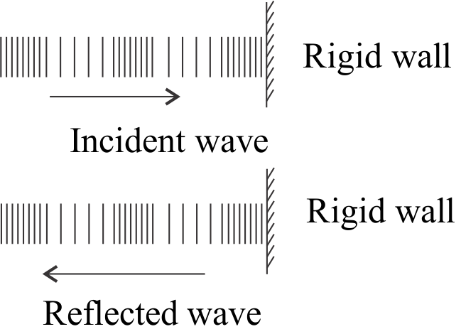
Thus, there is a phase difference of $180^\circ $ between the incident wave and the reflected wave.
Therefore, a compression which is travelling towards the wall is reflected as a compression in the direction opposite to the wall and a rarefaction incident on the wall is reflected as a rarefaction.
Hence, option A is correct.
Note: When a compression is formed in a medium, the density and pressure of the medium increases whereas when a rarefaction is formed in the same medium, density and pressure of the medium decreases.
Therefore, compression is also known as the region of high density and pressure whereas rarefaction is known as the region of low density and pressure.
Complete step-by-step solution:
Let us first discuss about what is compression and rarefaction.
In the motion of longitudinal wave, a compression is a formed when the particles comes very close to each other whereas a rarefaction is formed when the particles goes far apart from each other.
In other words, we can also say that the region where the medium is compressed is known as a compression and the region where the medium is spread out is known as a rarefaction.
Suppose that longitudinal waves in air are incident perpendicularly on a rigid wall (See the diagram). When a compression hits the wall, it exerts a force on the wall and the wall also exerts an equal and opposite force on the particles in compression and hence pushes the compression in the opposite direction.
Thus, there is a phase difference of $180^\circ $ between the incident wave and the reflected wave.
Therefore, a compression which is travelling towards the wall is reflected as a compression in the direction opposite to the wall and a rarefaction incident on the wall is reflected as a rarefaction.
Hence, option A is correct.
Note: When a compression is formed in a medium, the density and pressure of the medium increases whereas when a rarefaction is formed in the same medium, density and pressure of the medium decreases.
Therefore, compression is also known as the region of high density and pressure whereas rarefaction is known as the region of low density and pressure.
Recently Updated Pages
Master Class 12 Business Studies: Engaging Questions & Answers for Success

Master Class 12 Biology: Engaging Questions & Answers for Success
Master Class 12 Chemistry: Engaging Questions & Answers for Success
Class 12 Question and Answer - Your Ultimate Solutions Guide
Master Class 11 Social Science: Engaging Questions & Answers for Success
Master Class 11 English: Engaging Questions & Answers for Success
Trending doubts
Which are the Top 10 Largest Countries of the World?
Draw a labelled sketch of the human eye class 12 physics CBSE
Differentiate between homogeneous and heterogeneous class 12 chemistry CBSE
Sulphuric acid is known as the king of acids State class 12 chemistry CBSE
Why is the cell called the structural and functional class 12 biology CBSE
Which is the correct genotypic ratio of mendel dihybrid class 12 biology CBSE