




A long cylindrical volume contains a uniformly distributed charge of density $\rho$. Find the electric field at point P inside the cylindrical volume at a distance x from its axis.
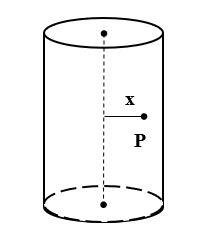
Answer
 Verified
603.6k+ views
Hint: To answer this question, initially, find the charge on the cylinder. Charge can be calculated by taking the product of volume charge density and volume of the cylinder. Then, use the integral form of Gauss law for volume charge density. Substitute the values and calculate the electric field at point P inside the cylindrical volume.
Formula used:
$Q= \rho V$
$\oint E. ds= \dfrac {Q}{{\epsilon}_{0}}$
Complete step by step answer:
Given: Volume charge density =$\rho$
Let the height of the cylinder be h
Charge on the cylinder is given by,
$Q= \rho V$
Where, V is the volume of the cylinder
Substituting values in above equation we get,
$Q= \rho \times 4\pi {x}^{2}h$
According to gauss law,
$\oint E. ds= \dfrac {Q}{{\epsilon}_{0}}$
$\therefore E= \dfrac {Q}{dx \times{\epsilon}_{0}}$
Substituting the values in above equation we get,
$\Rightarrow E= \dfrac { \rho \times 4\pi {x}^{2}h }{2\pi xh \times{\epsilon}_{0}}$
$\therefore E= \dfrac {\rho x}{2 {\epsilon}_{0}}$
Hence, the electric field at point P inside the cylinder is $\dfrac {\rho x}{2 {\epsilon}_{0}}$.
Note:
To answer these types of questions, students should remember the basic laws like Gauss law. There are two forms of Gauss law: integral form and differential form. Integral form of Gauss law is given by,
$\oint E. ds= \dfrac {Q}{{\epsilon}_{0}}$
Differential form is given by,
$\nabla . E= \dfrac {\rho}{{\epsilon}_{0}}$
Gauss law is a restatement of Coulomb's law. If we apply the Gauss law to a point charge, then we'll get back the Coulomb's law.
Formula used:
$Q= \rho V$
$\oint E. ds= \dfrac {Q}{{\epsilon}_{0}}$
Complete step by step answer:
Given: Volume charge density =$\rho$
Let the height of the cylinder be h
Charge on the cylinder is given by,
$Q= \rho V$
Where, V is the volume of the cylinder
Substituting values in above equation we get,
$Q= \rho \times 4\pi {x}^{2}h$
According to gauss law,
$\oint E. ds= \dfrac {Q}{{\epsilon}_{0}}$
$\therefore E= \dfrac {Q}{dx \times{\epsilon}_{0}}$
Substituting the values in above equation we get,
$\Rightarrow E= \dfrac { \rho \times 4\pi {x}^{2}h }{2\pi xh \times{\epsilon}_{0}}$
$\therefore E= \dfrac {\rho x}{2 {\epsilon}_{0}}$
Hence, the electric field at point P inside the cylinder is $\dfrac {\rho x}{2 {\epsilon}_{0}}$.
Note:
To answer these types of questions, students should remember the basic laws like Gauss law. There are two forms of Gauss law: integral form and differential form. Integral form of Gauss law is given by,
$\oint E. ds= \dfrac {Q}{{\epsilon}_{0}}$
Differential form is given by,
$\nabla . E= \dfrac {\rho}{{\epsilon}_{0}}$
Gauss law is a restatement of Coulomb's law. If we apply the Gauss law to a point charge, then we'll get back the Coulomb's law.
Recently Updated Pages
Three beakers labelled as A B and C each containing 25 mL of water were taken A small amount of NaOH anhydrous CuSO4 and NaCl were added to the beakers A B and C respectively It was observed that there was an increase in the temperature of the solutions contained in beakers A and B whereas in case of beaker C the temperature of the solution falls Which one of the following statements isarecorrect i In beakers A and B exothermic process has occurred ii In beakers A and B endothermic process has occurred iii In beaker C exothermic process has occurred iv In beaker C endothermic process has occurred

Master Class 12 Social Science: Engaging Questions & Answers for Success
Master Class 12 Physics: Engaging Questions & Answers for Success
Master Class 12 Maths: Engaging Questions & Answers for Success
Master Class 12 Economics: Engaging Questions & Answers for Success
Master Class 12 Chemistry: Engaging Questions & Answers for Success
Three beakers labelled as A B and C each containing 25 mL of water were taken A small amount of NaOH anhydrous CuSO4 and NaCl were added to the beakers A B and C respectively It was observed that there was an increase in the temperature of the solutions contained in beakers A and B whereas in case of beaker C the temperature of the solution falls Which one of the following statements isarecorrect i In beakers A and B exothermic process has occurred ii In beakers A and B endothermic process has occurred iii In beaker C exothermic process has occurred iv In beaker C endothermic process has occurred
Master Class 12 Social Science: Engaging Questions & Answers for Success
Master Class 12 Physics: Engaging Questions & Answers for Success
Trending doubts
Which are the Top 10 Largest Countries of the World?
Draw a labelled sketch of the human eye class 12 physics CBSE
Differentiate between homogeneous and heterogeneous class 12 chemistry CBSE
What are the major means of transport Explain each class 12 social science CBSE
Sulphuric acid is known as the king of acids State class 12 chemistry CBSE
Why should a magnesium ribbon be cleaned before burning class 12 chemistry CBSE