




A farmer $ {{F}_{1}} $ has a land in the shape of a triangle with vertices at $ P\left( 0,0 \right), Q\left( 1,1 \right) $ and $ R\left( 2,0 \right) $ . From this land, a neighbouring farmer $ {{F}_{2}} $ takes away the region which lies between the side PQ and a curve of the form $ y={{x}^{n}}\left( x>1 \right) $ . If the area of the region taken away by the farmer $ {{F}_{2}} $ is exactly 30% of the area of $ \Delta PQR $ , then the value of n is _________?
Answer
 Verified
645.3k+ views
Hint: since the land possessed by farmer $ {{F}_{1}} $ is in the form of a triangle, we find the area of the triangle first. Then we draw a triangle and give a curve $ y={{x}^{n}}\left( x>1 \right) $ . We find the equation of side PQ and find the area lies between side PQ and $ y={{x}^{n}}\left( x>1 \right) $ by using the area under the curve by integration. Now, we use the given relation between two areas to find the value of n.
Complete step-by-step answer:
According to the problem, we can see that farmer $ {{F}_{1}} $ has land in the shape of a triangle.
We can see that coordinates of vertices of the triangle are $ P\left( 0,0 \right), Q\left( 1,1 \right) $ and $ R\left( 2,0 \right) $ .
Let us find the area of the triangle first for proceeding further in problem.
We know that area(A) of the triangle with the vertices \[({{a}_{1}},{{b}_{1}}),\left( {{a}_{2}},{{b}_{2}} \right)\] and $ \left( {{a}_{3}},{{b}_{3}} \right) $ is:
$ A=\dfrac{1}{2}\times \left| \begin{matrix}
{{a}_{1}}-{{a}_{2}} & {{a}_{1}}-{{a}_{3}} \\
{{b}_{1}}-{{b}_{2}} & {{b}_{1}}-{{b}_{3}} \\
\end{matrix} \right| $ Sq.units, here $ \left| . \right| $ is determinant of $ 2\times 2 $ matrix.
We know that determinant of $ 2\times 2 $ matrix is:
$ \left| \begin{matrix}
p & q \\
r & s \\
\end{matrix} \right|=\left( p\times s \right)-\left( q\times r \right) $
Using these formulae we find the area of the triangle PQR. Let it be $ {{A}_{1}} $ .
$ {{A}_{1}}=\dfrac{1}{2}\times \left| \begin{matrix}
0-1 & 0-2 \\
0-1 & 0-0 \\
\end{matrix} \right| $
\[{{A}_{1}}=\dfrac{1}{2}\times \left| \begin{matrix}
-1 & -2 \\
-1 & 0 \\
\end{matrix} \right|\]
$ {{A}_{1}}=\dfrac{1}{2}\times \left| \left( \left( -1\times 0 \right)-\left( -1\times -2 \right) \right) \right| $
$ {{A}_{1}}=\dfrac{1}{2}\times \left| 0-\left( 2 \right) \right| $
$ {{A}_{1}}=\dfrac{1}{2}\times \left| -2 \right| $
$ {{A}_{1}}=\dfrac{1}{2}\times 2 $
$ {{A}_{1}}=1sq.units......(1) $
We found an area of land that farmer $ {{F}_{1}} $ owns as 1sq.units.
According to the problem, it is given that farmer $ {{F}_{2}} $ takes some region of the land from farmer $ {{F}_{1}} $ in the form of $ y={{x}^{n}}\left( x>1 \right) $ which lies near the side PQ.
It is also said that the area of the region taken by the farmer $ {{F}_{2}} $ is equal to the 30% of the total area of the land PQR.
To find the value of ‘n’ using this information, we plot triangle PQR and curve $ y={{x}^{n}}\left( x>1 \right) $ on a graph.
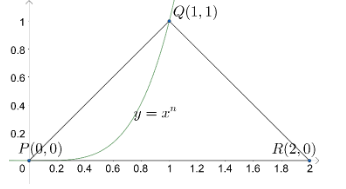
Let us find the equation of the side PQ.
We know that the equation of the line which is passing through \[\left( {{x}_{1}},{{y}_{1}} \right)\] and $ \left( {{x}_{2}},{{y}_{2}} \right) $ is $ y-{{y}_{1}}=\left( \dfrac{{{y}_{2}}-{{y}_{1}}}{{{x}_{2}}-{{x}_{1}}} \right)\times \left( x-{{x}_{1}} \right) $
Here we have points $ P\left( 0,0 \right) $ and $ Q\left( 1,1 \right) $ .
Now, the equation of side PQ is $ y-0=\left( \dfrac{1-0}{1-0} \right)\times \left( x-0 \right) $
$ y=\dfrac{1}{1}\times x $
$ y=x $
Now we find the area which lies between the side PQ and the curve $ y={{x}^{n}}\left( x>1 \right) $ .
We know that from area under curve by integration is defined as:
$ \text{Area between two curves between x=a and x=b}=\int\limits_{a}^{b}{\left( equation of above curve-equation of below curve \right)dx} $
Let us assume the area between side PQ and curve $ y={{x}^{n}}\left( x>1 \right) $ be $ {{A}_{2}} $ .
Since the curve $ y={{x}^{n}}\left( x>1 \right) $ cuts the triangle between x=0 and x=1, we take those as limits for the integration. Here we can observe that side PQ lies above the curve $ y={{x}^{n}}\left( x>1 \right) $ .
$ {{A}_{2}}=\int\limits_{0}^{1}{(x-{{x}^{n}})dx} $
We know that $ \int{{{x}^{k}}dx=\dfrac{{{x}^{k+1}}}{k+1}+C} $
$ {{A}_{2}}=\left[ \dfrac{{{x}^{2}}}{2} \right]_{x=0}^{x=1}-\left[ \dfrac{{{x}^{n+1}}}{n+1} \right]_{x=0}^{x=1} $
We know for a definite integral $ \int\limits_{a}^{b}{f'(x)dx=f(b)-f(a)} $ .
$ {{A}_{2}}=\left( \dfrac{{{1}^{2}}}{2}-\dfrac{{{0}^{2}}}{2} \right)-\left( \dfrac{{{1}^{n+1}}}{n+1}-\dfrac{{{0}^{n+1}}}{n+1} \right) $
$ {{A}_{2}}=\left( \dfrac{1}{2}-\dfrac{0}{2} \right)-\left( \dfrac{1}{n+1}-\dfrac{0}{n+1} \right) $
$ {{A}_{2}}=\left( \dfrac{1}{2}-0 \right)-\left( \dfrac{1}{n+1}-0 \right) $
$ {{A}_{2}}=\dfrac{1}{2}-\dfrac{1}{n+1}......(2) $
We know that $ {{A}_{2}} $ is 30% of $ {{A}_{1}} $ .
So, we got $ \dfrac{1}{2}-\dfrac{1}{n+1}=0.3\times \left( 1 \right) $
$ 0.5-\dfrac{1}{n+1}=0.3 $
$ 0.5-0.3=\dfrac{1}{n+1} $
$ 0.2=\dfrac{1}{n+1} $
$ n+1=\dfrac{1}{0.2} $ \
$ n+1=5 $
$ n=4 $
∴ The value of n is 4.
Note: Area of the triangle can also be calculated by using $ \dfrac{1}{2}\times base\times height $ . Since a given triangle is an Isosceles triangle with equal sides PQ and QR, height can be calculated by finding the distance between Q and midpoint of side PR. Here we should not consider the area of the triangle as a negative value while calculating through the determinant as it cannot be a negative value.
Complete step-by-step answer:
According to the problem, we can see that farmer $ {{F}_{1}} $ has land in the shape of a triangle.
We can see that coordinates of vertices of the triangle are $ P\left( 0,0 \right), Q\left( 1,1 \right) $ and $ R\left( 2,0 \right) $ .
Let us find the area of the triangle first for proceeding further in problem.
We know that area(A) of the triangle with the vertices \[({{a}_{1}},{{b}_{1}}),\left( {{a}_{2}},{{b}_{2}} \right)\] and $ \left( {{a}_{3}},{{b}_{3}} \right) $ is:
$ A=\dfrac{1}{2}\times \left| \begin{matrix}
{{a}_{1}}-{{a}_{2}} & {{a}_{1}}-{{a}_{3}} \\
{{b}_{1}}-{{b}_{2}} & {{b}_{1}}-{{b}_{3}} \\
\end{matrix} \right| $ Sq.units, here $ \left| . \right| $ is determinant of $ 2\times 2 $ matrix.
We know that determinant of $ 2\times 2 $ matrix is:
$ \left| \begin{matrix}
p & q \\
r & s \\
\end{matrix} \right|=\left( p\times s \right)-\left( q\times r \right) $
Using these formulae we find the area of the triangle PQR. Let it be $ {{A}_{1}} $ .
$ {{A}_{1}}=\dfrac{1}{2}\times \left| \begin{matrix}
0-1 & 0-2 \\
0-1 & 0-0 \\
\end{matrix} \right| $
\[{{A}_{1}}=\dfrac{1}{2}\times \left| \begin{matrix}
-1 & -2 \\
-1 & 0 \\
\end{matrix} \right|\]
$ {{A}_{1}}=\dfrac{1}{2}\times \left| \left( \left( -1\times 0 \right)-\left( -1\times -2 \right) \right) \right| $
$ {{A}_{1}}=\dfrac{1}{2}\times \left| 0-\left( 2 \right) \right| $
$ {{A}_{1}}=\dfrac{1}{2}\times \left| -2 \right| $
$ {{A}_{1}}=\dfrac{1}{2}\times 2 $
$ {{A}_{1}}=1sq.units......(1) $
We found an area of land that farmer $ {{F}_{1}} $ owns as 1sq.units.
According to the problem, it is given that farmer $ {{F}_{2}} $ takes some region of the land from farmer $ {{F}_{1}} $ in the form of $ y={{x}^{n}}\left( x>1 \right) $ which lies near the side PQ.
It is also said that the area of the region taken by the farmer $ {{F}_{2}} $ is equal to the 30% of the total area of the land PQR.
To find the value of ‘n’ using this information, we plot triangle PQR and curve $ y={{x}^{n}}\left( x>1 \right) $ on a graph.
Let us find the equation of the side PQ.
We know that the equation of the line which is passing through \[\left( {{x}_{1}},{{y}_{1}} \right)\] and $ \left( {{x}_{2}},{{y}_{2}} \right) $ is $ y-{{y}_{1}}=\left( \dfrac{{{y}_{2}}-{{y}_{1}}}{{{x}_{2}}-{{x}_{1}}} \right)\times \left( x-{{x}_{1}} \right) $
Here we have points $ P\left( 0,0 \right) $ and $ Q\left( 1,1 \right) $ .
Now, the equation of side PQ is $ y-0=\left( \dfrac{1-0}{1-0} \right)\times \left( x-0 \right) $
$ y=\dfrac{1}{1}\times x $
$ y=x $
Now we find the area which lies between the side PQ and the curve $ y={{x}^{n}}\left( x>1 \right) $ .
We know that from area under curve by integration is defined as:
$ \text{Area between two curves between x=a and x=b}=\int\limits_{a}^{b}{\left( equation of above curve-equation of below curve \right)dx} $
Let us assume the area between side PQ and curve $ y={{x}^{n}}\left( x>1 \right) $ be $ {{A}_{2}} $ .
Since the curve $ y={{x}^{n}}\left( x>1 \right) $ cuts the triangle between x=0 and x=1, we take those as limits for the integration. Here we can observe that side PQ lies above the curve $ y={{x}^{n}}\left( x>1 \right) $ .
$ {{A}_{2}}=\int\limits_{0}^{1}{(x-{{x}^{n}})dx} $
We know that $ \int{{{x}^{k}}dx=\dfrac{{{x}^{k+1}}}{k+1}+C} $
$ {{A}_{2}}=\left[ \dfrac{{{x}^{2}}}{2} \right]_{x=0}^{x=1}-\left[ \dfrac{{{x}^{n+1}}}{n+1} \right]_{x=0}^{x=1} $
We know for a definite integral $ \int\limits_{a}^{b}{f'(x)dx=f(b)-f(a)} $ .
$ {{A}_{2}}=\left( \dfrac{{{1}^{2}}}{2}-\dfrac{{{0}^{2}}}{2} \right)-\left( \dfrac{{{1}^{n+1}}}{n+1}-\dfrac{{{0}^{n+1}}}{n+1} \right) $
$ {{A}_{2}}=\left( \dfrac{1}{2}-\dfrac{0}{2} \right)-\left( \dfrac{1}{n+1}-\dfrac{0}{n+1} \right) $
$ {{A}_{2}}=\left( \dfrac{1}{2}-0 \right)-\left( \dfrac{1}{n+1}-0 \right) $
$ {{A}_{2}}=\dfrac{1}{2}-\dfrac{1}{n+1}......(2) $
We know that $ {{A}_{2}} $ is 30% of $ {{A}_{1}} $ .
So, we got $ \dfrac{1}{2}-\dfrac{1}{n+1}=0.3\times \left( 1 \right) $
$ 0.5-\dfrac{1}{n+1}=0.3 $
$ 0.5-0.3=\dfrac{1}{n+1} $
$ 0.2=\dfrac{1}{n+1} $
$ n+1=\dfrac{1}{0.2} $ \
$ n+1=5 $
$ n=4 $
∴ The value of n is 4.
Note: Area of the triangle can also be calculated by using $ \dfrac{1}{2}\times base\times height $ . Since a given triangle is an Isosceles triangle with equal sides PQ and QR, height can be calculated by finding the distance between Q and midpoint of side PR. Here we should not consider the area of the triangle as a negative value while calculating through the determinant as it cannot be a negative value.
Recently Updated Pages
Basicity of sulphurous acid and sulphuric acid are

Master Class 12 Economics: Engaging Questions & Answers for Success
Master Class 12 Biology: Engaging Questions & Answers for Success
Master Class 11 English: Engaging Questions & Answers for Success
Master Class 11 Physics: Engaging Questions & Answers for Success
Master Class 11 Computer Science: Engaging Questions & Answers for Success
Trending doubts
Draw a labelled sketch of the human eye class 12 physics CBSE
The chemical formula of tear gas is A CO Cl 2 B C 10 class 12 chemistry CBSE
Draw ray diagrams each showing i myopic eye and ii class 12 physics CBSE
Which are the Top 10 Largest Countries of the World?
Differentiate between homogeneous and heterogeneous class 12 chemistry CBSE
Which is the correct genotypic ratio of mendel dihybrid class 12 biology CBSE