




(a) Draw structure of the following compounds:
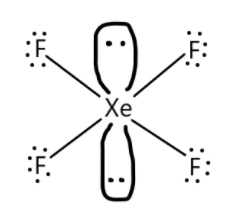
1. $Xe{F_4}$
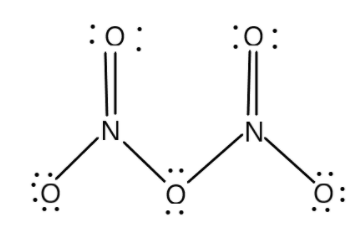
2. ${N_2}{O_5}$
(b) Write the structural difference between white phosphorus and red phosphorus.
Answer
 Verified
577.5k+ views
Hint: A structural formula displays the atoms of the molecule in the order they are bonded. It can tell us about the central atom and the atoms bonded to it. White and Red Phosphorus are the two allotropes of Phosphorus. Allotropes are the different physical forms of an element in which it can exist. They are different structural modifications of the element.
Complete step by step answer:
(a) A structural formula displays the atoms of the molecule in the order they are bonded. It also depicts how the atoms are bonded to one another for example single, double or triple bonds. For example in $Xe{F_4}$ we have one atom of Xenon and four atoms of fluorine. We can get from this information that the central atom is xenon and fluorine is bonded with the central atom. $Xe{F_4}$ is also known as Xenon Tetrafluoride and is the first discovered binary compound of noble gas. ${N_2}{O_5}$ is also called dinitrogen pentoxide and is one of the binary nitrogen oxides.
The structure of $Xe{F_4}$ is as shown below:
The structure of ${N_2}{O_5}$ is as follows:
(b) Before finding the difference between white and red phosphorus we need to know both of them in detail.
White phosphorus also called yellow phosphorus is simply tetraphosphorus ( ${P_4}$ ). It exists as molecules made up of four atoms in a tetrahedral structure. This tetrahedral arrangement results in ring strain and instability. The molecule is described as consisting of six single P-P bonds. Two different crystalline forms are known, the $\alpha $ and the $\beta $ form. The $\alpha $ form is defined as the standard state of the element but is actually metastable under standard conditions. It has a body-centred cubic crystal structure which transforms into $\beta $ form at $195.2K$ . The $\beta $ form is believed to have a hexagonal crystal structure. It is a translucent waxy solid that quickly becomes yellow when exposed to light and therefore it is also called yellow phosphorus. It is toxic and glows greenish in dark and is highly flammable and self-igniting upon contact with air. It is also slightly soluble in water.
Red phosphorus is of the most common allotropes of phosphorus and is a derivative of ${P_4}$ molecule. It exists in an amorphous network of phosphorus atoms. It is more stable than white phosphorus. It has a deep red colour and powdery texture. It is formed when white phosphorus is kept under certain conditions. It is odourless and not poisonous to humans.
The main difference between them is that white phosphorus is highly reactive and exists as a ${P_4}$ molecule but red phosphorus is less reactive and exits as a chain of ${P_4}$ units.
Note:
$Xe{F_4}$ is also known as Xenon tetrafluoride and is the first discovered binary compound of noble gas. ${N_2}{O_5}$ is also called dinitrogen pentoxide and is one of the binary nitrogen oxides. White and Red Phosphorus are the two allotropes of Phosphorus. Allotropes are the different physical forms of an element in which it can exist. They are different structural modifications of the element.
Complete step by step answer:
(a) A structural formula displays the atoms of the molecule in the order they are bonded. It also depicts how the atoms are bonded to one another for example single, double or triple bonds. For example in $Xe{F_4}$ we have one atom of Xenon and four atoms of fluorine. We can get from this information that the central atom is xenon and fluorine is bonded with the central atom. $Xe{F_4}$ is also known as Xenon Tetrafluoride and is the first discovered binary compound of noble gas. ${N_2}{O_5}$ is also called dinitrogen pentoxide and is one of the binary nitrogen oxides.
The structure of $Xe{F_4}$ is as shown below:
The structure of ${N_2}{O_5}$ is as follows:
(b) Before finding the difference between white and red phosphorus we need to know both of them in detail.
White phosphorus also called yellow phosphorus is simply tetraphosphorus ( ${P_4}$ ). It exists as molecules made up of four atoms in a tetrahedral structure. This tetrahedral arrangement results in ring strain and instability. The molecule is described as consisting of six single P-P bonds. Two different crystalline forms are known, the $\alpha $ and the $\beta $ form. The $\alpha $ form is defined as the standard state of the element but is actually metastable under standard conditions. It has a body-centred cubic crystal structure which transforms into $\beta $ form at $195.2K$ . The $\beta $ form is believed to have a hexagonal crystal structure. It is a translucent waxy solid that quickly becomes yellow when exposed to light and therefore it is also called yellow phosphorus. It is toxic and glows greenish in dark and is highly flammable and self-igniting upon contact with air. It is also slightly soluble in water.
Red phosphorus is of the most common allotropes of phosphorus and is a derivative of ${P_4}$ molecule. It exists in an amorphous network of phosphorus atoms. It is more stable than white phosphorus. It has a deep red colour and powdery texture. It is formed when white phosphorus is kept under certain conditions. It is odourless and not poisonous to humans.
The main difference between them is that white phosphorus is highly reactive and exists as a ${P_4}$ molecule but red phosphorus is less reactive and exits as a chain of ${P_4}$ units.
Note:
$Xe{F_4}$ is also known as Xenon tetrafluoride and is the first discovered binary compound of noble gas. ${N_2}{O_5}$ is also called dinitrogen pentoxide and is one of the binary nitrogen oxides. White and Red Phosphorus are the two allotropes of Phosphorus. Allotropes are the different physical forms of an element in which it can exist. They are different structural modifications of the element.
Recently Updated Pages
Master Class 12 Economics: Engaging Questions & Answers for Success

Master Class 12 Physics: Engaging Questions & Answers for Success
Master Class 12 English: Engaging Questions & Answers for Success
Master Class 12 Social Science: Engaging Questions & Answers for Success
Master Class 12 Maths: Engaging Questions & Answers for Success
Master Class 12 Business Studies: Engaging Questions & Answers for Success
Trending doubts
Which are the Top 10 Largest Countries of the World?
What are the major means of transport Explain each class 12 social science CBSE
Draw a labelled sketch of the human eye class 12 physics CBSE
What is a transformer Explain the principle construction class 12 physics CBSE
Why cannot DNA pass through cell membranes class 12 biology CBSE
Differentiate between insitu conservation and exsitu class 12 biology CBSE