




a) Define the potential gradient
b) Write the Kirchhoff’s junction rule.
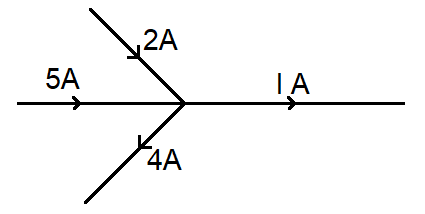
In the given diagram write the value of current $ I $
Answer
 Verified
594.3k+ views
Hint: Kirchhoff’s junction rule is Kirchhoff’s first law which gives the behaviour of current in a circuit. It is also known as the Kirchhoff’s current law. Gradient, in general, deals with the rate of a quantity with another (often spatial).
Formula used: In this solution we will be using the following formula;
$ {I_{in}} = {I_{out}} $ where $ {I_{in}} $ is the current going into a junction or node, and $ {I_{out}} $ is the current going out of the node.
Complete step by step answer
A) By definition, in general, the potential gradient can be said to be the rate of change of potential with the displacement. The potential could be electric potential, or gravitational potential or any other forms of potential in different fields.
B) The Kirchhoff’s junction rule, also known as the Kirchhoff’s current rule states that in a circuit, the total current flowing into a junction or node is equal to the current flowing out of the node. This is Kirchhoff's first law.
The diagram as seen shows three branches of current joining together at a point (called junction or node). The current $ I $ flowing in the resultant branch is to be found. To solve this, we must note the direction of the currents.
The 2 ampere and 5 ampere flow into the node, while the 4 ampere and the unknown ampere flow out
Hence, by the current law
$ 5 + 2 = 4 + I $
$ \Rightarrow I = 5 + 2 - 4 $
By calculating
$ I = 3{\text{A}} $.
Note
It is often common to see some text which states current law as “the total current flowing into a node is zero”. This statement is equally valid. But the difference is that the current flowing out the node is hence considered negative. As in since
$ {I_{in}} = {I_{out}} $ then
$ {I_{in}} - {I_{out}} = 0 $
Then we can write
$ {I_{in}} + \left( { - {I_{out}}} \right) = 0 $
$ \Rightarrow \sum I = 0 $ but it must be noted that the current flowing out is negative.
Formula used: In this solution we will be using the following formula;
$ {I_{in}} = {I_{out}} $ where $ {I_{in}} $ is the current going into a junction or node, and $ {I_{out}} $ is the current going out of the node.
Complete step by step answer
A) By definition, in general, the potential gradient can be said to be the rate of change of potential with the displacement. The potential could be electric potential, or gravitational potential or any other forms of potential in different fields.
B) The Kirchhoff’s junction rule, also known as the Kirchhoff’s current rule states that in a circuit, the total current flowing into a junction or node is equal to the current flowing out of the node. This is Kirchhoff's first law.
The diagram as seen shows three branches of current joining together at a point (called junction or node). The current $ I $ flowing in the resultant branch is to be found. To solve this, we must note the direction of the currents.
The 2 ampere and 5 ampere flow into the node, while the 4 ampere and the unknown ampere flow out
Hence, by the current law
$ 5 + 2 = 4 + I $
$ \Rightarrow I = 5 + 2 - 4 $
By calculating
$ I = 3{\text{A}} $.
Note
It is often common to see some text which states current law as “the total current flowing into a node is zero”. This statement is equally valid. But the difference is that the current flowing out the node is hence considered negative. As in since
$ {I_{in}} = {I_{out}} $ then
$ {I_{in}} - {I_{out}} = 0 $
Then we can write
$ {I_{in}} + \left( { - {I_{out}}} \right) = 0 $
$ \Rightarrow \sum I = 0 $ but it must be noted that the current flowing out is negative.
Recently Updated Pages
Master Class 12 Business Studies: Engaging Questions & Answers for Success

Master Class 12 Biology: Engaging Questions & Answers for Success
Master Class 12 Chemistry: Engaging Questions & Answers for Success
Class 12 Question and Answer - Your Ultimate Solutions Guide
Master Class 11 Social Science: Engaging Questions & Answers for Success
Master Class 11 English: Engaging Questions & Answers for Success
Trending doubts
Which are the Top 10 Largest Countries of the World?
Draw a labelled sketch of the human eye class 12 physics CBSE
Differentiate between homogeneous and heterogeneous class 12 chemistry CBSE
Sulphuric acid is known as the king of acids State class 12 chemistry CBSE
Why is the cell called the structural and functional class 12 biology CBSE
Which is the correct genotypic ratio of mendel dihybrid class 12 biology CBSE