




A convex lens is made of 3 layers of glass of 3 different materials as in the figure A point object is placed on its axis. The number of images of the object are
Answer
 Verified
599.3k+ views
Hint:The Convex lens is the type of lens that converges the incident rays towards the principal axis. Convex lens can converge a beam of parallel rays to a point on the other side of the lens.
Complete step-by-step answer:
As we all know that the lens is made of up three different materials, hence it can work as an equivalent lens with some other refractive index. The focal length of the converging lens is positive The rays are refracted by each part of the lens individually.
We can refer to the below figure for understanding the concept.
We can notice that the material combination is symmetric around the horizontal axis and the propagation of ray from the upper part of the horizontal axis experiences three different materials. In the same way the ray from the lower part of the horizontal axis also experiences three different materials having 3 distinct refractive indices. Hence the nature of ray travel is equal and symmetric and they finally meet at a single point on the horizontal axis and hence a single image is formed.
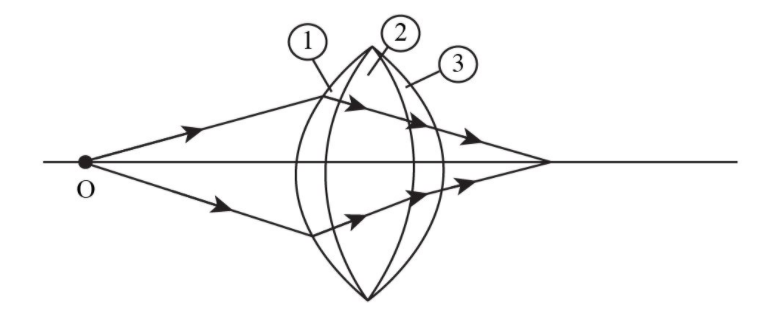
Therefore, we can conclude that a single i.e. 1 image is formed.
We can also point out the relation between the refractive index and refracted ray based on the material of the object. We know that when a light enters a material with higher refractive index, it gets more refracted towards the normal and the angle of incidence becomes larger than the angle of refraction.
As we know that the lens is made up of two different materials, hence their refractive index is different but has an equivalent refractive index that can work accordingly. We also know that the rays bend according to the individual refractive index by each and every material of the lens which is made up of different material.
Note:As we can see here a single image is formed because the line of light travelling is along the horizontal axis and the materials are aligned in the direction of the horizontal axis. Let’s suppose, If the materials would have been aligned in the direction of the vertical axis then 3 images would be formed. A convex lens is thicker at the centre and thinner at the edges. A concave lens is thicker at the edges and thinner at the centre. Convex lenses are used in eyeglasses for correcting farsightedness.
Complete step-by-step answer:
As we all know that the lens is made of up three different materials, hence it can work as an equivalent lens with some other refractive index. The focal length of the converging lens is positive The rays are refracted by each part of the lens individually.
We can refer to the below figure for understanding the concept.
We can notice that the material combination is symmetric around the horizontal axis and the propagation of ray from the upper part of the horizontal axis experiences three different materials. In the same way the ray from the lower part of the horizontal axis also experiences three different materials having 3 distinct refractive indices. Hence the nature of ray travel is equal and symmetric and they finally meet at a single point on the horizontal axis and hence a single image is formed.
Therefore, we can conclude that a single i.e. 1 image is formed.
We can also point out the relation between the refractive index and refracted ray based on the material of the object. We know that when a light enters a material with higher refractive index, it gets more refracted towards the normal and the angle of incidence becomes larger than the angle of refraction.
As we know that the lens is made up of two different materials, hence their refractive index is different but has an equivalent refractive index that can work accordingly. We also know that the rays bend according to the individual refractive index by each and every material of the lens which is made up of different material.
Note:As we can see here a single image is formed because the line of light travelling is along the horizontal axis and the materials are aligned in the direction of the horizontal axis. Let’s suppose, If the materials would have been aligned in the direction of the vertical axis then 3 images would be formed. A convex lens is thicker at the centre and thinner at the edges. A concave lens is thicker at the edges and thinner at the centre. Convex lenses are used in eyeglasses for correcting farsightedness.
Recently Updated Pages
Master Class 10 Computer Science: Engaging Questions & Answers for Success

Differentiate between voluntary action and reflex class 10 biology CBSE
The uses of bleaching powder are A It is used bleaching class 10 chemistry CBSE
Fill in the blanks with abstract nouns of the words class 10 english CBSE
How many threedigit numbers are there class 10 maths CBSE
What is a reflex arc class 10 biology CBSE
Trending doubts
Explain the Treaty of Vienna of 1815 class 10 social science CBSE
10 examples of evaporation in daily life with explanations
Which country is known as "The land of Fire and Ice"?
What is the full form of POSCO class 10 social science CBSE
Make a sketch of the human nerve cell What function class 10 biology CBSE
In which year voting age was reduced from 21 to 18?