




A colorblind man marries a woman with normal sight who has no history of color blindness in her family. What is the probability of their grandson being color-blind assuming that the F1 progeny marries only normal individuals having no genes for color-blindness?
(a)Nil
(b)0.25
(c)0.5
(d)1
Answer
 Verified
557.9k+ views
Hint: Colour blindness is a hereditary disease which means it is passed from one generation to the other.
Its inheritance is related to one of the allosomes or sex chromosomes. It gets expressed only in homozygous condition.
Complete answer:
When a cross between a color-blind man and a woman with normal sight who has no family history of color blindness is done then the progeny will have four children – two daughters and two sons.
The genotype of color-blind man is ${ X }^{ c }Y$
The genotype of a normal woman will be XX
The two sons will be normal and pure and the two daughters will be carriers as shown below

Assuming that all the F1 progeny from the above cross marry only normal individuals with no genes for color-blindness we can say that in the next generation, the progeny of all their sons will be normal as the wife is not a carrier of color-blindness. Therefore 0% of grandsons will be colorblind.
For their carrier daughters
-If they marry a normal man then 50% of their grandson or 25% of grandchildren will become color-blind. This can easily be understood by the following cross.
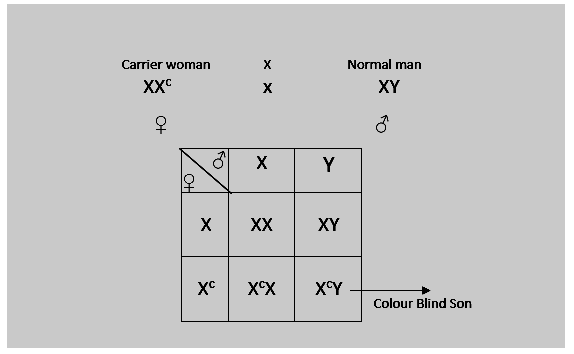
Therefore for the case of carrier daughters, only 25% of their children will be colorblind. Which also means 50% of grandsons will be colorblind.
Therefore the following calculations can be made:
If the total number of grandsons from four crosses of F1 progeny where each member of F1 mates with a normal person is 8, then out of these 8 only two grandsons will be color blind. These genes come from the carrier mother of the F1 generation. So we can see that the probability of the grandsons who are color-blind will be $\dfrac { 2 }{ 8 }$ or $\dfrac { 1 }{ 4 } $ which is 0.25.
So, the correct answer is, ’0.25.’
Note: Color blindness is of two types -Monochromacy or total blindness (both the color and lightness vision is
reduced to one dimension) and Dichromacy or partial blindness (only the color vision is reduced to two-dimension).
Its inheritance is related to one of the allosomes or sex chromosomes. It gets expressed only in homozygous condition.
Complete answer:
When a cross between a color-blind man and a woman with normal sight who has no family history of color blindness is done then the progeny will have four children – two daughters and two sons.
The genotype of color-blind man is ${ X }^{ c }Y$
The genotype of a normal woman will be XX
The two sons will be normal and pure and the two daughters will be carriers as shown below
Assuming that all the F1 progeny from the above cross marry only normal individuals with no genes for color-blindness we can say that in the next generation, the progeny of all their sons will be normal as the wife is not a carrier of color-blindness. Therefore 0% of grandsons will be colorblind.
For their carrier daughters
-If they marry a normal man then 50% of their grandson or 25% of grandchildren will become color-blind. This can easily be understood by the following cross.
Therefore for the case of carrier daughters, only 25% of their children will be colorblind. Which also means 50% of grandsons will be colorblind.
Therefore the following calculations can be made:
If the total number of grandsons from four crosses of F1 progeny where each member of F1 mates with a normal person is 8, then out of these 8 only two grandsons will be color blind. These genes come from the carrier mother of the F1 generation. So we can see that the probability of the grandsons who are color-blind will be $\dfrac { 2 }{ 8 }$ or $\dfrac { 1 }{ 4 } $ which is 0.25.
So, the correct answer is, ’0.25.’
Note: Color blindness is of two types -Monochromacy or total blindness (both the color and lightness vision is
reduced to one dimension) and Dichromacy or partial blindness (only the color vision is reduced to two-dimension).
Recently Updated Pages
Master Class 12 Business Studies: Engaging Questions & Answers for Success

Master Class 12 Biology: Engaging Questions & Answers for Success
Master Class 12 Chemistry: Engaging Questions & Answers for Success
Class 12 Question and Answer - Your Ultimate Solutions Guide
Master Class 11 Social Science: Engaging Questions & Answers for Success
Master Class 11 English: Engaging Questions & Answers for Success
Trending doubts
Which are the Top 10 Largest Countries of the World?
Draw a labelled sketch of the human eye class 12 physics CBSE
Differentiate between homogeneous and heterogeneous class 12 chemistry CBSE
Sulphuric acid is known as the king of acids State class 12 chemistry CBSE
Why is the cell called the structural and functional class 12 biology CBSE
Which is the correct genotypic ratio of mendel dihybrid class 12 biology CBSE