




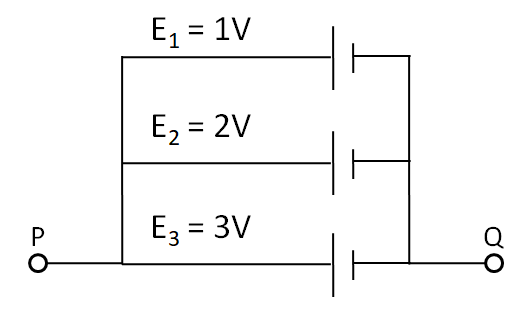
A circuit consists of three batteries of emf \[{E_1} = 1{\text{V}}\], ${E_1} = 2{\text{V}}$ and ${E_3} = 3{\text{V}}$ and internal resistances ${\text{1}}\Omega $, $2\Omega $ and ${\text{1}}\Omega $ respectively which are connected in parallel as shown in the figure. The potential difference between point P and Q is
A. \[1.0{\text{V}}\]
B. $2.0{\text{V}}$
C. \[2.2{\text{V}}\]
D. \[3.0{\text{V}}\]
Answer
 Verified
561.3k+ views
Hint: To solve this question, we need to use the formula for the equivalent emf of the batteries connected in parallel combination with each other. The batteries are connected in parallel combination across the point P and Q. Therefore the potential difference between the points P and Q will be equal to the equivalent emf of the batteries.
Formula used: The formulae used for solving this question are given by
$\dfrac{E}{{{R_{eq}}}} = \dfrac{{{E_1}}}{{{R_1}}} + \dfrac{{{E_2}}}{{{R_2}}} + .......... + \dfrac{{{E_n}}}{{{R_n}}}$
$\dfrac{1}{{{R_{eq}}}} = \dfrac{1}{{{R_1}}} + \dfrac{1}{{{R_2}}} + .......... + \dfrac{1}{{{R_n}}}$
Here $E$ is the equivalent emf of the parallel combination of the batteries of emfs ${E_1}$, ${E_2}$,…., ${E_n}$ and internal resistances of ${R_1}$, ${R_2}$,….., ${R_n}$ respectively. Also, ${R_{eq}}$ is the equivalent internal resistance.
Complete step by step answer:
We know that the equivalent emf of a combination of batteries connected in parallel to each other is given by
$\dfrac{E}{{{R_{eq}}}} = \dfrac{{{E_1}}}{{{R_1}}} + \dfrac{{{E_2}}}{{{R_2}}} + .......... + \dfrac{{{E_n}}}{{{R_n}}}$ (1)
According to the question, we have ${E_1} = 1{\text{V}}$, ${E_2} = 2{\text{V}}$, and ${E_3} = 3{\text{V}}$. Also, the internal resistances of these batteries are ${R_1} = {\text{1}}\Omega $, ${R_2} = 2\Omega $, and ${R_3} = 1\Omega $. Substituting these in (1) we get
\[\dfrac{E}{{{R_{eq}}}} = \dfrac{1}{1} + \dfrac{2}{2} + \dfrac{3}{1}\]
$ \Rightarrow \dfrac{E}{{{R_{eq}}}} = 5$ (2)
Also, since the internal resistances are connected in parallel combination with each other, the equivalent internal resistance of the combination is given by
$\dfrac{1}{{{R_{eq}}}} = \dfrac{1}{{{R_1}}} + \dfrac{1}{{{R_2}}} + .......... + \dfrac{1}{{{R_n}}}$
Substituting ${R_1} = {\text{1}}\Omega $, ${R_2} = 2\Omega $, and ${R_3} = 1\Omega $ in the above equation, we get
\[\dfrac{1}{{{R_{eq}}}} = \dfrac{1}{1} + \dfrac{1}{2} + \dfrac{1}{1}\]
$ \Rightarrow \dfrac{1}{{{R_{eq}}}} = \dfrac{5}{2}$
Taking the reciprocal, we get
${R_{eq}} = \dfrac{2}{5}\Omega $
Substituting this in (2) we get
$\dfrac{E}{{2/5}} = 5$
$ \Rightarrow E = \dfrac{2}{5} \times 5 = 2{\text{V}}$
So the equivalent emf of the given parallel combination of the batteries is equal to $2.0{\text{V}}$. This means that the potential difference between the points P and Q is equal to $2.0{\text{V}}$.
Hence, the correct answer is option B.
Note: There must be some drop across the equivalent internal resistance of the equivalent battery. This is because the circuit between points P and Q is not complete. So no current will flow through the equivalent battery, which means that the drop across the equivalent internal resistor will be equal to zero. Due to this we could take the potential difference is equal to the equivalent emf.
Formula used: The formulae used for solving this question are given by
$\dfrac{E}{{{R_{eq}}}} = \dfrac{{{E_1}}}{{{R_1}}} + \dfrac{{{E_2}}}{{{R_2}}} + .......... + \dfrac{{{E_n}}}{{{R_n}}}$
$\dfrac{1}{{{R_{eq}}}} = \dfrac{1}{{{R_1}}} + \dfrac{1}{{{R_2}}} + .......... + \dfrac{1}{{{R_n}}}$
Here $E$ is the equivalent emf of the parallel combination of the batteries of emfs ${E_1}$, ${E_2}$,…., ${E_n}$ and internal resistances of ${R_1}$, ${R_2}$,….., ${R_n}$ respectively. Also, ${R_{eq}}$ is the equivalent internal resistance.
Complete step by step answer:
We know that the equivalent emf of a combination of batteries connected in parallel to each other is given by
$\dfrac{E}{{{R_{eq}}}} = \dfrac{{{E_1}}}{{{R_1}}} + \dfrac{{{E_2}}}{{{R_2}}} + .......... + \dfrac{{{E_n}}}{{{R_n}}}$ (1)
According to the question, we have ${E_1} = 1{\text{V}}$, ${E_2} = 2{\text{V}}$, and ${E_3} = 3{\text{V}}$. Also, the internal resistances of these batteries are ${R_1} = {\text{1}}\Omega $, ${R_2} = 2\Omega $, and ${R_3} = 1\Omega $. Substituting these in (1) we get
\[\dfrac{E}{{{R_{eq}}}} = \dfrac{1}{1} + \dfrac{2}{2} + \dfrac{3}{1}\]
$ \Rightarrow \dfrac{E}{{{R_{eq}}}} = 5$ (2)
Also, since the internal resistances are connected in parallel combination with each other, the equivalent internal resistance of the combination is given by
$\dfrac{1}{{{R_{eq}}}} = \dfrac{1}{{{R_1}}} + \dfrac{1}{{{R_2}}} + .......... + \dfrac{1}{{{R_n}}}$
Substituting ${R_1} = {\text{1}}\Omega $, ${R_2} = 2\Omega $, and ${R_3} = 1\Omega $ in the above equation, we get
\[\dfrac{1}{{{R_{eq}}}} = \dfrac{1}{1} + \dfrac{1}{2} + \dfrac{1}{1}\]
$ \Rightarrow \dfrac{1}{{{R_{eq}}}} = \dfrac{5}{2}$
Taking the reciprocal, we get
${R_{eq}} = \dfrac{2}{5}\Omega $
Substituting this in (2) we get
$\dfrac{E}{{2/5}} = 5$
$ \Rightarrow E = \dfrac{2}{5} \times 5 = 2{\text{V}}$
So the equivalent emf of the given parallel combination of the batteries is equal to $2.0{\text{V}}$. This means that the potential difference between the points P and Q is equal to $2.0{\text{V}}$.
Hence, the correct answer is option B.
Note: There must be some drop across the equivalent internal resistance of the equivalent battery. This is because the circuit between points P and Q is not complete. So no current will flow through the equivalent battery, which means that the drop across the equivalent internal resistor will be equal to zero. Due to this we could take the potential difference is equal to the equivalent emf.
Recently Updated Pages
Master Class 12 Economics: Engaging Questions & Answers for Success

Master Class 12 Physics: Engaging Questions & Answers for Success
Master Class 12 English: Engaging Questions & Answers for Success
Master Class 12 Social Science: Engaging Questions & Answers for Success
Master Class 12 Maths: Engaging Questions & Answers for Success
Master Class 12 Business Studies: Engaging Questions & Answers for Success
Trending doubts
Which are the Top 10 Largest Countries of the World?
What are the major means of transport Explain each class 12 social science CBSE
Draw a labelled sketch of the human eye class 12 physics CBSE
What is a transformer Explain the principle construction class 12 physics CBSE
Why cannot DNA pass through cell membranes class 12 biology CBSE
Differentiate between insitu conservation and exsitu class 12 biology CBSE