




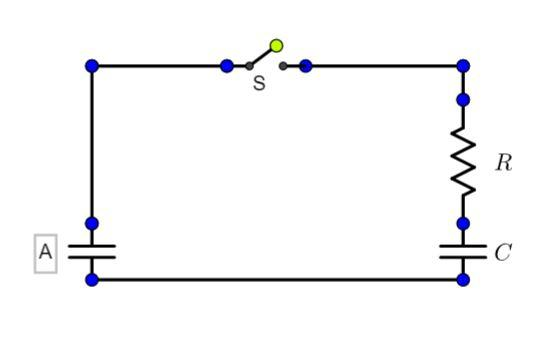
A capacitor of capacitance ${{C}_{0}}$ is charged to a potential ${{V}_{0}}$ and is connected with another capacitor of capacitance $C$ as shown. After closing the switch $S$ , the common potential across the two capacitors becomes \[V\] . The capacitance $C$ is given by:
A. $\dfrac{{{C}_{0}}\left( {{V}_{0}}-V \right)}{{{V}_{0}}}$
B. $\dfrac{{{C}_{0}}\left( V-{{V}_{0}} \right)}{{{V}_{0}}}$
C. $\dfrac{{{C}_{0}}\left( V+{{V}_{0}} \right)}{{{V}_{0}}}$
D. $\dfrac{{{C}_{0}}\left( {{V}_{0}}-V \right)}{V}$
Answer
 Verified
619.8k+ views
Hint: Calculate the initial charge stored in the capacitor, then calculate the final charge stored in the capacitor with potential $V$, we know all the charges in a system must be conserved and it cannot be dissipated.
Complete step-by-step answer:
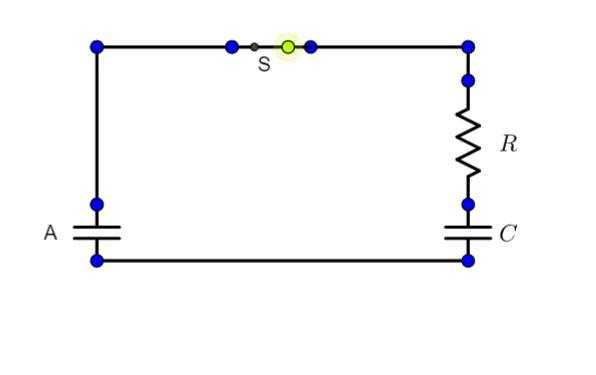
Given,
The initial charge stored in the capacitor A is ${{C}_{0}}{{V}_{0}}$.
The final charge stored in the capacitor A when a potential $V$is introduced is ${{C}_{0}}V$
The final charge in the capacitor $C$ is $CV$
We know, total charge must be conserved,
$\therefore {{C}_{0}}{{V}_{0}}={{C}_{0}}V+CV$
$\Rightarrow C=\dfrac{{{C}_{0}}\left( {{V}_{0}}-V \right)}{V}$
The correct option is (D).
Additional Information:
Capacitance is the potential of a system to store an electric charge.
$q=CV$ is the formula for capacitance, where q is the charge, C is the capacitance and V is the potential or voltage.
A device that shows capacitance is known as capacitor.
Farads(F) is the unit of capacitance.
The law of conservation of energy states that the total energy of a system stays constant and it can never be changed without any external features.
Note: The capacitor A initially had charge ${{V}_{0}}$ , but when the circuit was closed, the common potential between the two capacitors became V. Thus we at first have to find the initial charge then the final charge and they are conserved.
Complete step-by-step answer:
Given,
The initial charge stored in the capacitor A is ${{C}_{0}}{{V}_{0}}$.
The final charge stored in the capacitor A when a potential $V$is introduced is ${{C}_{0}}V$
The final charge in the capacitor $C$ is $CV$
We know, total charge must be conserved,
$\therefore {{C}_{0}}{{V}_{0}}={{C}_{0}}V+CV$
$\Rightarrow C=\dfrac{{{C}_{0}}\left( {{V}_{0}}-V \right)}{V}$
The correct option is (D).
Additional Information:
Capacitance is the potential of a system to store an electric charge.
$q=CV$ is the formula for capacitance, where q is the charge, C is the capacitance and V is the potential or voltage.
A device that shows capacitance is known as capacitor.
Farads(F) is the unit of capacitance.
The law of conservation of energy states that the total energy of a system stays constant and it can never be changed without any external features.
Note: The capacitor A initially had charge ${{V}_{0}}$ , but when the circuit was closed, the common potential between the two capacitors became V. Thus we at first have to find the initial charge then the final charge and they are conserved.
Recently Updated Pages
Master Class 12 Business Studies: Engaging Questions & Answers for Success

Master Class 12 Biology: Engaging Questions & Answers for Success
Master Class 12 Chemistry: Engaging Questions & Answers for Success
Class 12 Question and Answer - Your Ultimate Solutions Guide
Master Class 11 Social Science: Engaging Questions & Answers for Success
Master Class 11 English: Engaging Questions & Answers for Success
Trending doubts
Which is more stable and why class 12 chemistry CBSE
Which are the Top 10 Largest Countries of the World?
Draw a labelled sketch of the human eye class 12 physics CBSE
Differentiate between homogeneous and heterogeneous class 12 chemistry CBSE
What are the major means of transport Explain each class 12 social science CBSE
Sulphuric acid is known as the king of acids State class 12 chemistry CBSE