




A bullet strikes the dielectric slab of a parallel plate capacitor. Neglecting friction in any contacting surfaces which of the following is correct? The slab starts moving and comes out of the capacitor. The battery and the capacitor remain fixed.
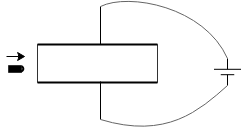
a) linear momentum of the bullet + dielectric slab is conserved
b) The current flows from the battery to the capacitor
c) The energy stored in the capacitor remains the same
d) Battery will draw some charge from the capacitor
Answer
 Verified
606.3k+ views
Hint: The capacitance of a parallel plate capacitor is proportional to the dielectric constant of the medium within the plates. Hence when a dielectric slab is inserted between the plates of the capacitor it increases the capacitance of that capacitor. When the bullet hits the dielectric slab the capacitance changes, but the potential across the capacitor remains fixed. Since there exists a relation between the charge (Q) on the capacitor, the capacitance(C) and the potential difference(V), from which we can figure out what will be the changes across the capacitor.
Formula used:
$Q=CV$
$C=\dfrac{A{{\in }_{\circ }}}{d}$
${{C}_{1}}=\dfrac{A\left( k{{\in }_{\circ }} \right)}{d}$
Complete step by step answer:
The capacitance of a parallel plate capacitor is given by,$C=\dfrac{A{{\in }_{\circ }}}{d}$ where A is the area of the plates of the capacitor, d is the distance between the two plates and ${{\in }_{\circ }}$is the permittivity of free space. If a dielectric slab of dielectric constant k is inserted between the plates of the capacitor, then its capacitance is given by ${{C}_{1}}=\dfrac{A\left( k{{\in }_{\circ }} \right)}{d}$ where k is always greater than zero.
The relation between the charge (Q) on the capacitor, the capacitance(C) and the potential difference(V), is given by $Q=CV$.
Let us say when the capacitor had the dielectric constant k, the capacitance of the capacitor was given by ${{C}_{1}}=\dfrac{A\left( k{{\in }_{\circ }} \right)}{d}$. But when the bullet hits the slab, it is given in the question that the slab comes out of the capacitor. Hence the capacitor of the parallel plate capacitor now becomes $C=\dfrac{A{{\in }_{\circ }}}{d}$. If we compare the old capacitance and the new capacitance we can say that that the capacitance of the capacitor has got reduced as K is a factor which is greater than 1. When the bullet hits the slab it is given that the potential difference maintained by the battery remains constant. Therefore the charge on the capacitor when the dielectric slab is present is given by,
$\begin{align}
& {{Q}_{1}}={{C}_{1}}V\text{, since }{{C}_{1}}=kC \\
& {{Q}_{1}}=kCV...(1) \\
\end{align}$
Similarly when the slab is removed from the capacitor, the charge on the capacitor is,
$Q=CV...(2)$
Dividing equation 1 by 2 we get,
$\begin{align}
& \dfrac{{{Q}_{1}}}{Q}=\dfrac{kCV}{CV} \\
& {{Q}_{1}}=kQ \\
\end{align}$
Hence we can conclude that ${{Q}_{1}} > Q$. This implies that when the dielectric slab was removed the battery withdrew some charge from the capacitor.
So, the correct answer is “Option D”.
Note: The first option suggests that the linear momentum of the bullet and the slab is conserved. This option also holds true if we consider the total momentum of the collision. If we consider their individual initial and final momentum we cannot say its conserved as the initial momentum of the slab is zero whereas its final momentum is not.
Formula used:
$Q=CV$
$C=\dfrac{A{{\in }_{\circ }}}{d}$
${{C}_{1}}=\dfrac{A\left( k{{\in }_{\circ }} \right)}{d}$
Complete step by step answer:
The capacitance of a parallel plate capacitor is given by,$C=\dfrac{A{{\in }_{\circ }}}{d}$ where A is the area of the plates of the capacitor, d is the distance between the two plates and ${{\in }_{\circ }}$is the permittivity of free space. If a dielectric slab of dielectric constant k is inserted between the plates of the capacitor, then its capacitance is given by ${{C}_{1}}=\dfrac{A\left( k{{\in }_{\circ }} \right)}{d}$ where k is always greater than zero.
The relation between the charge (Q) on the capacitor, the capacitance(C) and the potential difference(V), is given by $Q=CV$.
Let us say when the capacitor had the dielectric constant k, the capacitance of the capacitor was given by ${{C}_{1}}=\dfrac{A\left( k{{\in }_{\circ }} \right)}{d}$. But when the bullet hits the slab, it is given in the question that the slab comes out of the capacitor. Hence the capacitor of the parallel plate capacitor now becomes $C=\dfrac{A{{\in }_{\circ }}}{d}$. If we compare the old capacitance and the new capacitance we can say that that the capacitance of the capacitor has got reduced as K is a factor which is greater than 1. When the bullet hits the slab it is given that the potential difference maintained by the battery remains constant. Therefore the charge on the capacitor when the dielectric slab is present is given by,
$\begin{align}
& {{Q}_{1}}={{C}_{1}}V\text{, since }{{C}_{1}}=kC \\
& {{Q}_{1}}=kCV...(1) \\
\end{align}$
Similarly when the slab is removed from the capacitor, the charge on the capacitor is,
$Q=CV...(2)$
Dividing equation 1 by 2 we get,
$\begin{align}
& \dfrac{{{Q}_{1}}}{Q}=\dfrac{kCV}{CV} \\
& {{Q}_{1}}=kQ \\
\end{align}$
Hence we can conclude that ${{Q}_{1}} > Q$. This implies that when the dielectric slab was removed the battery withdrew some charge from the capacitor.
So, the correct answer is “Option D”.
Note: The first option suggests that the linear momentum of the bullet and the slab is conserved. This option also holds true if we consider the total momentum of the collision. If we consider their individual initial and final momentum we cannot say its conserved as the initial momentum of the slab is zero whereas its final momentum is not.
Recently Updated Pages
Master Class 12 Business Studies: Engaging Questions & Answers for Success

Master Class 12 Biology: Engaging Questions & Answers for Success
Master Class 12 Chemistry: Engaging Questions & Answers for Success
Class 12 Question and Answer - Your Ultimate Solutions Guide
Master Class 11 Social Science: Engaging Questions & Answers for Success
Master Class 11 English: Engaging Questions & Answers for Success
Trending doubts
Which are the Top 10 Largest Countries of the World?
Draw a labelled sketch of the human eye class 12 physics CBSE
Differentiate between homogeneous and heterogeneous class 12 chemistry CBSE
Sulphuric acid is known as the king of acids State class 12 chemistry CBSE
Why is the cell called the structural and functional class 12 biology CBSE
Which is the correct genotypic ratio of mendel dihybrid class 12 biology CBSE