




A Bio convex lens of Focal length 15 cm is in Front of a plane mirror the distance between the lens and the mirror is 10cm. A small object is kept at a distance of 30 cm from the Lens. The final image is:
A. Virtual and at a distance of 16 cm from the mirror.
B. Real and at a distance of 16 cm from the mirror.
C. Virtual and at a distance of 20 cm from the mirror.
D. Real and at a distance of 20 cm from the mirror.
Answer
 Verified
672.3k+ views
Hint:Biconvex lens are simple lenses which consist of two convex surfaces in spherical form, generally having the same kind of curvature.
Complete step by step answer:
We get the image distance by using lens
Formula \[\dfrac{1}{v}-\dfrac{1}{u}=\dfrac{1}{f}\Rightarrow \dfrac{1}{v}=\dfrac{1}{15}-\dfrac{1}{30}\Rightarrow v=30\text{ cm}\]
\[v=30\text{ cm}\] in front of the Convex mirror, which means 20 cm behind the mirror. Assuming a mirror to reflect from both the sides, this image will act as a virtual object for the mirror and second image. \[{{I}_{2}}\] will be formed at 20 cm in front of the mirror.
1. Understanding the convention used while taking
\[+ve\] and \[-ve\]sign for Image and object distance, the direction along which ray of light is travel taken as \[+ve\]
2. Focal length:
For convex lens \[+ve\]
For concave lens \[-ve\]
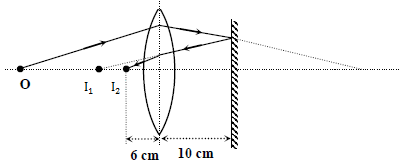
So, here the ray of light is coming from behind the mirror towards lens, for the second image \[{{I}_{2}}\] with respect to lens,
\[u=+10\text{ cm};f=15\text{ cm}\]
By using lens formula
\[\dfrac{1}{v}-\dfrac{1}{u}=\dfrac{1}{f}\]
\[\Rightarrow \dfrac{1}{v}-\dfrac{1}{10}=\dfrac{1}{15}\]
\[\Rightarrow v=6\text{ cm}\]
So, this image is at a distance of \[10+6=16\text{ cm}\] in front of the mirror.
So, the correct answer is “Option B”.
Note:
In this we need to remember that we need to find the distance of the image from the mirror. So we need to add 10 to give a final answer.
Also real images are always inverted in nature. In this converging rays actually made a collection of focus points which we called a real image because generally an image is a collection of focus points in optics.
Complete step by step answer:
We get the image distance by using lens
Formula \[\dfrac{1}{v}-\dfrac{1}{u}=\dfrac{1}{f}\Rightarrow \dfrac{1}{v}=\dfrac{1}{15}-\dfrac{1}{30}\Rightarrow v=30\text{ cm}\]
\[v=30\text{ cm}\] in front of the Convex mirror, which means 20 cm behind the mirror. Assuming a mirror to reflect from both the sides, this image will act as a virtual object for the mirror and second image. \[{{I}_{2}}\] will be formed at 20 cm in front of the mirror.
1. Understanding the convention used while taking
\[+ve\] and \[-ve\]sign for Image and object distance, the direction along which ray of light is travel taken as \[+ve\]
2. Focal length:
For convex lens \[+ve\]
For concave lens \[-ve\]
So, here the ray of light is coming from behind the mirror towards lens, for the second image \[{{I}_{2}}\] with respect to lens,
\[u=+10\text{ cm};f=15\text{ cm}\]
By using lens formula
\[\dfrac{1}{v}-\dfrac{1}{u}=\dfrac{1}{f}\]
\[\Rightarrow \dfrac{1}{v}-\dfrac{1}{10}=\dfrac{1}{15}\]
\[\Rightarrow v=6\text{ cm}\]
So, this image is at a distance of \[10+6=16\text{ cm}\] in front of the mirror.
So, the correct answer is “Option B”.
Note:
In this we need to remember that we need to find the distance of the image from the mirror. So we need to add 10 to give a final answer.
Also real images are always inverted in nature. In this converging rays actually made a collection of focus points which we called a real image because generally an image is a collection of focus points in optics.
Recently Updated Pages
Explain the structure of megasporangium class 12 biology CBSE

Why is chloroform kept in dark coloured bottles class 12 chemistry CBSE
Derive the balancing condition of a Wheatstone bri class 12 physics CBSE
Draw VI characteristics of a pn junction diode Explain class 12 physics CBSE
Is it possible to carry pride in ones language too class 12 english CBSE
In a population at Hardy Weinberg equilibrium the allele class 12 biology CBSE
Trending doubts
Draw a labelled sketch of the human eye class 12 physics CBSE
Which are the Top 10 Largest Countries of the World?
Draw ray diagrams each showing i myopic eye and ii class 12 physics CBSE
One megawatt is equal to how many units of electri class 12 physics CBSE
Which is the correct genotypic ratio of mendel dihybrid class 12 biology CBSE
Give 10 examples of unisexual and bisexual flowers