




A beam of light of wavelength 600 nm from a distant source falls on a single slit 1.0 mm wide and the resulting diffraction pattern is observed on a screen 2m away. What is the distance between the first dark fringes on either side of the central bright fringe?
A). \[1.2cm\]
B). \[1.2mm\]
C). \[2.4cm\]
D). \[2.4mm\]
Answer
 Verified
612.3k+ views
Hint: Single slit formula gives the relation between the slit width, wavelength of the light beam, angle of refraction for different values of \[n\]. For smaller values of \[n\], \[\theta \] can be considered as zero. When \[n=1\], the first dark fringe forms on either side of a central bright fringe. By substituting the values given, in the single slit formula, the distance can be found.
Formula used:
\[d\sin \theta =n\lambda \]
Complete step-by-step solution:
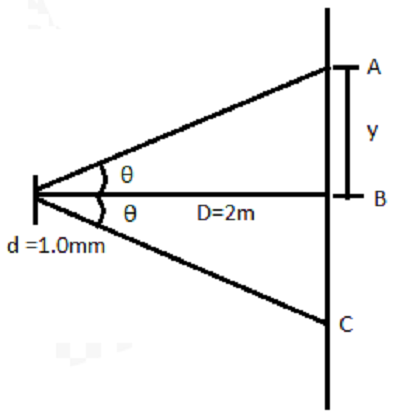
Let’s say, the first dark fringe formed at points A and C, and the central bright fringe at B. Here, the fringes formed on either side of the central fringe are symmetrical.
Hence, angle \[\theta \] is the same for both fringes.
We have single slit diffraction formula,
\[d\sin \theta =n\lambda \] --------- 1
Where,
\[\theta \] is the angle from the center of the wall to the dark fringe
\[n\] is a positive integer \[\left( n=1,2,3..... \right)\]
\[\lambda \] is the wavelength of light
\[d\] is the width of the slit
For small values of \[\theta \], \[\sin \theta \approx \theta \]
The, from figure
\[\theta =\dfrac{y}{D}\] ------- (2)
\[\text{D}\] is the distance from slit to screen.
The distance between points A and B = The distance between B and C \[\text{= y}\]
Then, The distance between points A and C
\[\text{= 2y}\]
Substitute 2 in equation 1.
\[d\dfrac{y}{D}=n\lambda \]
Then,
\[y=\dfrac{n\lambda D}{d}\]
For\[n=1\]
\[y=\dfrac{\lambda D}{d}\] --------- (3)
Given,
\[\lambda =600\times {{10}^{-9}}m\],
\[D=2m\], \[d=1\times {{10}^{-3}}m\]
Substitute the value of \[\lambda \],\[D\] and \[d\] in equation 3
\[y=\dfrac{600\times {{10}^{-9}}\times 2}{1\times {{10}^{-3}}}=1.2mm\]
Therefore, \[\text{Distance AC = 2y = 2}\times \text{1}\text{.2 = 2}\text{.4mm}\]
Hence, the answer is option D.
Note: For the fixed values of \[\lambda \] and \[n\], as the \[d\] gets smaller, \[\theta \] increases and vice versa. From the single slit formula, we can understand that the wave effects are most noticeable when the wave encountering object (here, slits a distance \[d\] apart) is small. Small values of \[d\] give large values of \[\theta \].
Formula used:
\[d\sin \theta =n\lambda \]
Complete step-by-step solution:
Let’s say, the first dark fringe formed at points A and C, and the central bright fringe at B. Here, the fringes formed on either side of the central fringe are symmetrical.
Hence, angle \[\theta \] is the same for both fringes.
We have single slit diffraction formula,
\[d\sin \theta =n\lambda \] --------- 1
Where,
\[\theta \] is the angle from the center of the wall to the dark fringe
\[n\] is a positive integer \[\left( n=1,2,3..... \right)\]
\[\lambda \] is the wavelength of light
\[d\] is the width of the slit
For small values of \[\theta \], \[\sin \theta \approx \theta \]
The, from figure
\[\theta =\dfrac{y}{D}\] ------- (2)
\[\text{D}\] is the distance from slit to screen.
The distance between points A and B = The distance between B and C \[\text{= y}\]
Then, The distance between points A and C
\[\text{= 2y}\]
Substitute 2 in equation 1.
\[d\dfrac{y}{D}=n\lambda \]
Then,
\[y=\dfrac{n\lambda D}{d}\]
For\[n=1\]
\[y=\dfrac{\lambda D}{d}\] --------- (3)
Given,
\[\lambda =600\times {{10}^{-9}}m\],
\[D=2m\], \[d=1\times {{10}^{-3}}m\]
Substitute the value of \[\lambda \],\[D\] and \[d\] in equation 3
\[y=\dfrac{600\times {{10}^{-9}}\times 2}{1\times {{10}^{-3}}}=1.2mm\]
Therefore, \[\text{Distance AC = 2y = 2}\times \text{1}\text{.2 = 2}\text{.4mm}\]
Hence, the answer is option D.
Note: For the fixed values of \[\lambda \] and \[n\], as the \[d\] gets smaller, \[\theta \] increases and vice versa. From the single slit formula, we can understand that the wave effects are most noticeable when the wave encountering object (here, slits a distance \[d\] apart) is small. Small values of \[d\] give large values of \[\theta \].
Recently Updated Pages
Master Class 12 Business Studies: Engaging Questions & Answers for Success

Master Class 12 Chemistry: Engaging Questions & Answers for Success
Master Class 12 Biology: Engaging Questions & Answers for Success
Class 12 Question and Answer - Your Ultimate Solutions Guide
Master Class 11 English: Engaging Questions & Answers for Success
Master Class 11 Social Science: Engaging Questions & Answers for Success
Trending doubts
Which are the Top 10 Largest Countries of the World?
Draw a labelled sketch of the human eye class 12 physics CBSE
Differentiate between homogeneous and heterogeneous class 12 chemistry CBSE
Differentiate between Pyramid of energy and pyramid class 12 biology CBSE
Why is the cell called the structural and functional class 12 biology CBSE
Draw the diagram of the pyramid of energy Explain In class 12 biology CBSE