




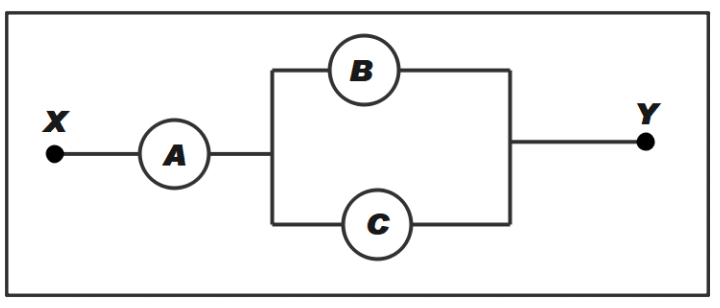
A, B and C are the voltmeters of resistance 1R, 1.5R and 3R respectively as shown in the figure. When some potential difference is applied between X and Y, the voltmeter reading are \[{{V}_{A}}\], \[{{V}_{B}}\] and \[{{V}_{C}}\] respectively. Then
A. \[{{V}_{A}}={{V}_{B}}\ne {{V}_{C}}\]
B. \[{{V}_{A}}\ne {{V}_{B}}\ne {{V}_{C}}\]
C. \[{{V}_{A}}={{V}_{B}}={{V}_{C}}\]
D. \[{{V}_{A}}\ne {{V}_{B}}\ne {{V}_{C}}\]
Answer
 Verified
608.7k+ views
Hint: In this question we are being asked the relation between \[{{V}_{A}}\],\[{{V}_{B}}\]and \[{{V}_{C}}\]. As we can see from the figure the resistor B and C are parallel. Therefore, we will have to calculate the equivalent resistance. The circuit is said to be given some potential difference. After calculating the equivalent resistance we can state the relation by using the Ohm’s law.
Formula used:
V = IR
Where V is the potential difference, R is the resistance and I is the current flowing through the circuit.
Complete step-by-step answer:
We have been given that resistance in A is R and that in B and C is 1.5R and 3R respectively. From the diagram we can see that resistance B is parallel to C. Therefore,
We know, the equivalent resistance for resistors in parallel combination is given by,
\[\dfrac{1}{{{R}_{eq}}}=\dfrac{1}{{{R}_{1}}}+\dfrac{1}{{{R}_{2}}}\]
Where,
\[{{R}_{eq}}\] = the equivalent resistance
\[{{R}_{1}}\] = resistance in B
\[{{R}_{2}}\] = resistance in C
Therefore, after substituting values in above equation we get,
\[\dfrac{1}{{{R}_{eq}}}=\dfrac{1}{1.5R}+\dfrac{1}{3R}\]
On solving above equation
We get,
\[\dfrac{1}{{{R}_{eq}}}=\dfrac{3}{3R}\]
Therefore,
\[{{R}_{eq}}=R\]………….. (1)
Now we know from ohm’s law
V = IR
Here we shall assume that current is the same throughout the circuit.
Therefore, we can say that potential difference is directly proportional to resistance.
\[V\propto R\]
From (1) we can say that equivalent resistance of B and C is R which is also the resistance for A. It means that resistance in every branch is equal to A.
Therefore, we can say that potential difference is same across A, B and C i.e. \[{{V}_{A}}={{V}_{B}}={{V}_{C}}\].
So, the correct answer is “Option C”.
Note: A voltmeter is the electric device that is used to measure the potential difference across two points in an electric circuit. Voltmeters show the deflection through the needle. They also show the direction of voltage applied. The voltmeter is always connected in parallel with the points between which the potential difference is to be measured.
Formula used:
V = IR
Where V is the potential difference, R is the resistance and I is the current flowing through the circuit.
Complete step-by-step answer:
We have been given that resistance in A is R and that in B and C is 1.5R and 3R respectively. From the diagram we can see that resistance B is parallel to C. Therefore,
We know, the equivalent resistance for resistors in parallel combination is given by,
\[\dfrac{1}{{{R}_{eq}}}=\dfrac{1}{{{R}_{1}}}+\dfrac{1}{{{R}_{2}}}\]
Where,
\[{{R}_{eq}}\] = the equivalent resistance
\[{{R}_{1}}\] = resistance in B
\[{{R}_{2}}\] = resistance in C
Therefore, after substituting values in above equation we get,
\[\dfrac{1}{{{R}_{eq}}}=\dfrac{1}{1.5R}+\dfrac{1}{3R}\]
On solving above equation
We get,
\[\dfrac{1}{{{R}_{eq}}}=\dfrac{3}{3R}\]
Therefore,
\[{{R}_{eq}}=R\]………….. (1)
Now we know from ohm’s law
V = IR
Here we shall assume that current is the same throughout the circuit.
Therefore, we can say that potential difference is directly proportional to resistance.
\[V\propto R\]
From (1) we can say that equivalent resistance of B and C is R which is also the resistance for A. It means that resistance in every branch is equal to A.
Therefore, we can say that potential difference is same across A, B and C i.e. \[{{V}_{A}}={{V}_{B}}={{V}_{C}}\].
So, the correct answer is “Option C”.
Note: A voltmeter is the electric device that is used to measure the potential difference across two points in an electric circuit. Voltmeters show the deflection through the needle. They also show the direction of voltage applied. The voltmeter is always connected in parallel with the points between which the potential difference is to be measured.
Recently Updated Pages
Master Class 12 Business Studies: Engaging Questions & Answers for Success

Master Class 12 Chemistry: Engaging Questions & Answers for Success
Master Class 12 Biology: Engaging Questions & Answers for Success
Class 12 Question and Answer - Your Ultimate Solutions Guide
Master Class 11 English: Engaging Questions & Answers for Success
Master Class 11 Maths: Engaging Questions & Answers for Success
Trending doubts
The value of constant k in coulombs law is beginalign class 12 physics CBSE
Which one is the sweetest sugar a Glucose b Fructose class 12 biology CBSE
Who discovered the cell and how class 12 biology CBSE
The correct structure of ethylenediaminetetraacetic class 12 chemistry CBSE
What is the Full Form of 1.DPT 2.DDT 3.BCG
How much time does it take to bleed after eating p class 12 biology CBSE