




(a) Account for the following :
(i) $C{H_3}CHO$ is more reactive than $C{H_3}COC{H_3}$ towards reaction with $HCN$ .
(ii) Carboxylic acid is a stronger acid than phenol.
(b) Write the chemical equations to illustrate the following name reactions:
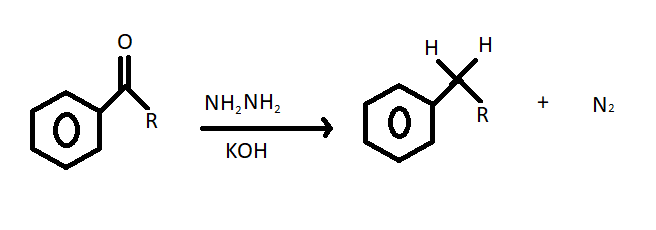
(i) Wolff-Kishner reduction
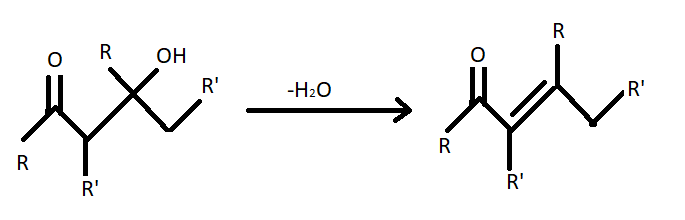
(ii) Aldol condensation
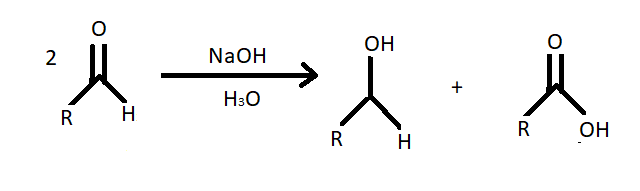
(iii) Cannizzaro reaction
Answer
 Verified
663k+ views
Hint: We can account for the reason of $C{H_3}CHO$ is more reactive than $C{H_3}COC{H_3}$ towards reaction with $HCN$ with the help of side groups attached to the carbonyl carbon atoms and in the (iI) part can be solved with the help of stability of the conjugate base of the given acids.
Complete step by step answer:
(a)
(i) $C{H_3}CHO$ is more reactive than $C{H_3}COC{H_3}$ towards reaction with $HCN$ - In the given compound $C{H_3}CHO$ the magnitude of the positive charge on the carbonyl carbon atom reduces because of the presence of methyl group $\left( {C{H_3} - } \right)$. As methyl groups reduce the positive charge because of its $ + I$ effect. In $C{H_3}COC{H_3}$ there are two methyl groups attached to the carbonyl group which also hinders the approach of $C{N^ - }$. Therefore $C{H_3}CHO$ is more reactive than $C{H_3}COC{H_3}$ towards reaction with $HCN$.
(ii) Carboxylic acid is a stronger acid than phenol – We know that the acid will be more acidic if its conjugate base will be more stable. The conjugate base of carboxylic acid and phenol are carboxylate ion and phenoxide ion respectively. The resonance structure of carboxylate ion is more stable than phenoxide ion because the negative charge is delocalised into the benzene ring to a smaller extent while in carboxylate ion it is delocalised on oxygen atom.
(b)
(i) Wolff-Kishner reduction – The Wolff Kishner reduction is performed with ketones or aldehyde substrate and hydrazine as a reducing agent in the presence of a strong base in a high boiling protic solvent such as ethylene glycerol. The chemical equation of the given reaction is as follows;
(ii) Aldol condensation - We have studied that $\beta - $ hydroxy aldehydes are known as aldols. Aldol condensation reaction occurs with aldehyde having $\alpha - $hydrogen with a dilute base to give aldols. The simple chemical equation of aldol condensation is given below;
(iii) Cannizzaro reaction – Cannizzaro reaction is redox disproportionation of non-enolizable aldehydes to carboxylic acids and alcohols. It is conducted in a concentrated base. It produces a primary alcohol and a carboxylic acid.
Note:
1- Hence the above problems are solved with the help of some important concepts of chemistry such as the induction effect of methyl group and resonating structure of conjugate bases.
2- These are very important reactions of aldehydes and ketones. They are mainly famous by their names such as Wolff-Kishner reduction, Cannizzaro reaction etc.
Complete step by step answer:
(a)
(i) $C{H_3}CHO$ is more reactive than $C{H_3}COC{H_3}$ towards reaction with $HCN$ - In the given compound $C{H_3}CHO$ the magnitude of the positive charge on the carbonyl carbon atom reduces because of the presence of methyl group $\left( {C{H_3} - } \right)$. As methyl groups reduce the positive charge because of its $ + I$ effect. In $C{H_3}COC{H_3}$ there are two methyl groups attached to the carbonyl group which also hinders the approach of $C{N^ - }$. Therefore $C{H_3}CHO$ is more reactive than $C{H_3}COC{H_3}$ towards reaction with $HCN$.
(ii) Carboxylic acid is a stronger acid than phenol – We know that the acid will be more acidic if its conjugate base will be more stable. The conjugate base of carboxylic acid and phenol are carboxylate ion and phenoxide ion respectively. The resonance structure of carboxylate ion is more stable than phenoxide ion because the negative charge is delocalised into the benzene ring to a smaller extent while in carboxylate ion it is delocalised on oxygen atom.
(b)
(i) Wolff-Kishner reduction – The Wolff Kishner reduction is performed with ketones or aldehyde substrate and hydrazine as a reducing agent in the presence of a strong base in a high boiling protic solvent such as ethylene glycerol. The chemical equation of the given reaction is as follows;
(ii) Aldol condensation - We have studied that $\beta - $ hydroxy aldehydes are known as aldols. Aldol condensation reaction occurs with aldehyde having $\alpha - $hydrogen with a dilute base to give aldols. The simple chemical equation of aldol condensation is given below;
(iii) Cannizzaro reaction – Cannizzaro reaction is redox disproportionation of non-enolizable aldehydes to carboxylic acids and alcohols. It is conducted in a concentrated base. It produces a primary alcohol and a carboxylic acid.
Note:
1- Hence the above problems are solved with the help of some important concepts of chemistry such as the induction effect of methyl group and resonating structure of conjugate bases.
2- These are very important reactions of aldehydes and ketones. They are mainly famous by their names such as Wolff-Kishner reduction, Cannizzaro reaction etc.
Recently Updated Pages
Which of the following graphs shows the variation of class 12 physics CBSE

Draw a labelled diagram of the human male reproductive class 12 biology CBSE
Describe the experiment to compare the emf of two cells class 12 physics CBSE
What is standard hydrogen electrode
What is conventional current and electric current class 12 physics CBSE
2Bromopentane is treated with an alcoholic KOH solution class 12 chemistry CBSE
Trending doubts
Draw a labelled sketch of the human eye class 12 physics CBSE
Which are the Top 10 Largest Countries of the World?
Differentiate between homogeneous and heterogeneous class 12 chemistry CBSE
Draw ray diagrams each showing i myopic eye and ii class 12 physics CBSE
Which is the correct genotypic ratio of mendel dihybrid class 12 biology CBSE
What is the Full Form of PVC, PET, HDPE, LDPE, PP and PS ?