









Definition of Sort in Maths with Examples and Explanation
Are you looking to know the meaning of “Sort” in Maths?
Yes!
Here, we will describe what sort is with a simple example.
Sort means to arrange or group in a special way (according to their type, size, texture, shapes, alphabetically, etc.). Let us look at a few examples below to understand better.
Sort Example:
Sorting by Size
The circles given below are sorted according to their size.

Sort by size
Sort by Colours
The geometrical objects given below are sorted according to their colours.
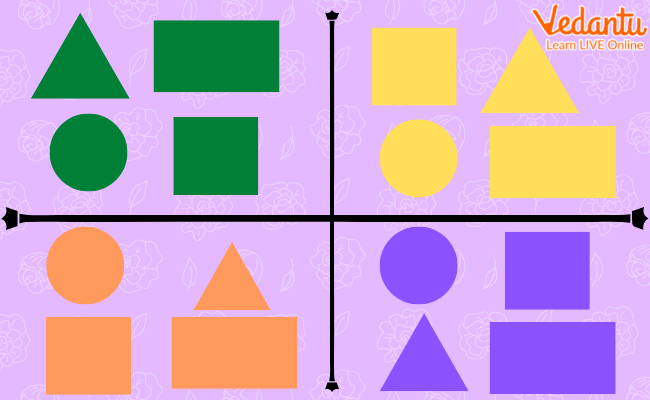
Sort by colour
Sort by Shapes
The image given below shows different geometric figures as square, triangle, rectangle, and circle are sorted according to their shapes.
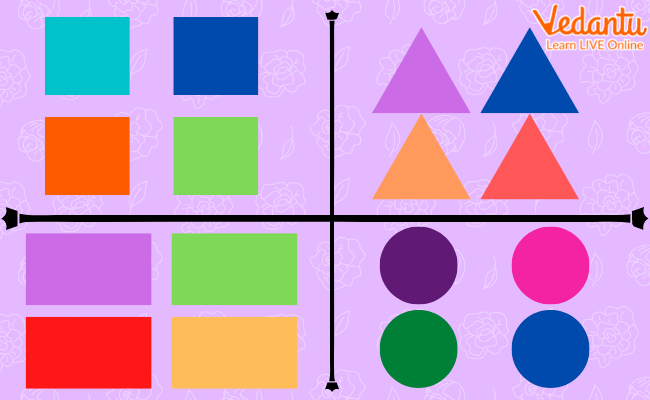
Sort by shapes
Let us learn the sort meaning in a better way through simple sorting activities.
Sorting Activities
Sorting activities are activities that require a child to identify what a number of items (whether pictures of objects) have in common or similar.
5 Sorting Activities for Kids to Learn
1. Sorting Fruits and Vegetables
Use plastic or wooden fruits and vegetables toys and categorise fruits and vegetables into vegetable soup or fruit salad. Now ask your child which among them can be eaten raw or which can be cooked. Also, you can ask your child to sort fruits and vegetables on the basis of their colour or size.
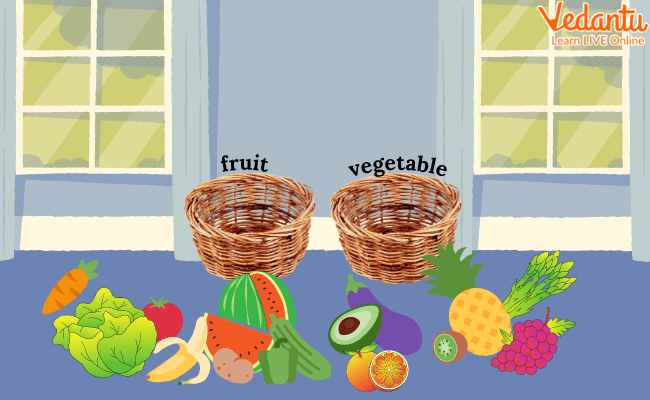
Sort fruits and vegetables
1. Sort Furniture
To sort furniture, you can use plastic or wooden furniture toys and ask children to sort furniture according to which room it belongs to.
2. Sort Beans
To sort beans, you can give children a bowl of dried beans and ask them to sort it. Also, after sorting, you can ask how many similar beans are in each container.
3. Sort Objects
To sort objects, you can give your child different objects and ask them to sort on the basis of their colour, size, or shapes.
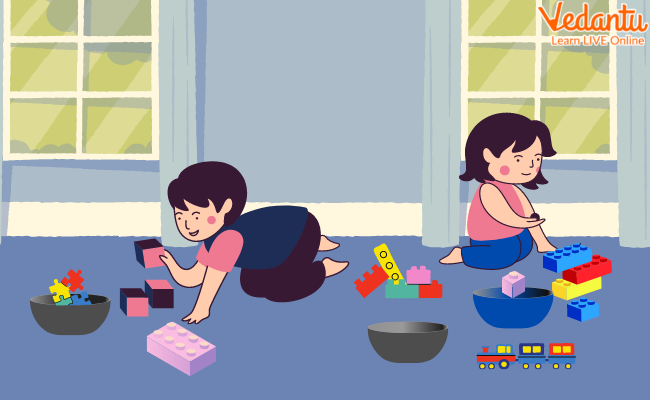
Sort objects
4. Sort Grocery
To sort groceries, you can use different grocery items or toys; or even you can make and ask children to sort groceries as they go together. For example, you can ask them to sort cleaning products, washables, bakery products, frozen foods, etc.

Sort grocery
Conclusion
In short, sort or sorting is the process of arranging items or objects systematically or in a sequence order. Also, sorting activities helps kids to observe similarities and differences between items and objects.
FAQs on What Does Sort Define in Mathematics
1. What does sort define in mathematics?
In mathematics, sort means to arrange numbers or objects in a specific order, usually ascending or descending. Sorting helps organize data so it is easier to compare, analyze, or interpret. The two most common types are:
- Ascending order: smallest to largest
- Descending order: largest to smallest
2. What does it mean to sort numbers in ascending order?
Sorting in ascending order means arranging numbers from the smallest value to the largest value. This order increases step by step. Example:
- Original numbers: 8, 3, 6, 1
- Ascending order: 1, 3, 6, 8
3. What does it mean to sort numbers in descending order?
Sorting in descending order means arranging numbers from the largest value to the smallest value. This order decreases step by step. Example:
- Original numbers: 4, 9, 2, 7
- Descending order: 9, 7, 4, 2
4. Why is sorting important in mathematics?
Sorting is important because it makes data easier to analyze, compare, and interpret. When numbers are sorted:
- Finding the median becomes simple
- Identifying the minimum and maximum is quick
- Patterns and trends are easier to see
5. How do you sort a list of numbers step by step?
To sort a list of numbers, compare and arrange them based on size from smallest to largest (or vice versa). Follow these steps:
- Step 1: Identify the smallest (or largest) number.
- Step 2: Place it in the first position.
- Step 3: Repeat with the remaining numbers.
- Smallest is 4
- Next is 6
- Largest is 10
- Final order: 4, 6, 10
6. What is the difference between sorting and ordering?
Sorting and ordering both mean arranging items, but sorting usually refers to arranging data systematically, while ordering is a broader term for placing items in a sequence. In mathematics, sorting specifically focuses on numerical or alphabetical arrangement, typically in ascending or descending order.
7. Can you give an example of sorting in statistics?
Sorting in statistics is arranging data values to calculate measures like the median or range. Example data set: 12, 7, 15, 10, 9.
- Sorted (ascending): 7, 9, 10, 12, 15
- Median (middle value): 10
8. What does sort mean in sets or algebra?
In sets or algebra, sorting means arranging elements according to a defined rule such as numerical size or alphabetical order. For example, the set {3, 1, 4} sorted in ascending order becomes {1, 3, 4}. Sorting does not change the set itself, only the arrangement of its elements.
9. What are common mistakes when sorting numbers?
Common mistakes when sorting numbers include incorrect comparison of values and ignoring negative signs or decimals. Key errors include:
- Forgetting that -5 is smaller than -2
- Misplacing decimal numbers like 0.45 and 0.5
- Skipping numbers during comparison
10. Is sorting used in real-life applications?
Yes, sorting is widely used in real-life applications such as ranking scores, organizing data, and computer algorithms. Examples include:
- Arranging exam marks from highest to lowest
- Sorting prices from low to high
- Computer sorting algorithms like bubble sort or quicksort
