









Definition of Halves with Examples and How to Find Half of a Number
In Mathematics, fractions are frequently used terms. As children go through the grades, they are introduced to a variety of words, such as fractions, 1 halves, thirds, and fourths. It is now common to be confused about how much 1 half is or what half means. In simpler terms, halves can be defined as the two equal parts of a whole object.
To better comprehend these phrases, however, we must first comprehend the concept of fractions. A fraction is defined as a piece of a larger collection. The numerator and denominator are the two halves of the fraction. The illustration below can help you understand the notion of fractions.

The Fraction Parts – The Numerator and Denominator
Since we have developed an understanding of what fractions are, let us now discuss what halves and their properties.
What Do Halves Mean?
Halves can be defined as the value of the equal division of a whole object. The term half or halves is used to mathematically represent the value of $\frac{1}{2}$. A half divides the whole object into two equivalent parts. Let us see some examples for a better understanding of the concept.
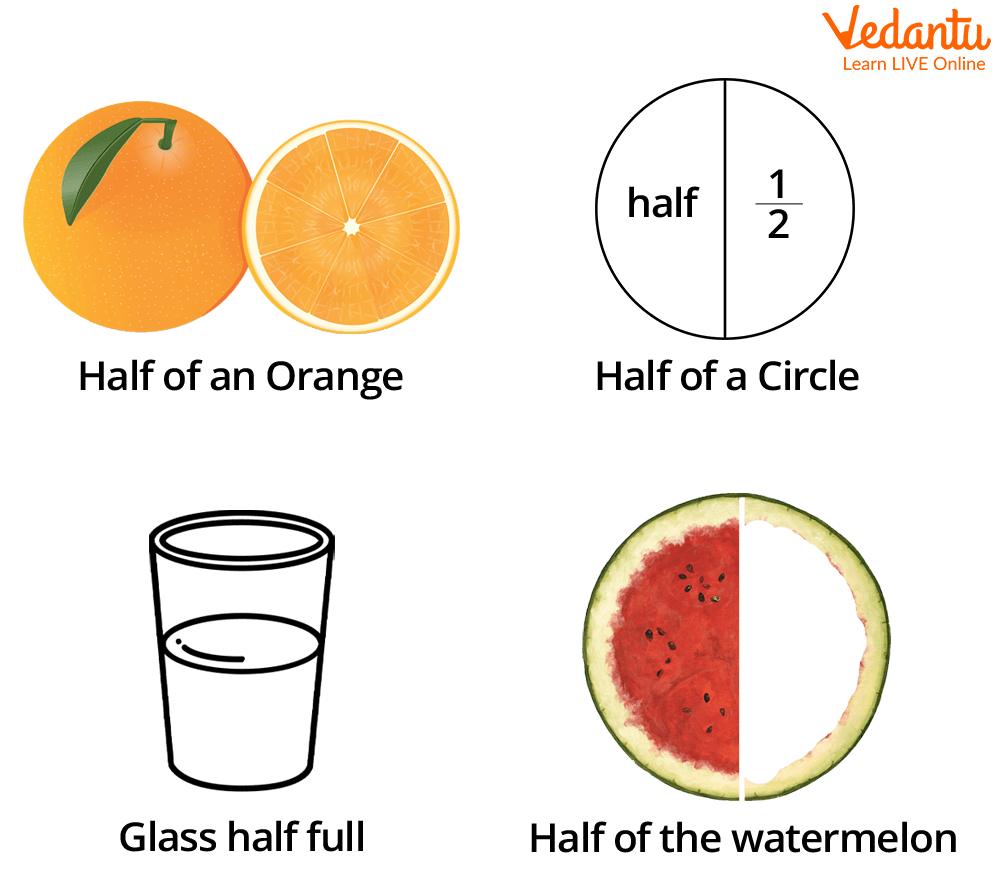
Examples of Halves
Calculation of the Value of Halves
Since we have now understood how to represent half in a fraction. Let us understand how to calculate the half for a given value. A simple method to calculate half of a value is to divide the total value by 2. It can be better understood by an example.
Example
If a person has 10 chocolates and is asked to give exactly half of the chocolate to their friend. How many chocolates would they have to give?
Since we know we can calculate the value of half by dividing the value by 2. The total number of chocolate is 10, so the value of half would be $\frac{10}{2}$ which is equal to 5. The person would give exactly 5 chocolates to their friend.
Representing Half on a Number Line
Let us look at how we can represent the value of half in a number line. On the number line, we can represent fractions. On a number line, the distance from 0 to 1 is always one whole. When we divide this distance in half, we will get two halves.

The Value of Half on a Number Line.
Conclusion
The terms half and halves are regularly used in fractions, as we've learnt. We have also learnt how to find the half-value of any number. We hope that we were able to aid in the development of a deeper understanding of the topic. To master the concept of fractions, children can practice solving various questions.
FAQs on What Are Halves in Mathematics
1. What are halves in Maths?
A half is one of two equal parts of a whole. When a whole object, number, or shape is divided into 2 equal parts, each part is called a half. In fraction form, a half is written as 1/2. For example, if you cut a pizza into two equal slices, each slice represents one half of the pizza.
2. How do you write a half as a fraction?
A half is written as the fraction 1/2. In the fraction 1/2:
- 1 is the numerator (number of parts taken).
- 2 is the denominator (total equal parts).
3. How do you find half of a number?
To find half of a number, divide the number by 2. Follow these steps:
- Take the given number.
- Divide it by 2.
- The result is the half.
4. What is half of an odd number?
Half of an odd number is a number ending in .5 or can be written as a fraction. Since odd numbers are not exactly divisible by 2, dividing them by 2 gives a decimal or fraction. Example: Half of 9 = 9 ÷ 2 = 4.5 or 9/2.
5. What is the decimal form of one-half?
The decimal form of one-half (1/2) is 0.5. You convert it by dividing 1 by 2: 1 ÷ 2 = 0.5. This shows that half is equal to five-tenths.
6. What is the percentage of one-half?
One-half is equal to 50%. To convert 1/2 into a percentage:
- Convert the fraction to decimal: 1 ÷ 2 = 0.5
- Multiply by 100: 0.5 × 100 = 50%
7. How do you show halves using shapes?
You show halves by dividing a shape into 2 equal parts. For example:
- Draw a circle or rectangle.
- Split it into two equal sections.
- Each section represents 1/2.
8. What is the difference between a half and a quarter?
A half is one of 2 equal parts, while a quarter is one of 4 equal parts. In fraction form:
- Half = 1/2
- Quarter = 1/4
9. Can you give a real-life example of halves?
A real-life example of halves is sharing something equally between two people. If you divide 8 apples equally between 2 children, each child gets 4 apples, which is half of 8. Halves are commonly used in cooking, sharing food, and measuring quantities.
10. What are common mistakes when finding halves?
A common mistake when finding halves is not dividing into equal parts or forgetting to divide by 2. Watch out for these errors:
- Dividing by the wrong number instead of 2.
- Splitting shapes into unequal parts.
- Misplacing decimals when halving odd numbers.
