









Definition Properties and Examples of Same Number in Maths
The term ‘same number’ is nothing but a similar or identical number that is selected by more than one member in any of the activities performed. For example, more than one in a group selects the same number without knowing each other. Though it seems to be fun, it is completely a coincidence that happens for sure, where more than one person selects the same. In Maths, we can also call it permutations and we can watch it in a few real time games like housie and more.
Let us look at the same with an example from this article.
Same Number Example
Assume you're in a thirty-student class. The teacher instructs everyone to jot down a whole number between one and 225 in secret. Do you believe it's likely or unlikely that everyone will have a different number?
You might test it out in class a few times or play around with the simulation below.
In the scenario below, everyone of the 30 members chooses the same number.

Same number selected by 30 members
The probable chances of selecting a number is given below.
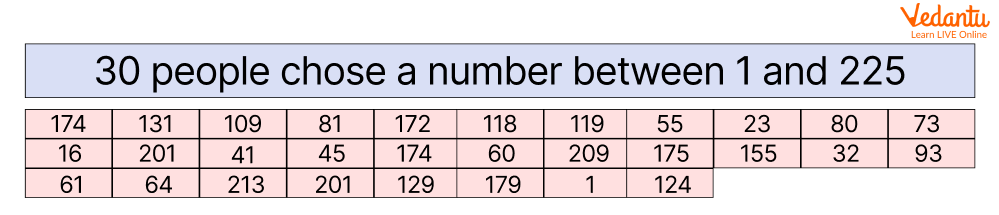
Probability of selecting the same number by the students between 1 and 225.
Birthday Problem
There is a famous mathematical problem called the Birthday Problem.
How many people do you need in a room so that the chance that there will be at least two people with the same birthday?
One way to solve this is to imagine that people enter the room one at a time and that each new person doesn't share a birthday with anyone already there. Here, we have to plan that, at a minimum of 730 people should be allowed. Since we have 365 days in a year, the probability of getting the same birthday date for at least 2 members can be possible if there are 2 persons with the same date.
Then, we have to ask them to share their birthday dates by writing them on a piece of paper. After that, we can check the papers and can find the probability of at least 2 members having the same birth dates.
This is a fun activity that we can perform to find the probable matches.
Summary
We can see the term same number in our daily lives, in many games and activities that we may perform. In addition, these are completely fun activities that can be performed with children by involving them in the concept as well. Ask your child to perform this with his/her friends.
FAQs on Understanding Same Number in Mathematics
1. What does the same number mean in Maths?
The same number in Maths means two or more values that are exactly equal in quantity or value. If two numbers represent the same amount on the number line, they are equal. For example:
- 5 and 5 are the same number.
- 0.5 and 1/2 represent the same number.
- 3 + 2 and 4 + 1 give the same result, which is 5.
2. How do you know if two numbers are the same?
Two numbers are the same if they have the same numerical value after simplification or calculation. To check:
- Simplify both numbers (fractions, decimals, or expressions).
- Convert to the same form if needed.
- Compare the final values.
3. What is an example of same numbers in an equation?
An example of same numbers in an equation is when both sides have equal values, such as 7 = 7. Another example:
- 2 + 3 = 4 + 1
- Both sides simplify to 5
4. What is the symbol used for the same number in Maths?
The symbol used to show the same number in Maths is the equals sign (=). It means the value on the left side is exactly equal to the value on the right side. For example:
- 10 = 10
- 6 × 2 = 12
5. Are equivalent fractions considered the same number?
Yes, equivalent fractions are considered the same number because they represent the same value. For example:
- 1/2 = 2/4 = 4/8
6. Can two different expressions represent the same number?
Yes, two different expressions can represent the same number if they simplify to the same value. For example:
- 3 × 4 and 6 + 6
- Both equal 12
7. What does it mean when variables have the same number?
When variables have the same number, it means they are assigned an equal value. For example, if x = 5 and y = 5, then x and y represent the same number. Substituting into expressions will give identical results where the variables appear.
8. Is 0 considered the same number as 0.0?
Yes, 0 and 0.0 are the same number because they represent the same value on the number line. The decimal form does not change the value. Similarly:
- 5 = 5.0
9. What property explains multiplying by the same number?
The identity property of multiplication explains that multiplying any number by 1 gives the same number. The formula is:
- a × 1 = a
- 9 × 1 = 9
10. Why is understanding the same number important in Maths?
Understanding the same number concept is important because it helps with equality, solving equations, comparing values, and simplifying expressions. It is used in:
- Checking if equations are true
- Identifying equivalent fractions and decimals
- Simplifying algebraic expressions
