









What Is Raw Data in Statistics With Examples and Uses
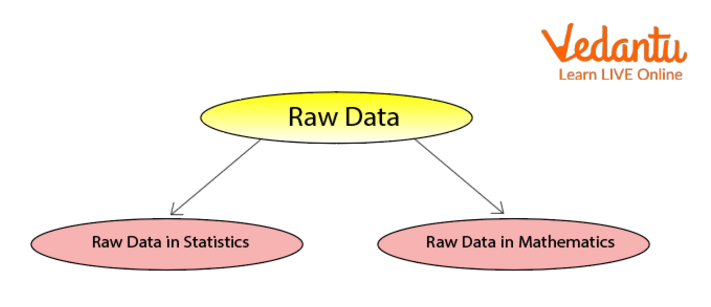
Data is a sort of information that is used to represent the figures, such as facts and numbers to analyse something and to take decisions on behalf. The data can be read in two terms: raw data in statistics and raw data in mathematics.
Raw Data
Raw Data in Statistics
In statistics, raw data can be defined as the data that has been collected directly from a primary source of data that is not processed or cleaned by anyone. The first step is to collect the data from the primary source of data and then when the data is gathered, it can be cleaned and summarised in various forms.
Terms Related to Statistics
Data: The collection of information in the form of numbers is known as data.
Observation: All the collection of numerical facts in given data is known as observation.
Array: Putting the raw data in ascending or descending order is known as an array. Example: \[4,8,1,6,5,4\;\;\;\] Array: Keeping the above data in ascending order: \[1,4,4,5,6,8\].
Range: Range is the difference between the highest number and the lowest number. For example, the highest number is 45 and the lowest number is 15. Hence, the range is \[45 - 15 = 30.\]
Raw Data Examples in Statistics
The grades of all the students in a class.
List of music being streamed on the radio.
Amount collected by students for teachers’ day function.
These are the common examples of raw data in statistics. Generally, all the data is used to make a better understanding and make decisions upon it.
Raw Data in Mathematics
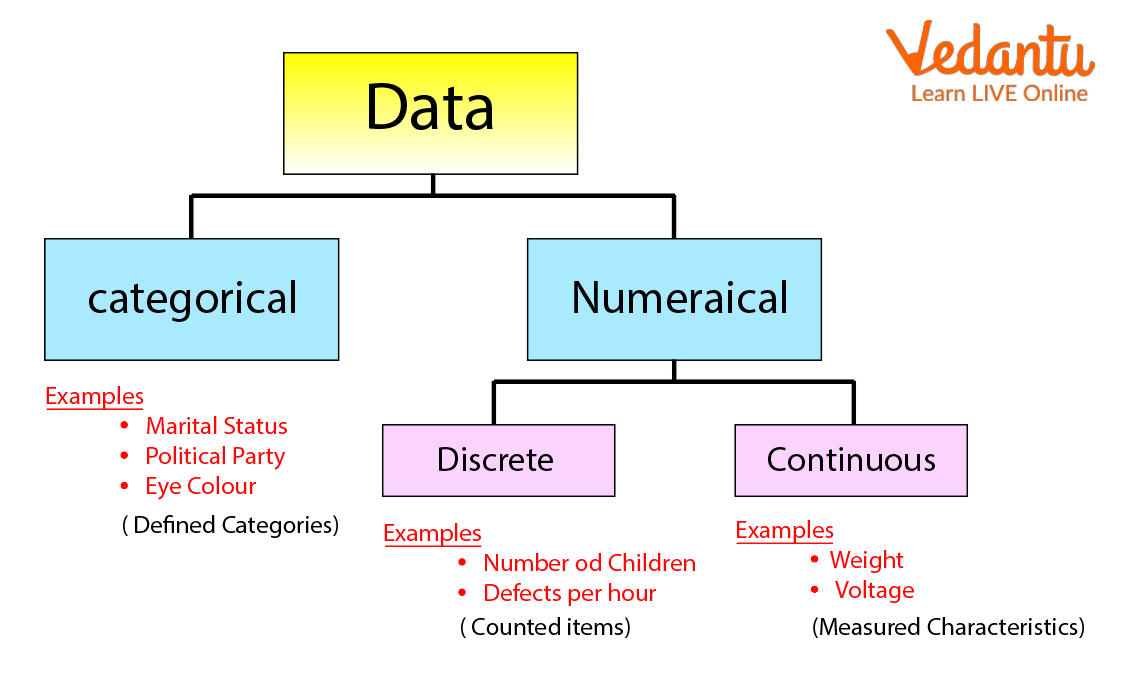
The data was collected in an unorganised form. if the data is collected in numerical value, it is quantitative raw data and the data collected by non-numerical values is called qualitative raw data. The given diagram will give you a slightly better understanding about the data and its types in Mathematics.
Data
Raw Data Examples in Mathematics
The marks obtained by 5 students in Maths tests: \[45,23,56,45,78\].
The number of apples in one kilogram of apples.
The number of bananas in one dozen bananas.
These all examples can be measured in numerical form.
Solved Questions
1. What is Raw Data?
Raw data is data that has been collected by a primary source. It is the first data collected by using a primary source; it is also known as primary data.
2. Name two terms related to statistics.
The two terms related to statistics are observation and array.
3. What is qualitative data?
The data collected in numerical value means it is quantitative raw data.
4. Give one example of raw data?
The number of apples in one kilogram of apples.
Summary
The raw data is the unorganised data that is collected by the primary source of data. The raw data can be qualitative and quantitative. The raw data can be studied in Statistics or Mathematics. There are many terms in statistics related to raw data. For example, Data, Array, Range etc.
FAQs on Raw Data in Statistics Explained for Students
1. What is raw data in statistics?
Raw data in statistics is the original, unprocessed information collected directly from observations, surveys, experiments, or measurements. It has not been organized, summarized, or analyzed.
- It can be numbers, categories, or measurements.
- It is recorded exactly as collected.
- Example: Test scores 45, 60, 72, 38, 90 are raw data before arranging or averaging.
Raw data is the starting point for statistical analysis and helps in calculating measures like mean, median, and mode.
2. What is the difference between raw data and grouped data?
The main difference is that raw data is unorganized original data, while grouped data is data arranged into classes or intervals.
- Raw data example: 5, 8, 10, 12, 15
- Grouped data example: 0–5, 6–10, 11–15
- Grouped data is easier to analyze when the dataset is large.
Raw data shows exact values, whereas grouped data summarizes values into frequency distributions.
3. How do you organize raw data?
You organize raw data by arranging it in ascending or descending order or by creating a frequency table.
- Step 1: Arrange values from smallest to largest (ascending order).
- Step 2: Count how many times each value appears.
- Step 3: Present the results in a table or chart.
Organizing raw data makes it easier to calculate statistical measures like mean, median, and mode.
4. How do you find the mean from raw data?
The mean of raw data is found using the formula Mean = (Sum of all observations) ÷ (Number of observations).
- Example data: 4, 6, 8
- Sum = 4 + 6 + 8 = 18
- Number of observations = 3
- Mean = 18 ÷ 3 = 6
The mean represents the average value of the raw dataset.
5. How do you find the median from raw data?
The median of raw data is the middle value after arranging the data in ascending order.
- Step 1: Arrange the data from smallest to largest.
- Step 2: If the number of values is odd, the middle value is the median.
- Step 3: If even, median = (Sum of two middle values) ÷ 2.
Example: 2, 5, 7 → Median = 5. For 2, 5, 7, 9 → Median = (5 + 7) ÷ 2 = 6.
6. How do you find the mode from raw data?
The mode of raw data is the value that appears most frequently in the dataset.
- Example: 3, 5, 5, 7, 9
- The number 5 appears twice.
- Mode = 5
A dataset can have one mode (unimodal), more than one mode (bimodal or multimodal), or no mode if all values occur once.
7. Can you give an example of raw data in real life?
A real-life example of raw data is recording the daily temperatures of a city for one week without organizing them.
- Example: 30°C, 32°C, 29°C, 31°C, 33°C, 30°C, 28°C
- These values are recorded exactly as observed.
Before calculating the average temperature or creating a graph, these temperature readings are considered raw statistical data.
8. Why is raw data important in statistics?
Raw data is important because it forms the foundation for all statistical analysis and conclusions.
- It allows accurate calculation of mean, median, mode, and range.
- It helps in creating tables, graphs, and charts.
- It ensures transparency and reliability of results.
Without raw data, statistical summaries and interpretations cannot be verified.
9. What is the range of raw data and how do you calculate it?
The range of raw data is the difference between the highest and lowest values, calculated as Range = Maximum − Minimum.
- Example data: 4, 9, 12, 15
- Maximum = 15
- Minimum = 4
- Range = 15 − 4 = 11
The range measures the spread or dispersion of the raw dataset.
10. What are common mistakes when working with raw data?
Common mistakes when working with raw data include not arranging the data correctly and miscounting observations.
- Not sorting data before finding the median.
- Incorrectly adding values when calculating the mean.
- Ignoring repeated values when identifying the mode.
- Using wrong maximum or minimum values for range.
Careful organization and accurate calculations help avoid errors in statistical analysis.
