








What Is Place Value in Grade 2 With Tens and Ones Examples
Place value is one of the most fundamental concepts of Mathematics covered in grade 2. Although students find it tricky to understand this concept, it becomes quite easy with a little practice. Let’s know about place value in detail.
While writing numbers, it is important to know the position or place of each digit of the number. The place value is nothing but it tells the position or value of each digit in a number. In short, ‘The Place’ represents ‘What Kind’ whereas the Value represents “How many” of that kind is shown. For example, in the number 457, the digit 5 represents there are 5 (How many) and it is in tenth place. So, tens represent (What Kind). Read on to know more about place values.
Learn Place Value With Example
Here is an example of place values to help you understand the concept in a better way:
In the number 746,
Starting From The Right,
6 is in one's position. It means 6 ones or (6 1 = 6 ).
4 is in the tenth position. It means 4 tens or forty (4 10 = 40).
7 is in the hundredth position. It means 7 hundreds (7 100 = 700)
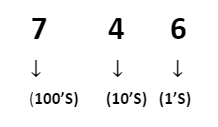
(Seven Hundred and Forty Six)
What is a Place Value Chart?
A place value chart is a table that helps us to find the value of each digit in a number based on its position. To accurately identify the positional values of a number, write the digits first in the place value chart then write the number in its standard form.
Remember, we use 10 digits to represent any number. The 10 digits are:
Introducing Different Types of Place Value Charts
There are two types of place value charts. These are:
Indian Place Value Chart
International Place Value Chart
Let’s briefly discuss both types of place value charts.
An Indian Place Value Chart
In the Indian place value chart, starting from the right:
The first period is Ones, which includes three values namely ones, tens, and hundreds.
The second period is thousands which includes two values namely thousands and ten thousand.
The third period is Lakhs which includes two values namely lakhs and ten lakhs.
The fourth period is Crores which includes two values namely crore, and ten crores.
Look at the table below to understand it better:
Note: In the above Indian Place Value, you can see as we move from Right To Left, each position is 10 times bigger.
Tens are 10 times bigger than Ones.
Hundreds are ten times bigger than Tens, and so on.
Similarly, if we move from Left to Right, each position is 10 times smaller.
Crores is 10 times less than Ten Crores.
Ten Lakhs is 10 times less than 1 Crore, and so on.
How are Numbers Separated by Commas in Indian Place Values Chart?
According to the Indian Place Value System, we use commas after every period.
For example, starting from the right,
We put the first comma after the hundreds place, i.e., after One’s Period.
The next comma we put after two places from the first comma, i.e., after Thousands period, and then after two digits, and so on. `
Example
The number 513657922 according to the Indian Place Value System using commas can be written as: 51, 36,57,922
International Place Value Chart
In the International place value chart, starting from the right,
The first period is Ones, which includes three values namely ones, tens, and hundreds.
The second period is thousands which includes three place values namely thousands, ten thousands, and hundred thousand.
The third period is Millions which includes three values namely Million, Ten Millions, and Hundred Millions, and so on.
Look at the table below to understand it better:
Note: Similarly to the Indian Place Value Chart, here also, you can see as we move from Right To Left, each position is 10 times bigger.
Tens are 10 times bigger than Ones.
Hundreds are ten times bigger than Tens, and so on.
Similarly, if we move from Left to Right, each position is 10 times smaller.
Ten Million is 10 times less than Hundred Millions.
One Million is 10 times less than Ten Million, and so on.
How are Numbers Separated by Commas in International Place Values Chart?
Similar to the Indian Place Value System, here also, we use commas after every period.
For example, starting from the right, the numbers in the International Place Value system are separated by a comma after every three digits.
Example:
The number 962657385 according to the International Place Value System using commas can be written as: 962, 657, 385
Let us understand place value with an example:
Place Value Examples With Solutions
Example 1:
Write the number 652156897 in the Indian Place Value System. Also, write the place value of each digit and put commas wherever required.
Solution:
First, we are placing each digit of the number 652156897 in the Indian Place Value table given below.
Now, we will write the place value of each digit of a number 652156897.
Starting from the right, In 652156897
The place of 7 is 7 × 1 = 7 as 7 is at the one’s or unit’s place.
The place of 9 is 9 × 10 = 90 as 9 is at the ten’s place.
The place of 8 is 8 × 100 = 800 as 8 is at the hundred’s place.
The place of 6 is 6 × 1000 = 6000 as 6 is at the thousand’s place.
The place of 5 is 5 × 10,000 = 50,000 as 5 is at the ten thousand’s place.
The place of 1 is 1 × 1,00,000 = 1,00,000 as 1 is at the lakhs’s place.
The place of 2 is 2 × 10,00,000 = 20,00,000 as 2 is at the ten lakh’s place.
The place of 5 is 5 × 1,00,00,000 = 5, 00,00,000 as 5 is at the crore’s place.
The place of 6 is 6 × 10,00,00,000 = 60,00,00,000 as 6 is at the ten crore’s place.
Therefore, using commas, 652156897 can be written as 65, 21, 56, 897. This number can be written in words as Sixty Five Crores Twenty One Lakhs Five Six Thousand Eight Hundred And Ninety-Seven.
Example 2:
Write the number 273498165 in the International Place Value System. Also, write the place value of each digit and put commas wherever required.
Solution:
First, we are placing each digit of the number 273498165 in the International Place Value table given below.
Now, we will write the place value of each digit of a number 273498165.
Starting from the right, In 273498165
The place of 5 is 5 × 1 = 5 as 5 is at the one’s or unit’s place.
The place of 6 is 6 × 10 = 60 as 6 is at the ten’s place.
The place of 1 is 1 × 100 = 100 as 1 is at the hundred’s place.
The place of 8 is 8× 1000 = 8000 as 8 is at the thousand’s place.
The place of 9 is 9 × 10,000 = 90,000 as 9 is at the ten thousand’s place.
The place of 4 is 1 × 100,000 = 400,000 as 1 is at the Hundred Thousands place.
The place of 3 is 3 × 1,000,000 = 3,000,000 as 3 is at the Million’’s place.
The place of 7 is 7 × 10, 000,000 = 70, 000,000 as 7 is at the ten millions place.
The place of 2 is 2 × 100, 000,000 = 200,000,000 as 2 is at the hundred millions place.
Therefore, using commas, 273498165 can be written as 273, 498,165. This can be read as two hundred and seventy-three million four hundred and ninety-eight thousand one hundred and sixty-five.
Conclusion
In short, a place value of a digit in a number is denoted according to its position in the number. The Indian and International place value charts help us to find the value and compare the place value of digits in number according to the Indian and International numeral systems respectively.
FAQs on Place Value Concepts and Examples for Grade 2
1. What is place value for Grade 2?
Place value is the value of a digit based on its position in a number. In Grade 2 place value, students learn about ones, tens, and sometimes hundreds.
- The rightmost digit shows ones.
- The next digit to the left shows tens.
- The third digit shows hundreds.
- 5 is in the ones place = 5
- 4 is in the tens place = 40
- 3 is in the hundreds place = 300
2. How do you teach place value to Grade 2 students?
Place value is best taught using concrete models, visual aids, and expanded form. Effective ways to teach place value in Grade 2 include:
- Using base ten blocks (ones cubes, tens rods, hundreds flats)
- Drawing place value charts
- Writing numbers in expanded form (e.g., 58 = 50 + 8)
- Grouping objects into sets of ten
3. What is the place value of a digit in a number?
The place value of a digit is the digit multiplied by the value of its position. To find the place value:
- Identify the digit.
- Look at its position (ones, tens, hundreds).
- Multiply the digit by that place value.
4. What is the difference between place value and face value?
The face value of a digit is the digit itself, while the place value depends on its position in the number.
- Face value: The actual digit (e.g., 6 in 64 is 6).
- Place value: The digit multiplied by its place (6 in 64 = 60).
5. How do you write a number in expanded form?
Expanded form shows a number as the sum of its place values. To write a number in expanded form:
- Break the number into hundreds, tens, and ones.
- Write each digit with its place value.
6. Why is place value important in Grade 2 maths?
Place value is important because it helps students understand how numbers are formed and supports addition and subtraction. Understanding place value allows students to:
- Add and subtract two- and three-digit numbers correctly
- Compare and order numbers
- Understand regrouping (carrying and borrowing)
7. How do you find the value of the digit 5 in 352?
The value of the digit 5 in 352 is 50 because it is in the tens place. Step-by-step:
- Number: 352
- Digit: 5
- Place: Tens
- Calculation: 5 × 10 = 50
8. How do you compare numbers using place value?
To compare numbers using place value, compare digits starting from the greatest place (hundreds first). Steps:
- Compare the hundreds digits.
- If equal, compare the tens digits.
- If still equal, compare the ones digits.
- Hundreds: 4 = 4
- Tens: 5 < 7
9. What are ones, tens, and hundreds in place value?
Ones, tens, and hundreds are positions in the base ten number system.
- Ones: Single units (1–9)
- Tens: Groups of 10 ones (10, 20, 30…)
- Hundreds: Groups of 10 tens (100, 200, 300…)
- 1 hundred = 100
- 3 tens = 30
- 4 ones = 4
10. What are common mistakes students make with place value?
Common place value mistakes include confusing digit position and ignoring zero as a placeholder. In Grade 2 place value, students often:
- Read 305 as 35 (ignoring the zero)
- Confuse face value with place value
- Compare numbers from the ones place instead of the hundreds place
