









Is 13 a Prime Number Factors Properties and Examples
What is Thirteen?
The number 13 in Maths represents a value of a quantity that is thirteen in the count. It is a whole number that is greater than 10 and lies between 12 and 14. The number name of 13 is thirteen. Examples of thirteen numbers are given below. In the following figure, there are thirteen buttons and thirteen frogs. You can count them.
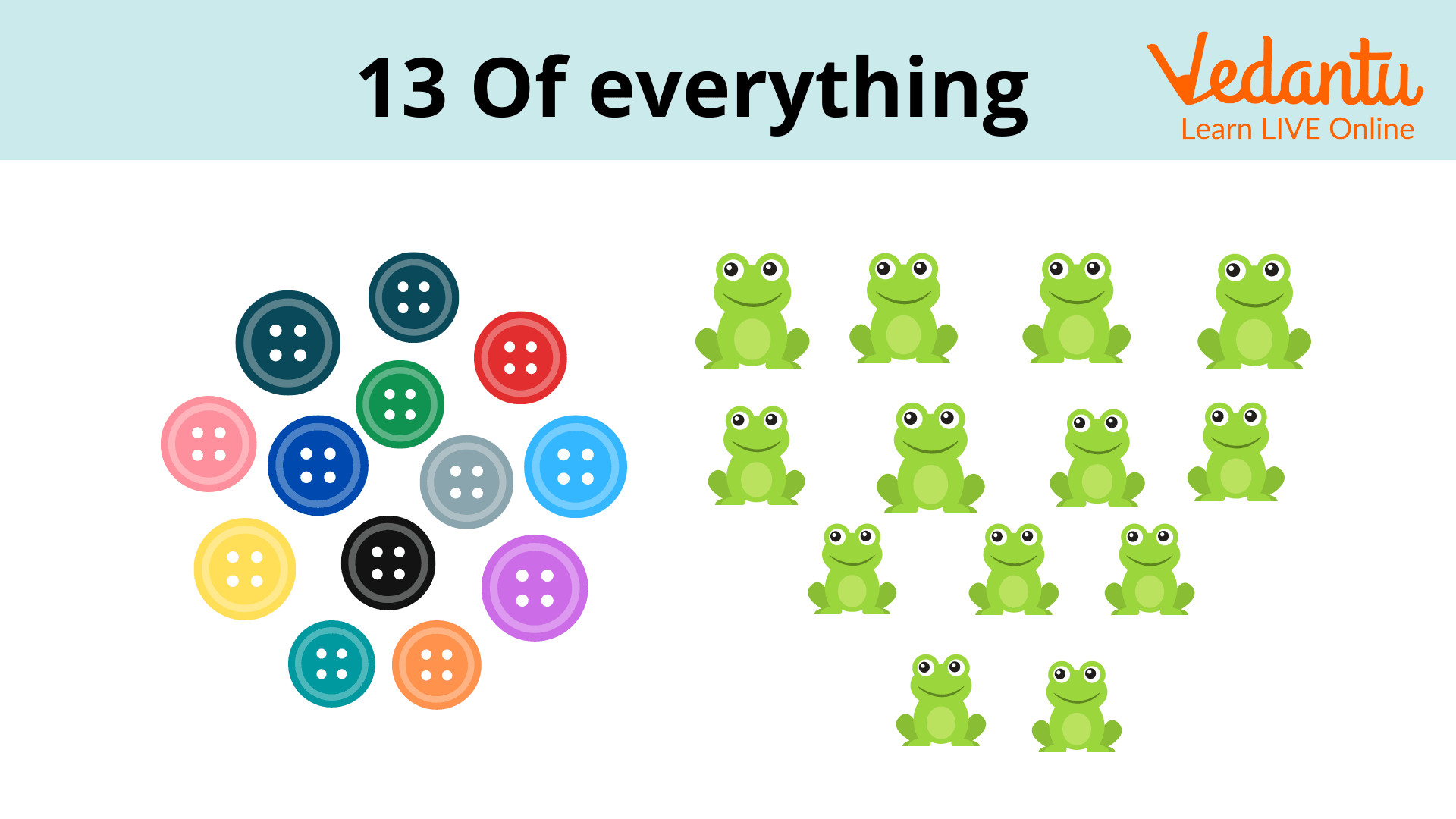
Examples of number thirteen
In this article, you will learn about the number thirteen with fun.
Activities for Kids
Children will learn about the numbers when they will observe the things around them and count them. Parents or teachers can ask their kids to count the things in their surroundings which are thirteen in number. You can write down numbers and ask your child to draw that quantity. You can also ask them to count fingers and toes.
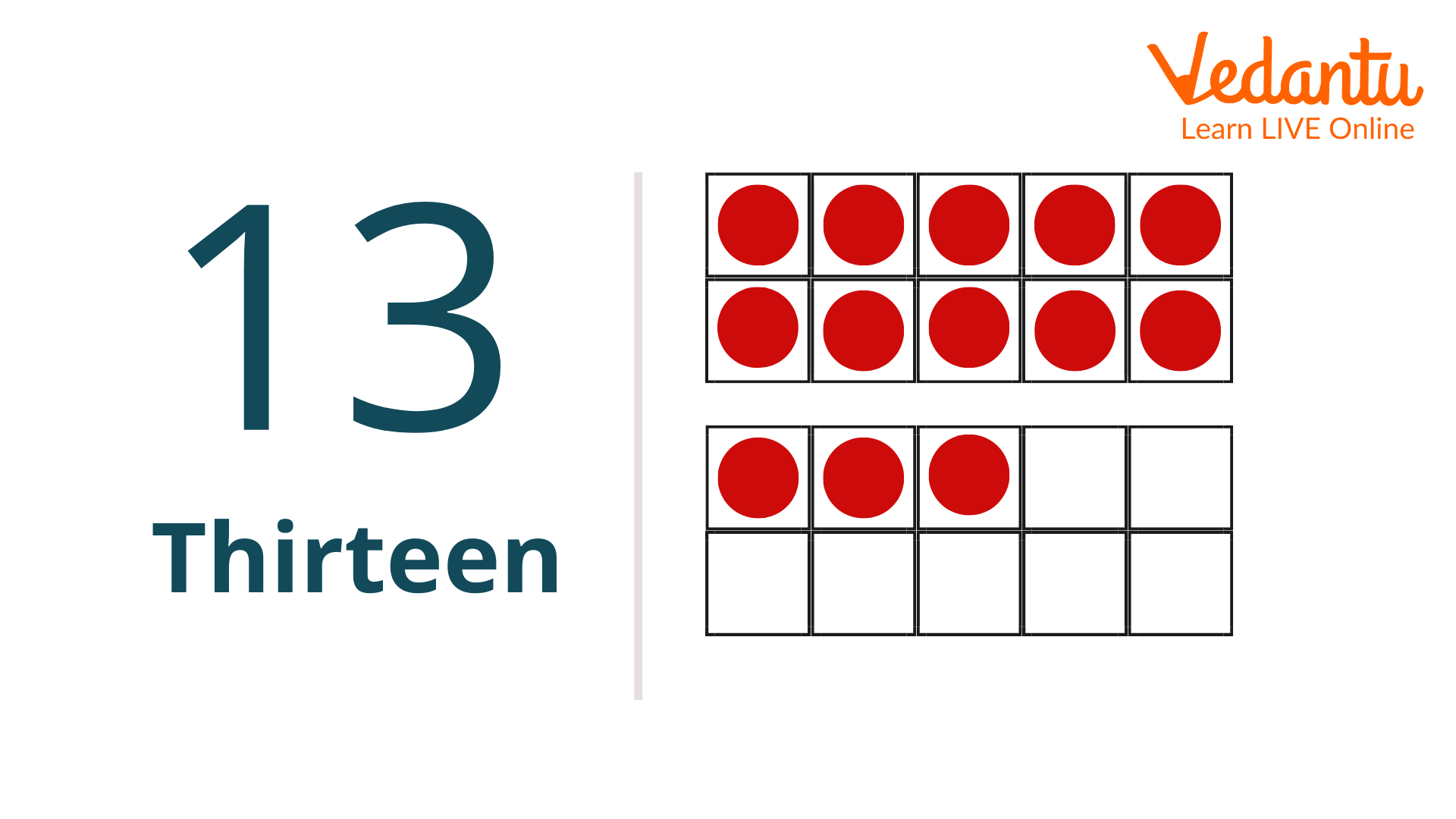
Number 13
Fun Facts About Number Thirteen
13 number is not divisible by number 2. Hence, it is an odd number.
A prime number is a number that can be divided exactly only by itself. Hence, 13 is also a prime number.
A quantity of thirteen is called a baker's dozen or a devil's dozen in a baking batch. It is one more than a standard dozen for the baker to test.
Conclusion
The above article is useful for kids to learn about the number 13 in Maths. Examples of objects that are 13 in the count are provided with figures which will give a visualisation to kids of number thirteen because kids are more prone to learn through figures and images.
FAQs on Understanding the Number 13 in Mathematics
1. What is the number 13 in math?
The number 13 is a natural number that comes after 12 and before 14, and it is an odd prime number in mathematics.
- It belongs to the set of natural numbers and integers.
- It is a prime number because it has exactly two factors: 1 and 13.
- It is also an odd number since it is not divisible by 2.
2. Is 13 a prime number and why?
Yes, 13 is a prime number because it has only two positive factors: 1 and 13.
- A prime number is divisible only by 1 and itself.
- 13 cannot be divided evenly by 2, 3, 4, 5, or any other number except 1 and 13.
- Since it has exactly two distinct factors, it satisfies the definition of a prime number.
3. What are the factors of 13?
The only factors of 13 are 1 and 13.
- A factor is a number that divides another number exactly.
- 13 ÷ 1 = 13
- 13 ÷ 13 = 1
4. Is 13 an odd or even number?
The number 13 is an odd number because it is not divisible by 2.
- Even numbers are divisible by 2 with no remainder.
- 13 ÷ 2 = 6 remainder 1.
- Because there is a remainder, 13 is classified as odd.
5. What is 13 in Roman numerals?
The number 13 in Roman numerals is XIII.
- X represents 10.
- III represents 3.
- So, 10 + 3 = 13.
6. What is the square of 13?
The square of 13 is 169.
- Squaring a number means multiplying it by itself.
- 13 × 13 = 169.
7. What is the cube of 13?
The cube of 13 is 2197.
- Cubing a number means multiplying it by itself three times.
- 13 × 13 × 13 = 2197.
- First, 13² = 169, then 169 × 13 = 2197.
8. What are the multiples of 13?
Multiples of 13 are numbers obtained by multiplying 13 by whole numbers.
- 13 × 1 = 13
- 13 × 2 = 26
- 13 × 3 = 39
- 13 × 4 = 52
- 13 × 5 = 65
9. Is 13 a Fibonacci number?
Yes, 13 is a Fibonacci number because it appears in the Fibonacci sequence.
- The Fibonacci sequence starts: 0, 1, 1, 2, 3, 5, 8, 13, 21…
- Each number is the sum of the two previous numbers.
- 8 + 5 = 13.
10. What is the prime factorization of 13?
The prime factorization of 13 is 13 itself because it is a prime number.
- Prime factorization expresses a number as a product of prime numbers.
- Since 13 has no other prime factors except itself, it cannot be broken down further.
- So, the prime factorization of 13 is simply 13.
