








Minute Hand Movement Speed Angle Formula and Solved Clock Problems
Introduction to Clock
We all look towards whenever we need to tell the time, whether for going to school or for waking up early in the morning, the ability to read clock is an important skill. The understanding of the concept of time is an important part of the development of a child. It only helps kids academically, it helps kids to develop an organised daily routine. The understanding of time management is an important life skill. To learn these skills, it is very important for kids to understand the working of a clock. The article deals with defining the working of a clock. The article defines the function of the minute hand, hour hand, and the second hand of the clock.
What is the Clock?
Before understanding how to tell time using a clock, we must understand what a clock is. A clock is a mechanical device that gives information about the time at any given moment of the day or night. The origins of the clock are intriguing to learn about. The analogue watches that we use today evolved from sand dial prototypes. It's fascinating to note that people used to analyse shadows to determine time. The clock is, without a doubt, a valuable invention.
The most commonly used watch today is the analogue watch. The analogue watches are used to teach kids about the minute hand and hour hand of a clock. It contains three hands or pointers that, depending on their position at different times of the day, tell the time.
Parts of the Clock
The minute hand and hour hand are the most important parts of the clock. The minute hand is the comparatively long pointer that is used to tell the minutes in the watch. The short arrow or hand is known as the hour hand. Based on the movement of the hour hand, the time is calculated. The longest hand in the watch is known as the second hand. It is responsible for giving the seconds of the time. The image shown below describes the minute hand and other hands of the watch.
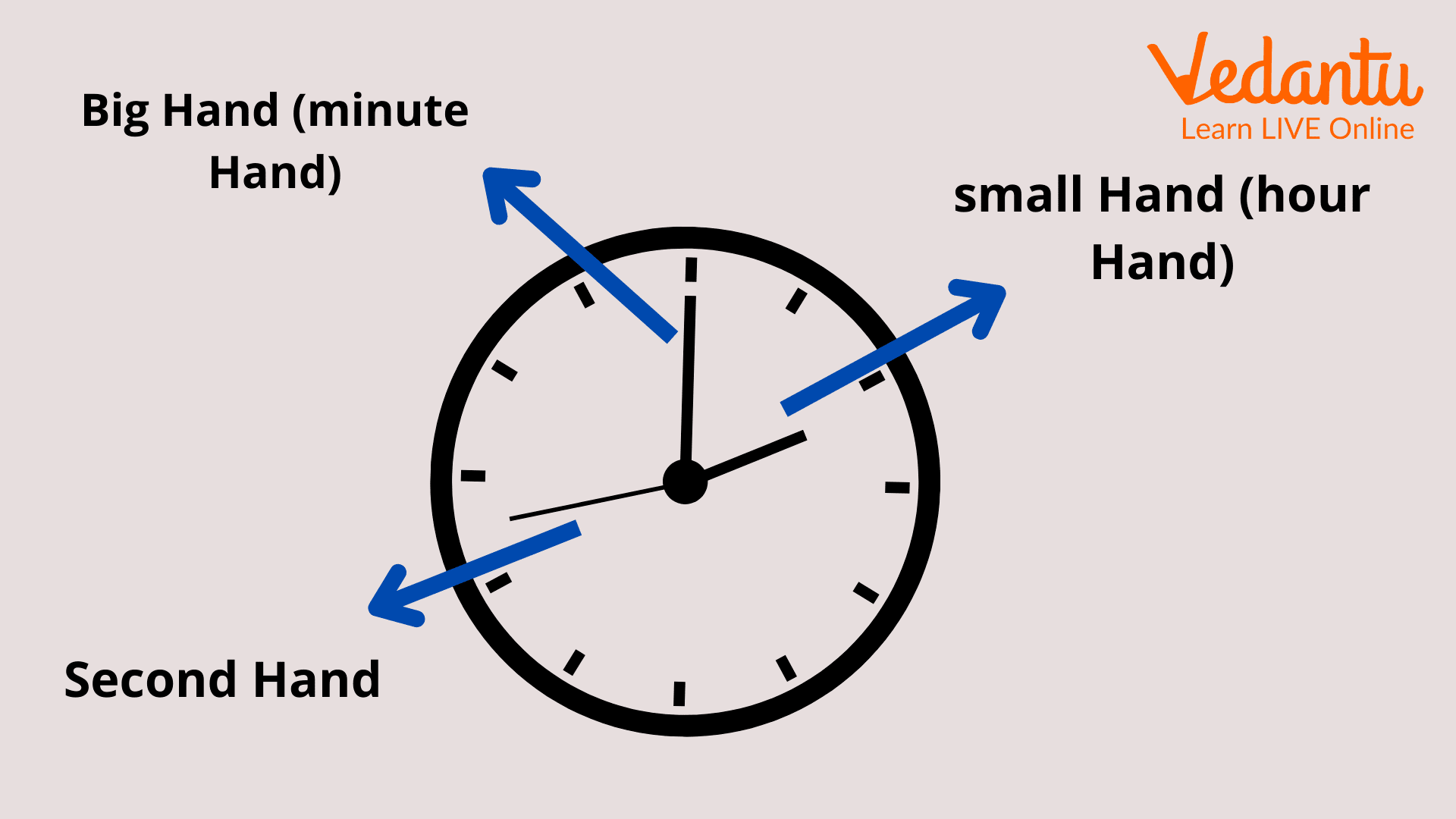
Minute Hand
How to Read an Analogue Watch?
Starting at the top, the clock features 12 digits. To the right of the number 12, we can see 1. If one follows the numbers from right to left, they will progress from 1 to 12.
The minute section is represented by the minute hand by the space between two consecutive digits, such as 1, 2, and 3. The gap between the two consecutive numbers represents the interval of 5 minutes. These segments can be regarded Mathematically as a multiple of five. As a result, 1 denotes five minutes (1 5= 5) and 2 denotes 10 minutes (25 = 10) and so on.
The shorter arrow, the hour hand, points at the number. The number at which it points is considered as the hour at that moment. It can be better understood by the following image.
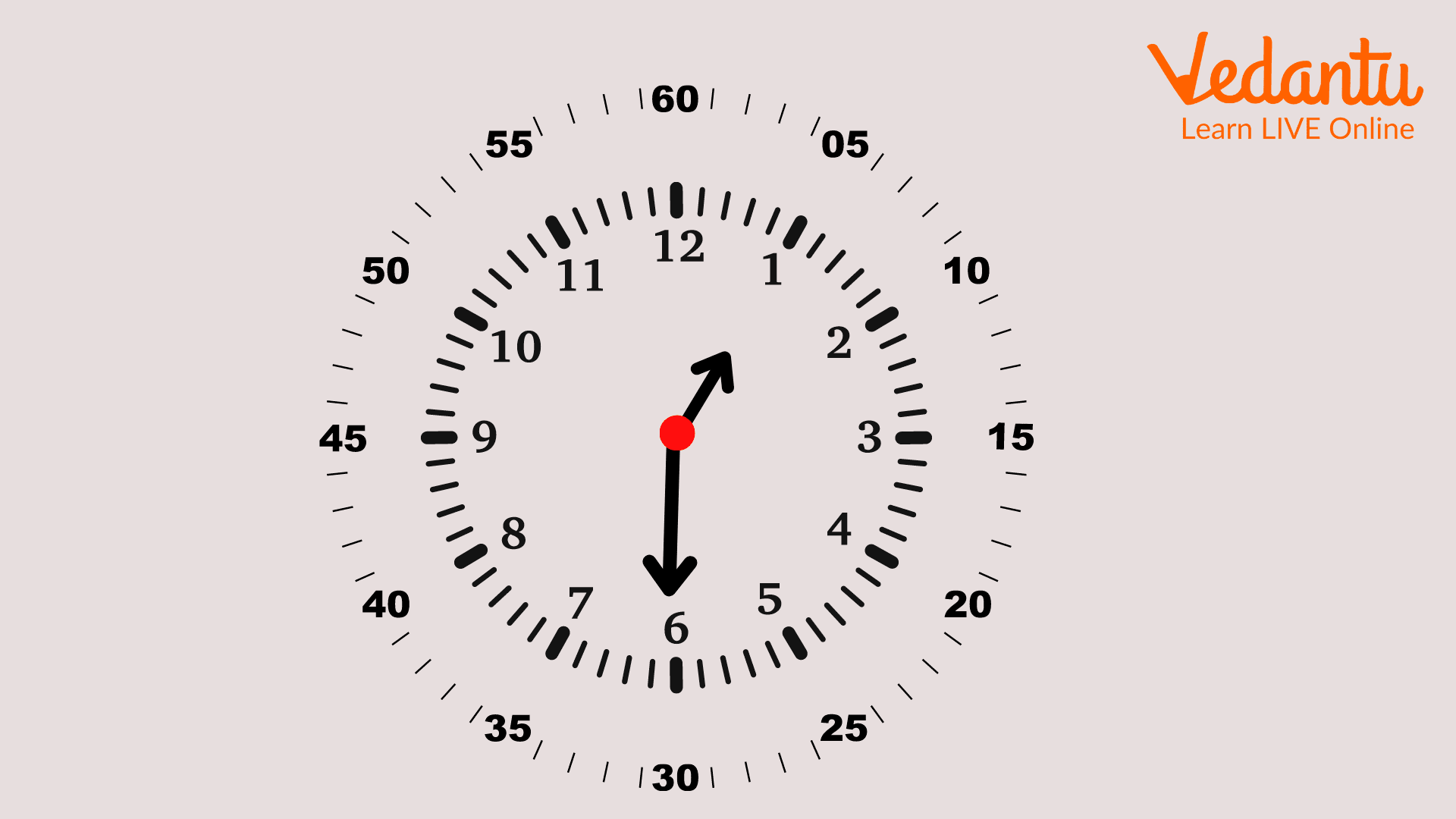
Clock
In the above-mentioned image, the short hour hand points at 1 whereas the longer minute hand points at 6. The product of 6 5 is 30. Thus, the minute represented here is 30 mins. The time represented in the clock is 1:30. The time shown in the image can also be said as half-past one.
The Use of AM and PM
AM and PM are used to classify the time. The complete form of a.m is ante meridiem, and the extended version of p.m is post meridiem. The hour before noon is referred to as a.m. The period from 12:00 a.m. to 11:59 a.m. is known as a.m. P.M. refers to the time between the middle of the day to midnight. The period from 12:00 p.m. to 11:59 p.m. is known as p.m.
This was the complete discussion on the clock. We have learnt about the hour, second, and minute hands of the clock. We have learnt how to read time in an analogue watch. We hope this discussion would help kids to understand how to read the time.
FAQs on Minute Hand Clock in Maths Concept and Angle Calculation
1. What is the minute hand on a clock?
The minute hand is the longer hand on an analog clock that shows the number of minutes past the hour. It completes one full rotation in 60 minutes.
- Each number on the clock represents 5 minutes.
- One full circle = 60 minutes.
- It works together with the hour hand to show exact time.
2. How many degrees does the minute hand move in one minute?
The minute hand moves 6° per minute. Since a full circle is 360° and the minute hand completes it in 60 minutes:
- Degree movement per minute = 360° ÷ 60
- = 6°
3. What is the formula for the angle moved by the minute hand?
The formula for the angle moved by the minute hand is Angle = 6 × Minutes.
- Each minute = 6°
- After 15 minutes: 6 × 15 = 90°
- After 30 minutes: 6 × 30 = 180°
4. How long does the minute hand take to complete one full rotation?
The minute hand takes 60 minutes to complete one full rotation.
- One full rotation = 360°
- 1 hour = 60 minutes
- After every hour, it returns to the 12 position
5. How do you find the angle between the minute hand and hour hand?
The angle between clock hands is found using |30H − 5.5M|, where H = hour and M = minutes.
- Hour hand moves 30° per hour.
- Minute hand moves 6° per minute.
- Relative speed = 5.5° per minute.
6. Why does the minute hand move faster than the hour hand?
The minute hand moves faster because it completes a full circle in 1 hour, while the hour hand takes 12 hours.
- Minute hand speed = 6° per minute
- Hour hand speed = 0.5° per minute
- The minute hand is 12 times faster
7. How many times do the minute and hour hands overlap in 12 hours?
The minute and hour hands overlap 11 times in 12 hours. They meet approximately every 65 5/11 minutes.
- Relative speed = 5.5° per minute
- Time to gain 360° = 360 ÷ 5.5
- = 65 5/11 minutes
8. What angle does the minute hand make at 15 minutes?
At 15 minutes, the minute hand makes an angle of 90° from 12.
- Angle = 6 × 15
- = 90°
- This corresponds to the 3 on the clock
9. How do you calculate the position of the minute hand at any time?
The position of the minute hand is calculated using 6 × Minutes degrees from 12.
- At 10 minutes: 6 × 10 = 60°
- At 45 minutes: 6 × 45 = 270°
- Always measure clockwise from 12
10. What are common mistakes when solving minute hand clock problems?
The most common mistake is ignoring that the hour hand also moves continuously.
- Students forget hour hand moves 0.5° per minute
- Using 30H instead of 30H + 0.5M
- Not taking absolute value of the angle
