









What Is a Kilometre Definition Formula and Conversion in Maths
Introduction to Kilometre for Kids
Everyone loves taking long walks or bicycling around a park. But have you ever wondered how the distance that we travel during these walks or bicycling is measured? How can we measure the distance between our home and school? We measure the distance in kilometres. But now we often hear or read on maps that the turn is 10 metres away or the destination metres. What does it mean? Well, the metre is also a term used to quantify the distance.
In this article, we will learn about the metre and kilometre definitions in Maths and their conversion.
What is the Metric System?
A Metric system is an international system that deals with the use of metric units. These units are used to measure height, weight, distance, or length. The metric system also has units like kilometres and metres that are used to measure the length or the distance of the object. Another example of a metric unit is kilograms, this is used to quantify the mass of a body. Grams is a smaller metric unit that is also used to quantify the mass of an object. The image illustrated below represents the different units that are used to measure length.
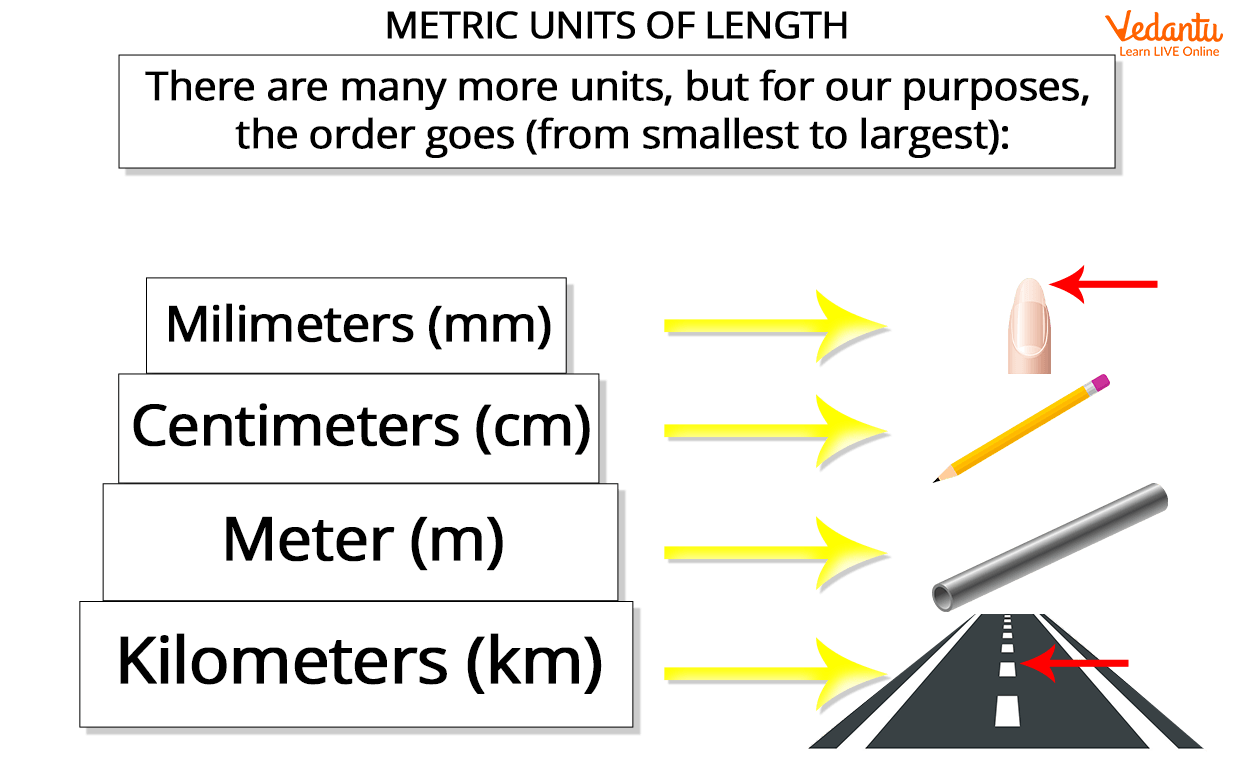
Metric units used to measure the length
What is a Kilometre?
Since we have learnt about the metric system, we can now discuss the kilometre definition in Maths. A kilometre is a SI unit that is used to measure distance. The term is abbreviated as km. The prefix kilo is derived from Greek which refers to a thousand. This interesting fact can help kids in understanding the conversion of metric units. Let us look into some examples where kilometres can be used.
The distance between the school and my home is 2 km.
The distance between Delhi and Bangalore is 2147 km.
I go for a 3 km walk every morning.
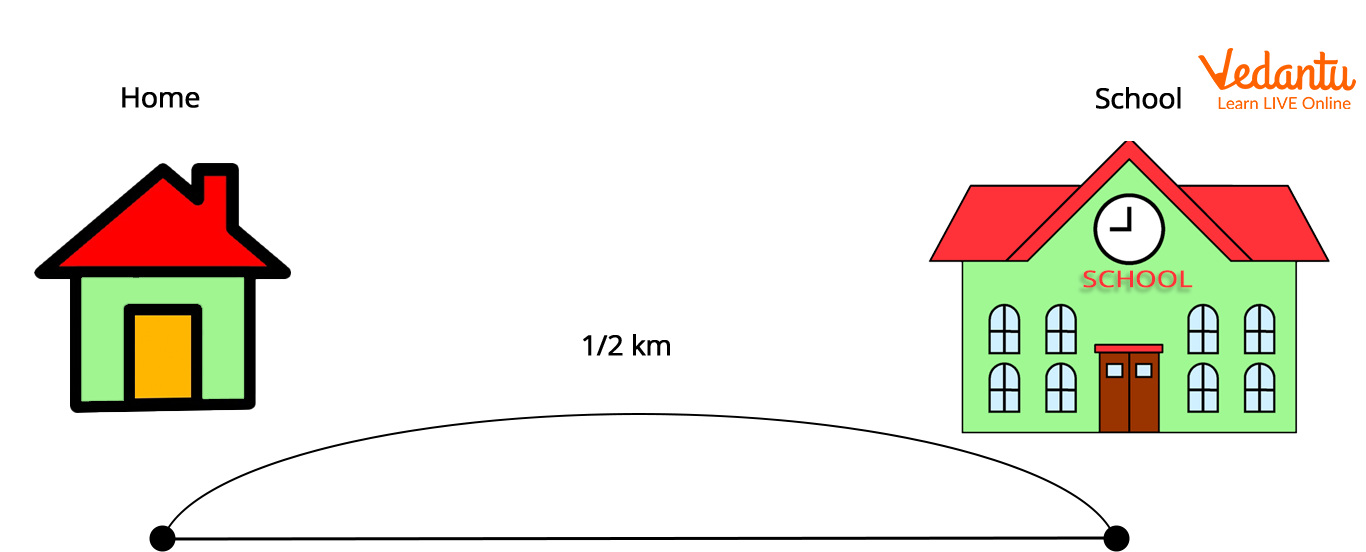
Distance from home to school
What is a Metre?
A metre is defined as the metric unit that is used to measure smaller distances and lengths. It is abbreviated as (m). The term metre is commonly used to measure lengths that are smaller than 1000 metres. For example, the term is used to measure the length of the table or the length of a Christmas tree. The term is also used to quantify small distances, for instance:
The turn is 10 metres away.
There is a basketball court 60 m from the school playground.
Relation Between Metres and Kilometres
As we have learnt the kilometre definition in Maths and the metre definition as well, let us look into the relationship between them. As km and m are metric units, they can be converted into each other. 1 kilometre is equal to 1000 metres. That means we can express the values of a given distance in both units. The following examples can help students understand the conversion.
Example 1
If a car travels 20 km to reach points A to B, what is the distance travelled by car in metres?
Solution: Since 1 km is equal to 1000 m, to convert the 20 km, we need to multiply 20 by 1000.
20 x1000 = 20000 metres.
Example 2
What is the distance in kilometres if the distance travelled is 3 metre?
Solution: The distance travelled is 3 m.
1 km = 1000 m
1 m = 11000 km
31000=0.003 km
The distance travelled is 0.003 km.
Conclusion
This was the complete discussion on the kilometre and metre. We have learnt the kilometre definition in Maths as well as its relation with metres. We have also learnt how to convert the length into metres and kilometres. Students can practise more questions to develop a better understanding of the concept.
FAQs on Kilometre in Math Meaning and Measurement Explained
1. What is a kilometre in math?
A kilometre (km) is a unit of length in the metric system equal to 1,000 metres. It is commonly used in mathematics and measurement to express long distances such as roads, travel distances, and geographical lengths. In the International System of Units (SI), the kilometre is derived from the metre, where:
- 1 km = 1000 m
- It is used to measure large distances
- Symbol: km
2. How many metres are in 1 kilometre?
There are 1,000 metres in 1 kilometre. This conversion is based on the metric system where the prefix “kilo-” means 1,000. The relationship is:
- 1 km = 1000 m
- To convert km to metres, multiply by 1000
- Example: 3 km = 3 × 1000 = 3000 m
3. How do you convert kilometres to metres?
To convert kilometres to metres, multiply the number of kilometres by 1000. The conversion formula is:
- Metres = Kilometres × 1000
- 5 km = 5 × 1000 = 5000 m
4. How do you convert metres to kilometres?
To convert metres to kilometres, divide the number of metres by 1000. The formula is:
- Kilometres = Metres ÷ 1000
- 4500 m = 4500 ÷ 1000 = 4.5 km
5. What is the formula for converting kilometres to miles?
The formula to convert kilometres to miles is Miles = Kilometres × 0.621371. This conversion is used when switching from the metric system to the imperial system. Example:
- 10 km = 10 × 0.621371 = 6.21371 miles
6. What is the difference between a kilometre and a metre?
The main difference is that 1 kilometre equals 1000 metres. A metre is the base unit of length in the metric system, while a kilometre is used for measuring longer distances. Key differences:
- 1 km = 1000 m
- Metre measures shorter lengths (room size, height)
- Kilometre measures longer distances (roads, cities)
7. Why is a kilometre used to measure long distances?
A kilometre is used to measure long distances because it represents 1,000 metres, making large measurements easier to express. Instead of writing 5,000 metres, we write 5 km. It simplifies calculations in:
- Geography
- Travel and transportation
- Speed calculations (km/h)
8. Can you give an example of a kilometre in a math problem?
A typical example is calculating total distance when distances are given in kilometres. Example problem:
- A car travels 12 km in the morning and 8 km in the evening.
- Total distance = 12 + 8 = 20 km
9. What does km stand for in mathematics?
The symbol km stands for kilometre, a metric unit of length equal to 1,000 metres. It combines:
- kilo- meaning 1000
- metre as the base unit of length
10. How is kilometre used in speed calculations?
A kilometre is used in speed calculations such as kilometres per hour (km/h), which measures distance travelled per hour. The speed formula is:
- Speed = Distance ÷ Time
- If a car travels 60 km in 2 hours, speed = 60 ÷ 2 = 30 km/h
