









What is a Fraction Bar and How to Use It in Fractions
Are you excited to know how fractions are represented?
What role does a fraction bar play in a fraction?
Yes!
Here, we will discuss what fraction bar means and its different uses. But, before knowing about the fraction bar, let’s know what fractions are.
What Are Fractions?
A fraction is a number that represents the equal parts of a whole number. Let’s understand with an example:
Suppose you have one whole watermelon and if you cut it into two equal parts, it will be represented as 1/2.
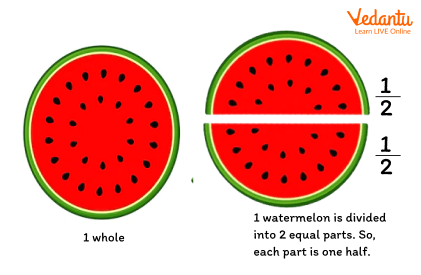
Fractions
But, if you cut one whole watermelon into 4 equal parts, it will be represented as 1/4.
Parts of a Fraction
A fraction has two main parts known as numerator and denominator. The number written on the top of a line is called a numerator. On the other hand, the number written below the line is called a denominator.
(Image will be uploaded soon)
Meaning of Numerator and Denominator
The numerator means the total number of equal parts you have.
Contrarily, the term denominator means the total number of parts in a whole.
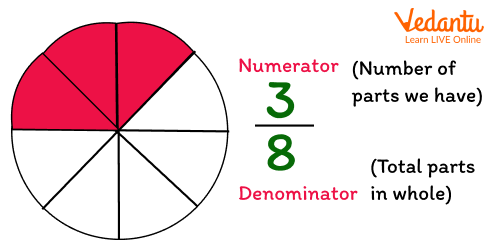
Numerator and Denominator
Now, let's know what a fraction bar means in a fraction.
What Does Fraction Bar Mean?
Fraction bar is nothing but a line that separates both numerator and denominator in a fraction.
Fraction bars are also known as “ Vinculum” in some countries.
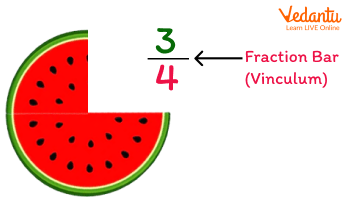
Fraction Bar
What Are Fraction Bar Models?
Fraction bars, also known as strips, are types of bar models. A fraction bar model is nothing but a drawing of a fraction using a rectangle. Below, you can see the fraction bar model for one whole, one half, one third, one fourth, one fifth, one sixth, one seventh, and one eight.
Fraction Bar Models
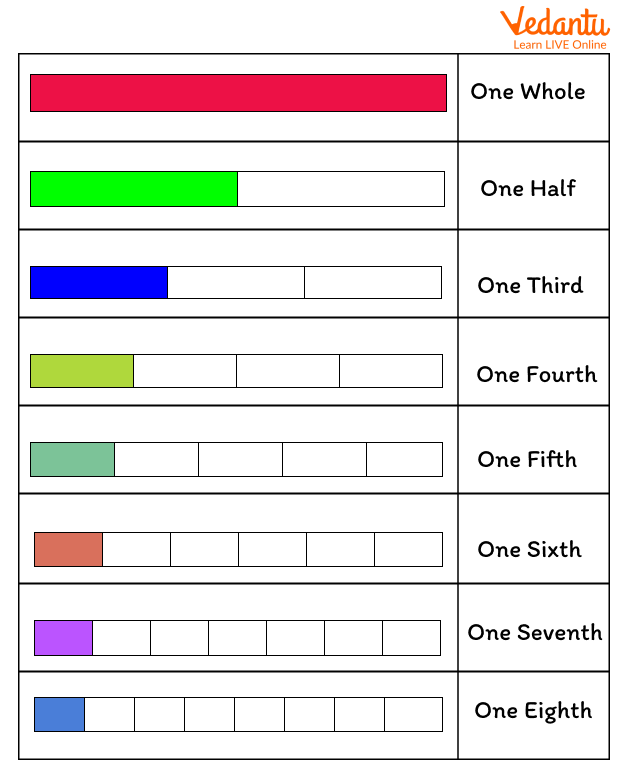
Fraction Bar Models
Fraction Bar Represents Division
Do you know the fraction bar indicates “division” in fraction.
Let’s see how!
Fraction bar is also represented as 1/12 or 1/2. The meaning of fraction bar is the same regardless of its representation. It separates both numerator and denominator in a division. Also, the fraction bar represents division in a fraction. In division, the fraction bar acts as a division symbol where the numerator is the dividend and denominator is the divisor.
Fraction Bar Represents Equality
Fraction bars are used to represent equality. Let’s learn how.
Two fraction bars with the same shaded amount represent two equal fractions. Look at the fraction bar below to understand it in a better way.
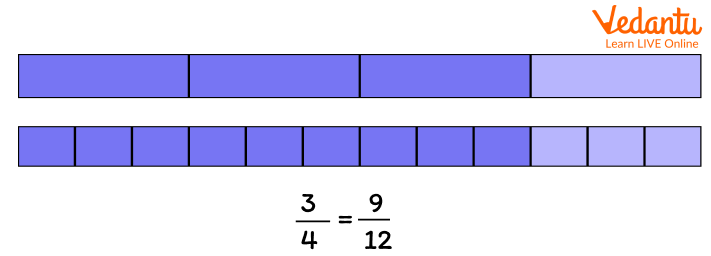
Fraction Bar Represents Equality
Fraction Bar Represents Inequality
Fraction bar also represents inequality. Let’s learn how.
If two fraction bars have different shaded amounts, the bar with the greater amount of shading is termed as greater fraction. Look at the fraction bar below to understand it in a better way.
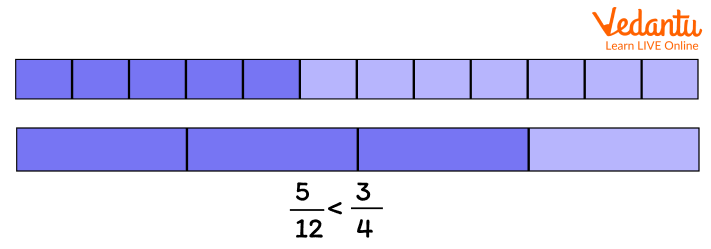
Fraction Bar Represents Inequality
Fraction Bar with Common Denominators
Two fraction bars with different numbers of parts have different denominators in their fraction. For example, the fraction bars of 1/2 and 1/3 have different numbers of parts and different denominators.
If we replace the fraction bars of 1/2 and 1/3 by fraction bars having the same or common number of parts, namely a 3/6 fraction bar and 2/6 fraction bar respectively, we will get a new denominator 6 as a common denominator for 1/2 and 1/3. Look at the fraction bars below to understand it in a better way.
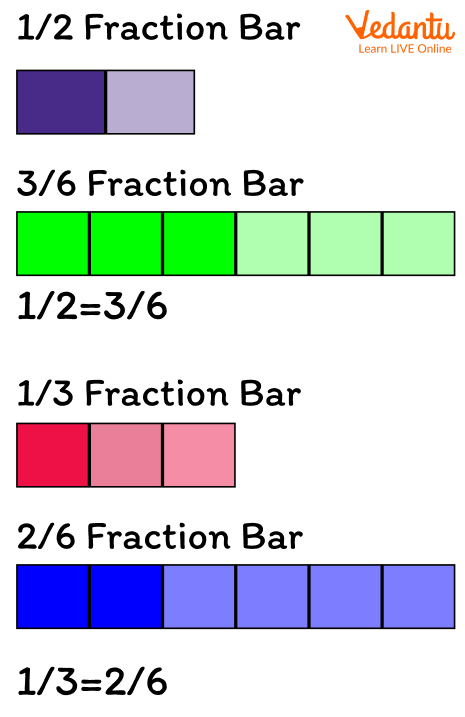
Fraction Bar with Common Denominators
Here, the new denominator ‘6’ is a common denominator for the fractions 1/2 and 1/3.
Fraction Bar Acts as a Grouping Symbol
Fraction bar also acts as a grouping symbol. The expression written above and below the fraction bar should be treated as if they are placed in parenthesis. For example, the expression $\frac{7+3}{5-3}$ means ( 7 + 3) (5 - 3). This order of operation tells us to simplify the numerator first, then the denominator, and then fraction. Let’s simplify it!
Step 1: Simplifying the numerator:
$\frac{7+3}{5-3}$ = $\frac{10}{5-3}$
Step 2: Simplifying the denominator:
$\frac{7+3}{5-3}$ = $\frac{10}{2}$
Step 3: Simplifying the fraction:
$\frac{10}{2}$ = 5
Did You Know?
The Arabs were the first to introduce the horizontal fraction bar. They first copied the Hindu notation but later on improved it by placing a horizontal bar between two numbers.
The diagonal fraction bar is also termed as solidus or virgule.
The horizontal line in a fraction is not termed a fraction bar if the numbers written on the top and bottom of the fraction bar are not integers. For example, \[ \frac{2.5}{4} \] → Not a Fraction Bar
FAQs on Understanding the Fraction Bar in Mathematics
1. What is a fraction bar in math?
A fraction bar is the horizontal line that separates the numerator and denominator in a fraction and represents division. In a fraction like 3/4, the number 3 (numerator) is above the fraction bar and the number 4 (denominator) is below it. The fraction bar means that 3 is divided by 4. It is also called the division bar in arithmetic.
2. What does the fraction bar mean?
The fraction bar means division. For example, in the fraction 8/2, the fraction bar tells us to divide 8 by 2, which equals 4. This shows that every fraction can also be written as a division expression. The fraction bar connects the numerator and denominator as one mathematical operation.
3. How do you read a fraction with a fraction bar?
A fraction with a fraction bar is read as the numerator followed by the denominator in ordinal form. For example:
- 1/2 is read as “one-half”
- 3/5 is read as “three-fifths”
- 7/10 is read as “seven-tenths”
The top number (numerator) tells how many parts are taken, and the bottom number (denominator) tells how many equal parts make a whole.
4. How is a fraction bar different from a division symbol?
A fraction bar and a division symbol both represent division, but they are written differently. The fraction bar appears between two numbers written vertically (e.g., 6/3), while the division symbol is written as 6 ÷ 3. Both expressions mean the same thing and give the same result, which is 2.
5. How do you use a fraction bar to divide numbers?
To use a fraction bar for division, write the dividend as the numerator and the divisor as the denominator. For example:
- Write 15 divided by 5 as 15/5
- Divide: 15 ÷ 5 = 3
So, the fraction 15/5 equals 3. The fraction bar directly shows the division operation.
6. What happens if there is a fraction inside another fraction bar?
A fraction inside another fraction is called a complex fraction, and it means you divide one fraction by another. For example:
- (1/2) / (3/4)
- Rewrite as division: (1/2) ÷ (3/4)
- Multiply by reciprocal: (1/2) × (4/3) = 4/6
- Simplify: 2/3
The fraction bar still represents division, even in complex fractions.
7. Can a fraction bar act like grouping symbols?
Yes, a fraction bar acts like a grouping symbol because it groups the entire numerator and denominator. For example, in (2 + 3)/4, you must first add 2 + 3 = 5, then divide by 4 to get 5/4. The fraction bar ensures that everything above it is divided by everything below it.
8. How do you simplify a fraction using the fraction bar?
To simplify a fraction, divide both the numerator and denominator by their greatest common factor (GCF). For example:
- Given fraction: 12/18
- GCF of 12 and 18 is 6
- Divide both by 6: 12 ÷ 6 = 2 and 18 ÷ 6 = 3
The simplified fraction is 2/3. The fraction bar keeps the division relationship intact.
9. What is the difference between numerator and denominator in a fraction bar?
The numerator is the number above the fraction bar, and the denominator is the number below it. In 5/8:
- 5 is the numerator (parts taken)
- 8 is the denominator (total equal parts)
The fraction bar separates these two values and shows that 5 is divided by 8.
10. Why is the fraction bar important in algebra?
The fraction bar is important in algebra because it represents division and groups algebraic expressions. For example:
- (x + 2)/3 means the entire expression (x + 2) is divided by 3
- You must simplify the numerator first if possible
The fraction bar helps solve algebraic fractions, rational expressions, and equations accurately by clearly showing the division structure.
