









How to Add Hours Minutes and Seconds with Carry Over Method and Examples
The addition of time is similar to the addition of numbers, but here, we need to consider the conversion for the addition of time. One unit of time is made up of 60 subunits and is different from the other mathematical conversion units. Here, we will learn how to convert them according to the given problem. For instance, we need to apply this notion of the addition of time to determine the total amount of time spent travelling across various forms of transportation. In this article, we will learn how to add time accurately by using the step-by-step procedure. With the help of some examples, you will learn about conversion and the addition of time.
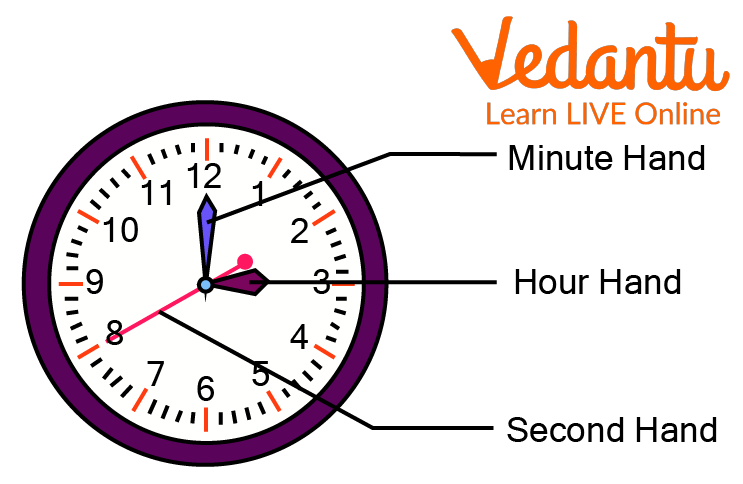
A Clock showing Minutes, Hours, and Second hand
Time Definition
Time can be defined as the sequence of events that takes place in the present, past, and future, and it is measured using seconds, minutes, hours, days, weeks, months, and years.
A period of time equal to $\dfrac{1}{24}$ of a day is called an hour.
The S.I. unit of time is a second, and a collection of 60 seconds equals 1 minute.
A collection of 60 minutes is equal to 1 hour.
Units of Time
The basic units of time are as follows:
1 day = 24 hours
1 hour = 60 minutes
1 minute = 60 seconds
Adding Hours, Minutes, and Seconds
By following the simple steps provided below, we can add hours, minutes, and seconds.
Add the hours.
Now, minutes addition takes place and if the number of minutes is 60 or more, then do the following:
Subtract 60 from the number of minutes.
Increase the number of hours by one.
If the number of minutes is still 60 or more, repeat the same process.
After completion of the minute addition, follow the steps to perform the second's addition.
When the number of seconds is 60 or more, then do the following:
Subtract 60 from the number of seconds.
Increase the number of minutes by one.
If the number of seconds is still 60 or more, repeat the same process.
Below is an example to understand the above process more clearly.
Add 3 hours 45 minutes 30 seconds and 2 hours 20 minutes 24 seconds.
Step 1: On adding hours together, we get 3 + 2 = 5 hours.
Step 2: Doing minutes addition, we get 45 + 20 = 65 minutes. Since the number of minutes is more than 60, subtract 60 minutes from that, i.e., 65 - 60 = 5 minutes, and increase the number of hours by 1, i.e., 5 + 1 = 6 hours.
Step 3: On adding seconds together, we get 30 + 24 = 54 seconds. So, the number of seconds is less than 60.
Therefore, the result will be 6 hours 5 minutes 54 seconds.
Solved Examples
1. Compute the addition of time.
(a) 2 hours 25 minutes and 1 hour 15 minutes.
Solution: Adding hours and minutes is done by following the given steps:
Step 1: Add the hours together, we get 2 + 1 = 3 hours
Step 2: Performing minute addition, we get 25 + 15 = 40 minutes
Therefore, the result of the addition will be 3 hours 40 minutes.
(b) 3 hours 35 minutes 50 seconds and 2 hours 40 minutes 34 seconds.
Solution: Adding hours, minutes, and seconds by following the given steps:
Step 1: On adding hours together, we get 3 + 2 = 5 hours
Step 2: Doing minutes addition, we get 35 + 40 = 75 minutes. Since the number of minutes is more than 60, subtract 60 minutes from that, i.e., 15 minutes, and increase the number of hours by 1, i.e., 5 + 1 = 6 hours.
Step 3: On adding seconds together, we get 50 + 34 = 84 seconds. As the number of seconds is more than 60, subtract 60 seconds from that, i.e., 24 seconds, and increase the number of minutes by 1, i.e., 15 + 1 = 16 minutes.
Therefore, the result will be 6 hours 16 minutes 24 seconds.
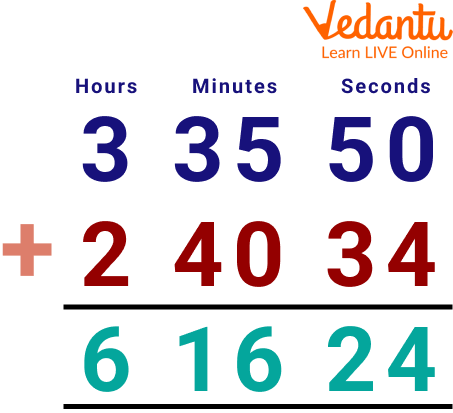
Adding Hours and Minutes along with Seconds
2. Ruth started his homework at 6:30 P.M and completed it at 8 P.M. How many hours and minutes were spent by Ruth to complete her homework?
Solution: We need to subtract 6:30 from 8:00. As we know, 8 hours = 7 hours and 60 minutes. Therefore, (7 hours 60 minutes - 6 hours 30 minutes) equals 1 hour and 30 minutes. Therefore, Ruth spends 1 hour and 30 minutes completing his homework.
Practice Questions
1. Compute the addition of time 2 hrs 30 min 5 sec and 1 hr 20 min 3 sec.
Ans: 3 hrs 50 mins 8 sec
2. Add 3 hrs 45 min 3 sec and 2 hrs 50 min 4 sec.
Ans: 6 hrs 35 mins 7 sec
3. Anna plans to visit a zoological park. She takes a cab at 3.45 P.M. It takes about 1 hour and 5 minutes to reach her destination. At what time does Anna reach the zoological park?
Ans: 4:50 P.M.
Summary
In this article, we have learned about time, along with the ways to perform the addition of time. Due to the availability of time addition calculators, children have now become dependent on time addition calculators for calculating time. But by reading this article, they will learn to add the time without using a time addition calculator. We also talked about the units of time and the procedure of adding hours and minutes together. Also, we solved a few examples related to time which helped us to understand the topic better.
FAQs on Addition of Hours Minutes and Seconds in Time Calculations
1. What is the rule for addition of hours, minutes, and seconds?
The rule for addition of hours, minutes, and seconds is to add each unit separately and then convert whenever the sum reaches 60 seconds = 1 minute or 60 minutes = 1 hour.
Follow these steps:
- Add the seconds first.
- If seconds ≥ 60, convert excess into minutes.
- Add the minutes including any carry.
- If minutes ≥ 60, convert excess into hours.
- Add the hours including any carry.
2. How do you add hours, minutes, and seconds step by step?
To add hours, minutes, and seconds, align each unit and add from right to left, carrying over when needed.
Example: Add 2 h 45 m 50 s and 3 h 20 m 30 s.
- Seconds: 50 + 30 = 80 s → 1 m 20 s
- Minutes: 45 + 20 + 1 = 66 m → 1 h 6 m
- Hours: 2 + 3 + 1 = 6 h
3. Why do we carry over after 60 seconds or 60 minutes?
We carry over after 60 because the time system is based on 60 seconds = 1 minute and 60 minutes = 1 hour.
This is called the sexagesimal system, which uses base 60 instead of base 10. Whenever seconds or minutes reach 60 or more, they must be converted to the next higher unit to maintain correct time format.
4. What is the formula for adding time in hours, minutes, and seconds?
There is no single algebraic formula, but the standard method is unit-wise addition with conversion using 60 seconds = 1 minute and 60 minutes = 1 hour.
General structure:
- Total Seconds = Sum of seconds
- Convert excess seconds ÷ 60 into minutes
- Total Minutes = Sum of minutes + carried minutes
- Convert excess minutes ÷ 60 into hours
- Total Hours = Sum of hours + carried hours
5. Can you give an example of addition of time?
Yes, here is a simple example of time addition.
Add 1 h 35 m 40 s and 2 h 40 m 35 s:
- Seconds: 40 + 35 = 75 s → 1 m 15 s
- Minutes: 35 + 40 + 1 = 76 m → 1 h 16 m
- Hours: 1 + 2 + 1 = 4 h
6. How do you add time when minutes exceed 60?
When minutes exceed 60, divide by 60 and carry the quotient to hours.
Example: 50 m + 30 m = 80 minutes.
- 80 ÷ 60 = 1 hour and 20 minutes
- Write 20 m and carry 1 h
7. What are common mistakes in addition of hours, minutes, and seconds?
The most common mistake is forgetting to convert when seconds or minutes exceed 60.
Other common errors include:
- Not aligning hours, minutes, and seconds correctly
- Forgetting to add the carried value
- Treating time as a base-10 system instead of base-60
8. How do you add time with carryover?
To add time with carryover, add smaller units first and transfer excess to the next higher unit.
Steps:
- Add seconds and carry extra minutes.
- Add minutes including carry and convert extra hours.
- Add hours including carry.
9. How is addition of time used in real life?
Addition of hours, minutes, and seconds is used to calculate total duration in daily life.
Common applications include:
- Finding total travel time
- Calculating working hours
- Determining total game or event duration
- Adding lap times in sports
10. How do you add time in 24-hour format?
To add time in 24-hour format, follow the same unit-wise addition rules and keep hours within 0–23 if needed.
Example: 18:45:30 + 02:20:40
- Seconds: 30 + 40 = 70 s → 1 m 10 s
- Minutes: 45 + 20 + 1 = 66 m → 1 h 6 m
- Hours: 18 + 2 + 1 = 21 h
