









How to Solve 4 Digit Subtraction Without Borrowing Step by Step with Examples
Introduction to 4-digit Subtraction
In mathematics, subtraction is a mathematical operator which is used for calculating the difference between two numbers. 4-digit subtraction refers to the subtraction of numbers in which the minuend is of 4 digits and the subtrahend is either of 1, 2, or 3 digits. In 4-digit subtraction, we subtract the numbers one by one according to their place values, that is, ones, tens, hundreds, and thousands. Here we will discuss 4-digit subtraction without borrowing and solved examples on subtraction without regrouping. So let's get started.
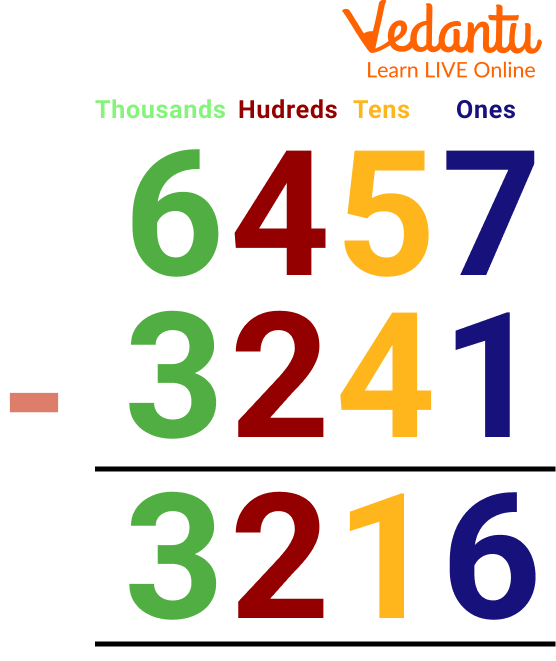
4-digit Subtraction
What is 4-digit Subtraction?
4-digit subtraction is the difference between a 4-digit number and another 4-digit number. Any number that is smaller than the 4-digit number can also be subtracted from it. We know that the larger number should be placed up and the smaller one should be placed below it. The larger number on top is called the minuend and the smaller number written below is the subtrahend. The final result of the subtraction of two numbers is called their difference. Both the numbers are placed one below the other in their respective place value columns and then they are subtracted.
4-Digit Subtraction Without Borrowing
4-digit subtraction without regrouping means the numbers are subtracted without any borrowing. In such cases, all the digits in the minuend are bigger than the digits in the subtrahend. Let us understand this using an example.
Example: Subtract 2719 from 3989.
Ans:The 4-digit subtraction can be done using the following steps.
Step 1: Arrange the numbers according to their place value one below the other.
Step 2: Start subtracting the digits in one column. Since all the digits of the minuend are greater than the subtrahend, no regrouping/borrowing is required here. Subtract the numbers in one column and write the difference. (9 - 9 = 0)
Step 3: Then, subtract the numbers in the tens column and write the difference. (8 - 1 = 7).
Step 4: After this, subtract the numbers in the hundreds column and write the difference. (9 - 7 = 2).
Step 5: Now, subtract the numbers in the thousands column and write the difference. (3 - 2 = 1)
4 digit subtraction without regrouping
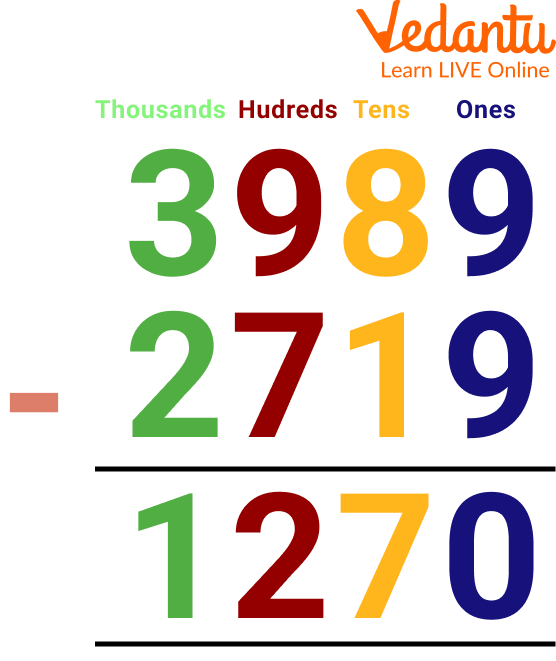
Subtract 2719 from 3989
Therefore, the difference between the numbers is 1270.
Solved Examples on Subtraction Without Regrouping
Q1. Subtract 3518 from 7689.
Ans: The 4-digit subtraction can be done using the following steps.
Step 1: Arrange the numbers according to their place value one below the other.
Step 2: Start subtracting the digits in ones column. Since all the digits of the minuend are greater than the subtrahend, no regrouping/borrowing is required here. Subtract the numbers in ones column and write the difference. (9 - 8 = 0)
Step 3: Then, subtract the numbers in the tens column and write the difference. (8 - 1 = 7).
Step 4: After this, subtract the numbers in the hundreds column and write the difference. (6 - 5 = 1).
Step 5: Now, subtract the numbers in the thousands column and write the difference. (7 - 3 = 4)
4 digit subtraction without regrouping
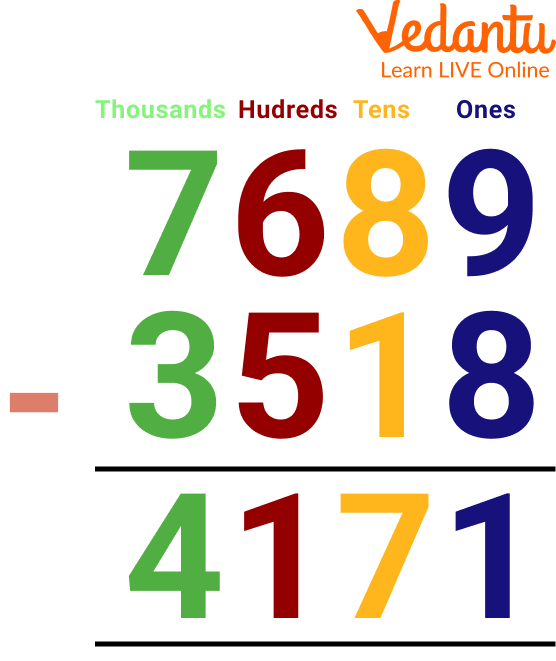
Subtract 3518 from 7689
Therefore, the difference between the numbers is 4171.
Q2. Subtract 1502 from 9999.
Ans: The 4-digit subtraction can be done using the following steps.
Step 1: Arrange the numbers according to their place value one below the other.
Step 2: Start subtracting the digits in ones column. Since all the digits of the minuend are greater than the subtrahend, no regrouping/borrowing is required here. Subtract the numbers in ones column and write the difference. (9 - 2 = 7)
Step 3: Then, subtract the numbers in the tens column and write the difference. (9 - 0 = 9).
Step 4: After this, subtract the numbers in the hundreds column and write the difference. (9 - 5 = 4).
Step 5: Now, subtract the numbers in the thousands column and write the difference. (9 - 1 = 8)
4 digit subtraction without regrouping
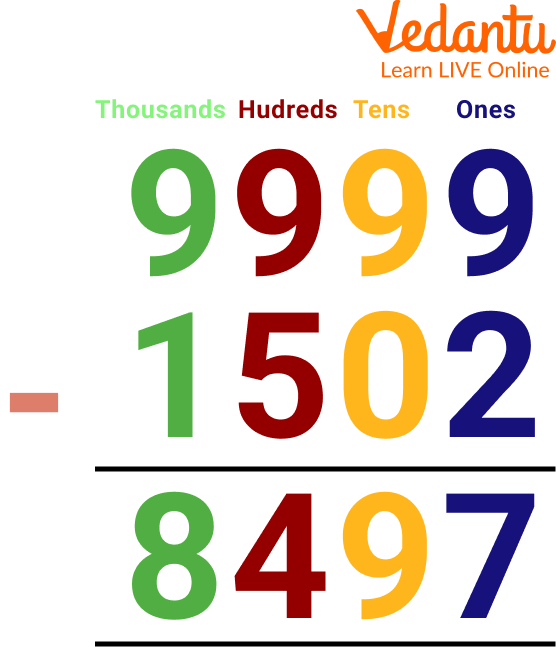
Subtract 1502 from 9999
Therefore, the difference between the numbers is 8497.
Practice Problems
Q1. Subtract 1111 from 9999.
Ans: 8888
Q2. Subtract 3256 from 8768.
Ans: 5512
Q3. Subtract 7896 from 9897.
Ans: 2001
Summary
In the above topic, we have learnt the concept of subtraction and also how subtraction without regrouping and borrowing is done. We have seen here to calculate the difference between the numbers using the number line. Also, we solved examples on subtraction without regrouping. Hope this article will enhance your concept of 4-digit subtraction without borrowing. To be more perfect in subtraction solve the above-given practice problems. Addition and subtraction are very useful in our day-to-day life. Hope you enjoyed reading the article.
FAQs on Understanding 4 Digit Subtraction Without Borrowing
1. What is 4 digit subtraction without borrowing?
4 digit subtraction without borrowing is the process of subtracting two four-digit numbers where each digit in the minuend is greater than or equal to the corresponding digit in the subtrahend. In this method, you subtract digits place by place without regrouping.
- Work from the ones place to the thousands place.
- Ensure each top digit is larger than or equal to the bottom digit.
- No carrying or borrowing is required.
2. How do you solve 4 digit subtraction without borrowing step by step?
To solve 4 digit subtraction without borrowing, subtract each digit starting from the rightmost place value. Follow these steps:
- Step 1: Write the numbers in column form aligned by place value.
- Step 2: Subtract the ones digits.
- Step 3: Subtract the tens digits.
- Step 4: Subtract the hundreds digits.
- Step 5: Subtract the thousands digits.
3. Can you give an example of 4 digit subtraction without regrouping?
An example of 4 digit subtraction without regrouping is 7645 − 3124 = 4521. Solve it place by place:
- 5 − 4 = 1 (ones)
- 4 − 2 = 2 (tens)
- 6 − 1 = 5 (hundreds)
- 7 − 3 = 4 (thousands)
4. What is the rule for subtraction without borrowing?
The rule for subtraction without borrowing is that each digit in the top number must be greater than or equal to the corresponding digit in the bottom number. Key points include:
- Align numbers by place value.
- Subtract from right to left.
- No regrouping is required if the top digit is larger.
5. What is the difference between subtraction with borrowing and without borrowing?
The main difference is that subtraction without borrowing does not require regrouping, while subtraction with borrowing does. In detail:
- Without borrowing: Each top digit ≥ bottom digit.
- With borrowing: A top digit is smaller, so you regroup from the next place value.
6. Why is place value important in 4 digit subtraction?
Place value is important because subtraction must be done according to thousands, hundreds, tens, and ones. Correct subtraction depends on:
- Aligning digits by thousands, hundreds, tens, and ones.
- Subtracting digits in the same place value column.
- Avoiding calculation errors.
7. What are common mistakes in 4 digit subtraction without borrowing?
Common mistakes in 4 digit subtraction without borrowing include misalignment and subtracting in the wrong order. Students often:
- Fail to align numbers by place value.
- Subtract from left to right instead of right to left.
- Confuse the minuend and subtrahend.
8. How do you check the answer of a 4 digit subtraction problem?
You can check a 4 digit subtraction answer by adding the difference to the subtrahend. Use this formula:
- Difference + Subtrahend = Minuend
9. When is borrowing not required in 4 digit subtraction?
Borrowing is not required when every digit in the minuend is greater than or equal to the corresponding digit in the subtrahend. This means:
- Ones digit ≥ ones digit
- Tens digit ≥ tens digit
- Hundreds digit ≥ hundreds digit
- Thousands digit ≥ thousands digit
10. How can I teach 4 digit subtraction without borrowing to students?
You can teach 4 digit subtraction without borrowing by focusing on place value and step-by-step column subtraction. Effective strategies include:
- Using place value charts.
- Practicing vertical column subtraction.
- Starting with simple examples like 7654 − 3210.
- Encouraging students to check answers using addition.
