









How to Do 2 Digit Addition With Regrouping Step by Step
The addition is a process of combining two or more numbers to obtain their sum. When the total of the values in one place value column exceeds nine, regrouping is employed. No matter how many numbers are included in the query or how many digits each number has, this method of moving a number to the next place value column can be applied with any addition. Setting the table, getting change at the store, playing some games, and many other daily tasks all benefit from the addition.
2 Digit Addition:
By keeping in mind the place value of numbers, 2-digit addition can be performed. Ones and tens are used to express the place value of 2-digit numerals. We organise the integers column-wise beneath the corresponding place values when adding two digits together.
You can mentally add two numbers by following some simple instructions.
The digits can be added one at a time using this procedure. You can perform 2-digit addition both with and without regrouping.
For instance, let’s add 57 and 31

Addition of 57 and 31
The answer will be 88.
2 Digit Addition without Regrouping:
A 2-digit addition without regrouping is the simplest addition. This method is employed in daily life while carrying out any kind of financial transaction. When the sum is less than or equal to 9, we write the number in the appropriate place value column and do not carry any numbers to the next column.
2 Digit Addition with Regrouping:
We can perform 2-digit addition by regrouping the given numbers as a result of a situation. If the sum of the numbers in one column is greater than 9, we must move the excess number to the following column. We start in the ones column and go left toward the tens column when regrouping two-digit values.
Let's use an illustration to better grasp this:
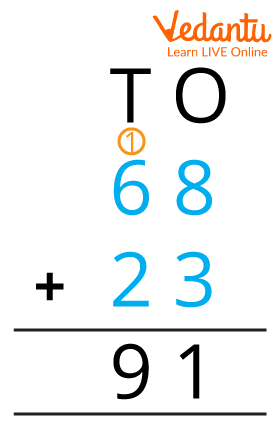
Addition of 68 and 23
Steps for Doing 2 Digit Addition with regrouping:
Let us understand it with one example :
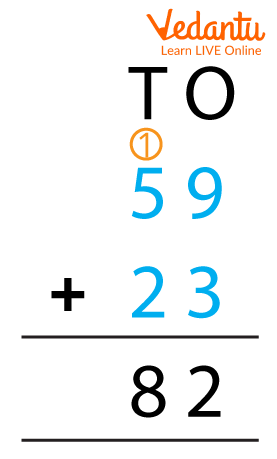
Addition for 59 and 23
STEP 1: Sort the numbers into columns based on their place value, such as ones and tens column-wise. As a result, 9 and 3 will go in the ones column and 5 and 2 in the tens column.
STEP 2: Start adding the numbers from the right, i.e., the ones column and proceed towards the left, i.e., the tens column. Here, 9 + 3 = 12.
STEP 3: A double-digit number results when the total of the ones in the column is more than 9. In the case of a double-digit number, the ones digit goes in the ones column, while the tens digit is carried over or regrouped to the tens column. We add 1 to the tens column because 12 is more than 9, and we write 2 as the sum in the ones column because 12 is greater than 9.
STEP 4: We add the value that was carried over from the ones column when adding the tens column. We will get 8 when we add 5 + 2 + 1 (carry-over).
STEP 5: We get the total after adding the values from both columns.
The result of adding both columns is 59 + 23 = 82.
Properties of 2 Digit Addition with Regrouping:
PROPERTY 1 :
Commutative Property: The commutative property of addition states that no matter how the addends are arranged, the sum remains constant.
PROPERTY 2 :
Identity Property: According to the identity feature of addition, a number remains unchanged when a zero is added to it.
PROPERTY 3 :
Associative Property: When three or more numbers are added, the sum is the same regardless of which two addends are added first, according to the associative property of addition.
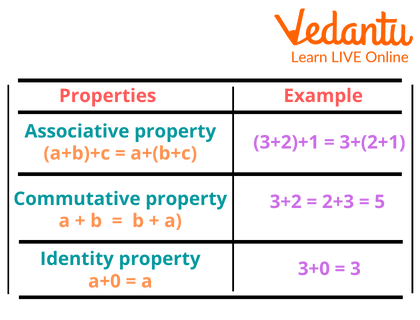
Properties for Addition
Solved Examples:
1: Add 58 + 23.
Solution: The sum of 58 and 23 is 81.

2: If Aman has 87 chocolates, his teacher gives him 45 more chocolates. How many chocolates Aman has in total?
Solution: If Aman had 87 chocolates and his teacher gave him 45 more.
Thus,
The number of chocolates Aman have are 87
The number of chocolates the teacher gave is 45
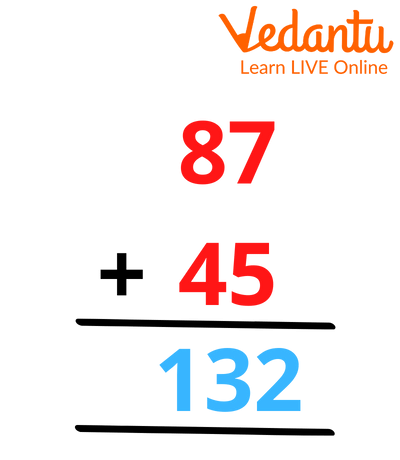
In total Aman has 132 chocolates.
3: There are 756 boys and 525 girls in the school. How many children were there altogether?
Solution: Number of boys = 756
Number of girls =+ 525
Total children = 1281
There were 1281 children in the school.
Conclusion:
When the sum is less than or equal to 9, we regroup the numbers and write the result beneath the appropriate place value column before moving the results to the next column.
FAQs on 2 Digit Addition With Regrouping Explained Simply
1. What is 2 digit addition with regrouping?
2 digit addition with regrouping is a method of adding two two-digit numbers where you carry over a value from the ones place to the tens place. Regrouping is needed when the sum of the ones digits is 10 or more.
- Add the ones digits first.
- If the sum is 10 or greater, write the ones digit and carry the tens digit.
- Add the tens digits including the carried number.
2. How do you do 2 digit addition with regrouping step by step?
To do 2 digit addition with regrouping, you add the ones first and carry over if the sum is 10 or more.
- Example: 47 + 38
- Add ones: 7 + 8 = 15. Write 5, carry 1.
- Add tens: 4 + 3 + 1 = 8.
- Final answer: 85.
3. Why do we regroup in 2 digit addition?
We regroup in 2 digit addition because the sum of the ones digits equals or exceeds 10, which forms a new ten. Since 10 ones equal 1 ten, we carry that extra value to the tens column.
- Example: 6 + 7 = 13
- 13 ones = 1 ten and 3 ones
4. Can you give an example of 2 digit addition with regrouping?
An example of 2 digit addition with regrouping is 56 + 27 = 83.
- Add ones: 6 + 7 = 13 → write 3, carry 1.
- Add tens: 5 + 2 + 1 = 8.
- Final answer: 83.
5. What is the difference between addition with regrouping and without regrouping?
The difference is that addition with regrouping requires carrying over, while addition without regrouping does not. In addition without regrouping, the ones digits add up to 9 or less.
- Without regrouping: 23 + 14 = 37
- With regrouping: 28 + 17 = 45 (carry needed)
6. What happens if the ones place adds up to more than 9?
If the ones place adds up to more than 9, you regroup by carrying the tens digit to the tens column. For example:
- 9 + 6 = 15
- Write 5 in the ones place.
- Carry 1 to the tens place.
7. How do you check your answer in 2 digit addition with regrouping?
You can check your answer in 2 digit addition with regrouping by using the inverse operation, subtraction. For example:
- If 64 + 29 = 93
- Check: 93 − 29 = 64
8. What are common mistakes in 2 digit addition with regrouping?
Common mistakes in 2 digit addition with regrouping include forgetting to carry or adding the carried number incorrectly.
- Not carrying when the sum is 10 or more.
- Forgetting to add the carried 1 in the tens column.
- Misaligning place values.
9. How do you teach 2 digit addition with regrouping to beginners?
To teach 2 digit addition with regrouping, use place value models and step-by-step practice. Start with base-ten blocks or drawings to show that 10 ones = 1 ten.
- Demonstrate with visual models.
- Practice adding ones first.
- Explain carrying clearly.
10. Is 2 digit addition with regrouping the same as carrying?
Yes, 2 digit addition with regrouping is also called carrying in addition. Both terms describe moving a value from one place value to the next when the sum is 10 or more.
- Regrouping emphasizes place value.
- Carrying describes the action of moving the digit.
