







What is a SONAR?
SONAR is an acronym that stands for Sound Navigation and Ranging, used in detecting, measuring distance and determining the direction of an object on or under the water. It is based on the principle of reflection (echo) of sound waves from an object.
SONAR works by calculating echo. Once you know the speed of sound in water and the time it takes for the signal to return, you can determine an object's distance. SONAR is also used for the device to transmit and detect sound.
Types of SONAR
There are two types of SONAR: Active and Passive.
Passive SONAR simply listens to the sounds of water. It listens for marine life and other ships that may be nearby or using active SONAR.
Active SONAR, on the other hand, actively sends pulses of sound and listens for how long they take to return when they 'bounce' off an object.
How Does a SONAR Device Work?
SONAR works using ultrasonic waves or ultrasound. The entire device is installed on the ship. It has a transmitter and detector.
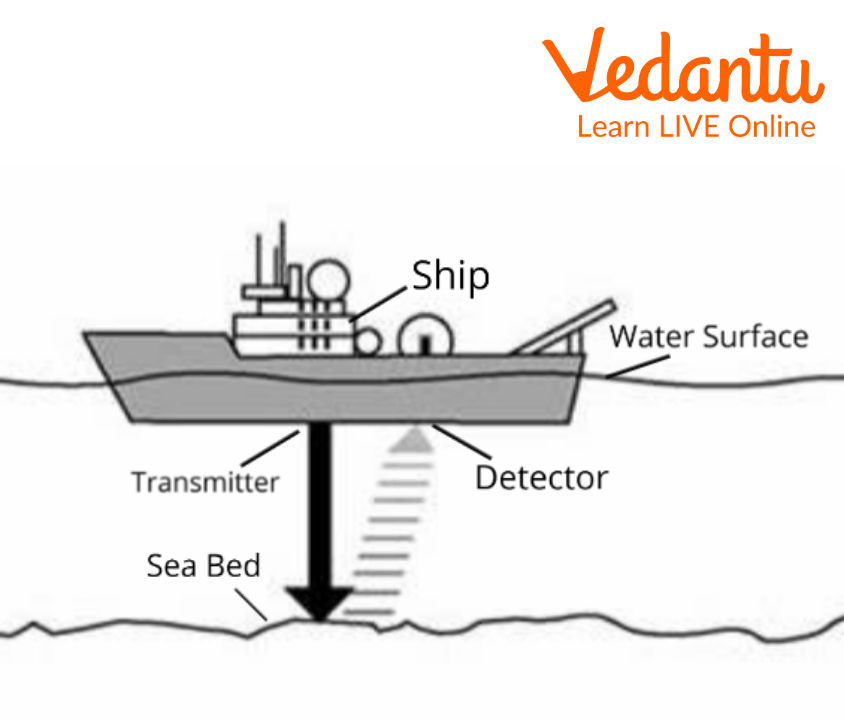
SONAR Device
The transmitter generates powerful ultrasonic waves or ultrasounds.
These waves travel through water and hit objects submerged or on the seabed.
After striking the object or seabed, the detector reflects and receives the wave.
The ultrasonic waves are then converted into electrical signals by the detector.
These signals are studied to determine the underwater condition and obstacles.
Uses of SONAR
SONAR is used for underwater communication between submerged submarines or between a submarine and a surface vessel.
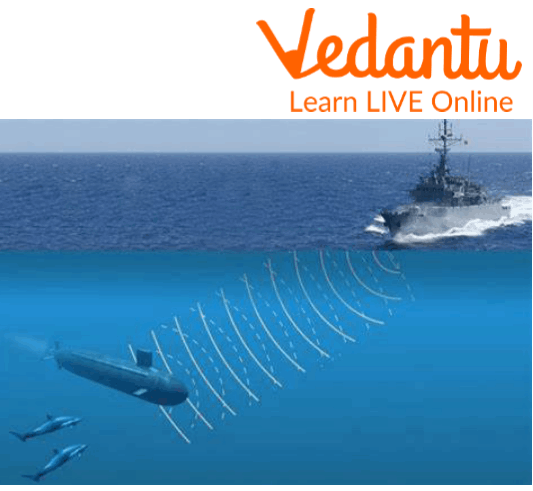
SONAR is Used for Underwater Communication.
The military uses SONAR to track enemy warships or submarines.
It is used by fishermen for fish finding.
SONAR is used for seafloor mapping or seafloor imaging.

SONAR Seafloor Image
It is used in medical imaging to find cysts or cancer cells. This process is known as a sonogram.
Animals like dolphins, bats, toothed whales, etc., also use SONAR to communicate, detect any obstacle in their surroundings, and detect their prey. This ability in animals is called echolocation or biosonar.
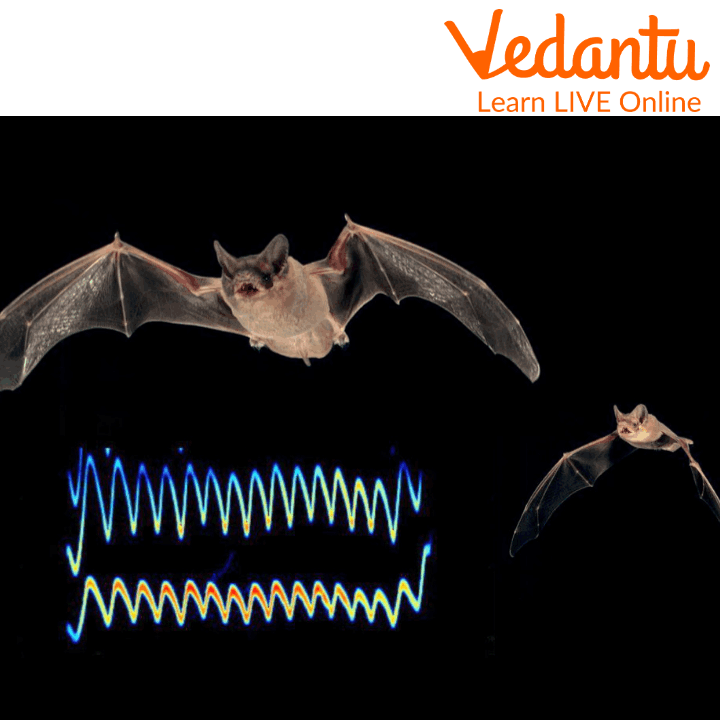
Bats Use Sound Navigation to Detect Their Prey.
Summary
SONAR is used because sound waves travel through the water much better than light waves or radar. Since submarines do not have windows, SONAR is a submerged submarine's eyes.
FAQs on Sonar Working
1. What does the acronym SONAR stand for, and what is its primary function?
SONAR stands for SOund Navigation And Ranging. It is a technology that uses sound propagation (usually underwater) to navigate, measure distances, communicate with or detect other vessels, and map the seabed.
2. What is the fundamental principle behind the working of SONAR?
The working principle of SONAR is based on the phenomenon of echo, which is the reflection of sound. A SONAR device sends out pulses of sound waves and measures the time it takes for the echoes to return after reflecting off an object. This time interval is then used to determine the distance to the object.
3. Can you explain the working of a SONAR device step-by-step?
The working of SONAR can be understood in a few simple steps:
Transmission: The SONAR device, equipped with a transmitter, produces and sends out a pulse of ultrasonic sound waves.
Reflection: These sound waves travel through the water until they hit an object, such as the seabed, a submarine, or a school of fish. Upon hitting the object, the waves are reflected back towards the device as an echo.
Detection: A detector or receiver on the SONAR device captures the returning echo.
Calculation: The device precisely measures the time interval (t) between the transmission of the sound pulse and the reception of the echo. This time is used to calculate the distance.
4. What are the two main components of a SONAR system?
A basic SONAR system consists of two key components:
A transmitter (or projector) which produces the sound pulses.
A detector (or receiver/hydrophone) which detects the echo (the reflected sound waves).
In many systems, these two components are combined into a single unit called a transducer.
5. How is the distance to an underwater object calculated using SONAR?
The distance to an object is calculated using the time taken for the echo to return and the speed of sound in water. The formula used is:
Distance = (Speed of sound in water × Time interval) / 2
We divide the product by 2 because the measured time interval represents the time taken for the sound to travel to the object and then back again (a round trip).
6. What type of sound waves are used in SONAR and why are they preferred?
SONAR systems use ultrasonic waves (ultrasound), which are sound waves with frequencies higher than the upper limit of human hearing (above 20,000 Hz). They are preferred because:
They have high energy and can penetrate deep into the water.
They can travel long distances without significant loss of strength.
Their short wavelength allows them to detect smaller objects with greater precision.
They are inaudible to humans, so they don't cause noise disturbance.
7. What are some important real-world examples and applications of SONAR technology?
SONAR technology has several important applications, including:
Marine Navigation: Ships use SONAR to measure the depth of the sea (a technique called echo-sounding) and avoid underwater obstacles.
Military Operations: Submarines use it to detect enemy vessels, and surface ships use it to locate submarines.
Fishing Industry: Fishermen use SONAR to locate large schools of fish.
Oceanography: Scientists use it to map the features of the ocean floor and locate shipwrecks or other submerged artefacts.
8. What is the main difference between how SONAR and RADAR work?
The main difference lies in the type of waves they use. SONAR uses sound waves and is primarily designed for use in water, as sound travels well in this medium. In contrast, RADAR (RAdio Detection And Ranging) uses electromagnetic waves (specifically radio waves) and is designed for use in air or space, as these waves travel best through a vacuum or the atmosphere.
9. Can the principle of SONAR be used in air, or is it strictly for underwater use?
Yes, the basic principle of using sound waves for ranging can be used in air. For example, some cars are equipped with ultrasonic sensors for parking assistance, which work similarly. However, the term SONAR is almost exclusively associated with underwater applications because sound travels much farther and more efficiently in water than in air. The high attenuation (loss of energy) of sound in air makes it less effective for the long-range detection that SONAR is known for.
10. Why is it so important to know the exact speed of sound in water for SONAR to be accurate?
Knowing the exact speed of sound in water is crucial because the entire distance calculation depends directly on this value (Distance = v × t / 2). The speed of sound ('v') in water is not constant; it changes with factors like temperature, pressure (depth), and salinity. If an inaccurate value for the speed of sound is used, the calculated distance to the object will be incorrect, potentially leading to navigational errors or inaccurate mapping.
