







What Is the Preposition In Front Of and How to Use It Correctly
Prepositions are those words or phrases that are used to show time, direction, place, etc. These words are generally used before a noun or pronoun. Prepositions are very useful to understand the structure of a sentence. Proper usage of prepositions helps students to understand what a narrator or author wants to say.
You can easily understand the preposition with these basic examples:
1. The cat is on the table.
2. The cat is under the table.
3. The cat is in front of me.
There are many prepositions. In this article, we will discuss the preposition ‘in front of’.
How to Use Prepositions in Front of?
Prepositions of place are excellent terms to begin learning, particularly for children with a limited English vocabulary. These prepositions describe the position of something: in front of, behind, or between. While your children may be able to express the name of their favourite item, they can indicate where it is by using preposition words. "My teddy bear is behind the bed," for example, or "My automobile is in front of the table." While learning preposition words might be difficult, it's always enjoyable to practise them with children.
A noun phrase is commonly used with a function word to generate a phrase that communicates a change or prediction. A preposition is a tiny, frequent word that indicates direction (to in "a letter to you"), place (at in "at the door"), or time (by in "by noon"), or that introduces an item (of in "a basket of apples"). The object of a preposition is usually a noun (noon), a noun phrase (the door), or a pronoun (you).
A preposition is a word that connects a noun or pronoun to the remainder of the phrase, according to English grammar. The words "in," "beside," "through," and "into" are examples of prepositions. Your children will want to be able to express themselves more completely as they get more comfortable utilising English words and phrases that they already know. Prepositions come into play here!
Examples of Preposition in Front of
They've come to a halt in front of their house.
This Cow statue is in front of a temple.
The car is in front of the building.
Last night, they sat in front of the TV and watched a movie.
He's in front of his computer.
Right in front of us, a dolphin leapt from the ocean.
On occasion, it's impolite to chuckle in front of others, especially while they're attempting to concentrate on something important.
He tries not to smoke in front of his children since he doesn't want them to be exposed to secondhand smoke.
This cat is walking in front of its owner.
The teacher is standing in front of the class.
Almasri is standing in front of the Eiffel Tower.
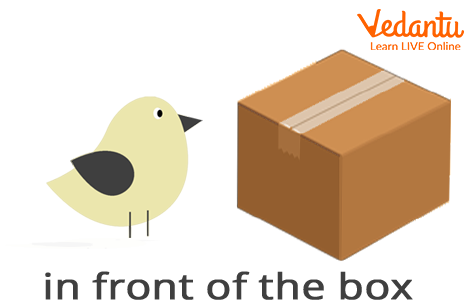
The Bird in Front of the Box
Preposition Song
Prepositions give you time, place, position
Come on along sing The Preposition Song
Prepositions give you time, place, position
Come on along sing The Preposition Song.
In front of, behind, between,
In front of, behind, between,
In front of, behind, between,
In front of, behind, between.
Prepositions give you time, place, position
Come on along sing The Preposition Song
Prepositions give you time, place, position
Come on along sing The Preposition Song.
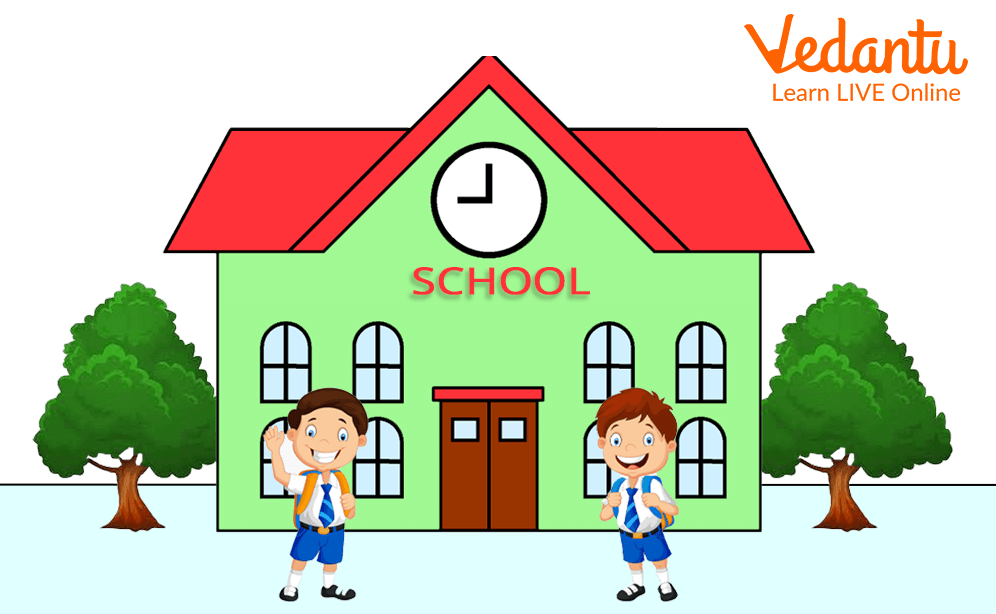
Kids are in Front of the School
The Most Frequently Used Prepositions
Some of the most frequently used prepositions are at, for, from, in, of, on, to, with, about, above, across, after, against, along, among, around, because of, before, behind, below, beneath, beside, between, close to, down, during, except, inside, instead of, into, like, near, off, on top of, onto, out of, outside, over, past, since, through, toward, under, until, up, upon, within, without.
Conclusion
English can become more enjoyable when kids learn prepositions. The children will be able to begin describing the world around them and recognising how English is used in their daily lives. Play a prepositional phrase game at home to improve your skills. Tell the kid to stand behind the sofa or in front of the refrigerator. This will keep students engaged and make grammar more interesting for them.
FAQs on Preposition In Front Of Meaning and Usage in English
1. What does the preposition "in front of" mean in English?
The preposition in front of means “ahead of” or “facing the front part of something or someone.” It shows position and describes where a person or object is located.
- It is used to talk about physical position.
- It answers the question “Where?”
- Example: She is standing in front of the house.
2. How do you use "in front of" in a sentence?
You use in front of before a noun or pronoun to show that someone or something is ahead of another person or object. The structure is:
- Subject + verb + in front of + object
- The car stopped in front of the school.
- He sat in front of me.
3. What is the difference between "in front of" and "in the front of"?
The difference is that in front of means outside and ahead of something, while in the front of refers to the inside front part of something.
- In front of = outside position (The car is in front of the house.)
- In the front of = inside front area (She sat in the front of the bus.)
4. Is "in front of" a preposition or a prepositional phrase?
"In front of" is a compound preposition made up of multiple words that function as one preposition. It behaves like a single unit and is followed by a noun or pronoun.
- Structure: in + front + of
- Example: The teacher stood in front of the class.
5. Can "in front of" be used with pronouns?
Yes, in front of can be used with object pronouns such as me, you, him, her, us, and them. It must be followed by an object pronoun, not a subject pronoun.
- Correct: She stood in front of me.
- Incorrect: She stood in front of I.
6. What are some common examples of "in front of" in everyday English?
Common examples of in front of show physical position in daily situations.
- The bus stopped in front of the station.
- There is a garden in front of my house.
- He parked in front of the supermarket.
7. What is the opposite of "in front of"?
The opposite of in front of is usually behind. While “in front of” means ahead of something, “behind” means at the back of something.
- The car is in front of the building.
- The car is behind the building.
8. Is "in front of" used for people as well as objects?
Yes, in front of is used for both people and objects to describe position. It shows that someone or something is ahead of another person or thing.
- She stood in front of her friends.
- The statue is in front of the museum.
9. What are common mistakes when using "in front of"?
A common mistake with in front of is confusing it with similar expressions or using the wrong pronoun.
- Using subject pronouns instead of object pronouns (Incorrect: in front of I).
- Confusing it with in the front of when referring to outside position.
- Leaving out “of” (Incorrect: in front the house).
10. Can "in front of" be used in figurative or non-physical situations?
Yes, in front of can also be used in non-physical or figurative contexts to mean “in the presence of.”
- He spoke in front of the audience.
- She felt nervous in front of her boss.
