







What Is an Adjective List with Definition Types and Usage Examples
 Table of Content
An adjective is a word that is used to describe something. Have you ever thought about it? How would you describe a pretty dress or enjoy a beautiful sunrise? To complete this, we put adjectives that add further description to nouns. You can understand adjectives through examples. To learn the uses of adjectives, you should spend time reading examples of adjectives and their uses in sentences. Read the following article to learn about adjectives with fun. We have created a list of adjectives for students focusing on important points for their better marks. You will get a list of adjectives and examples that will help you to use adjectives in sentences. Also, this page contains an adjectives list for kids.
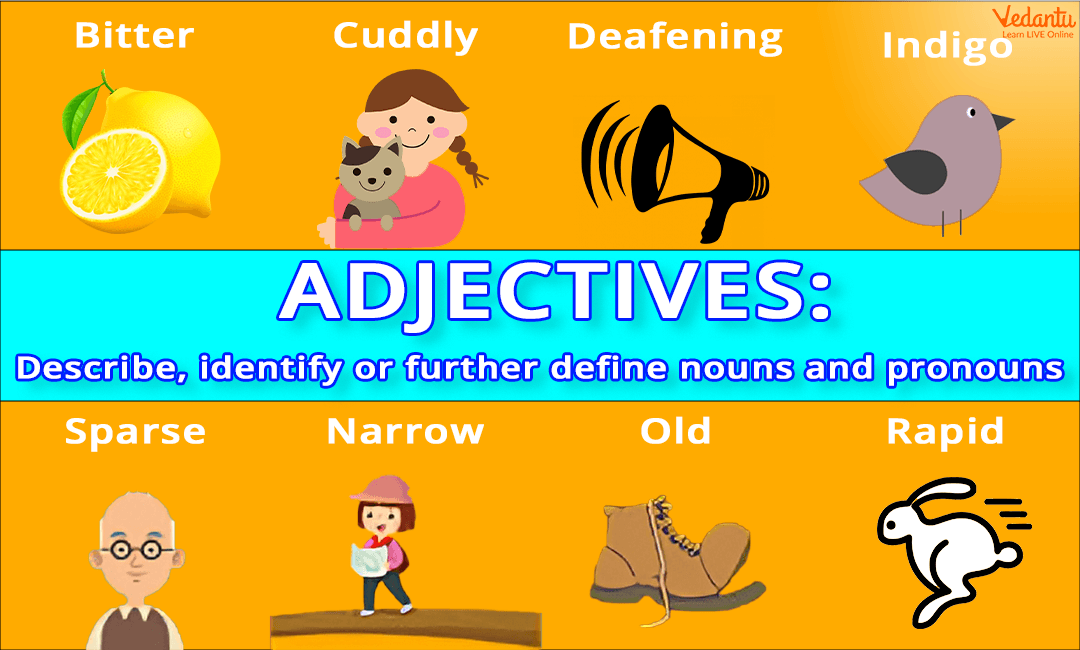
Adjectives List
A list of adjectives is given below.
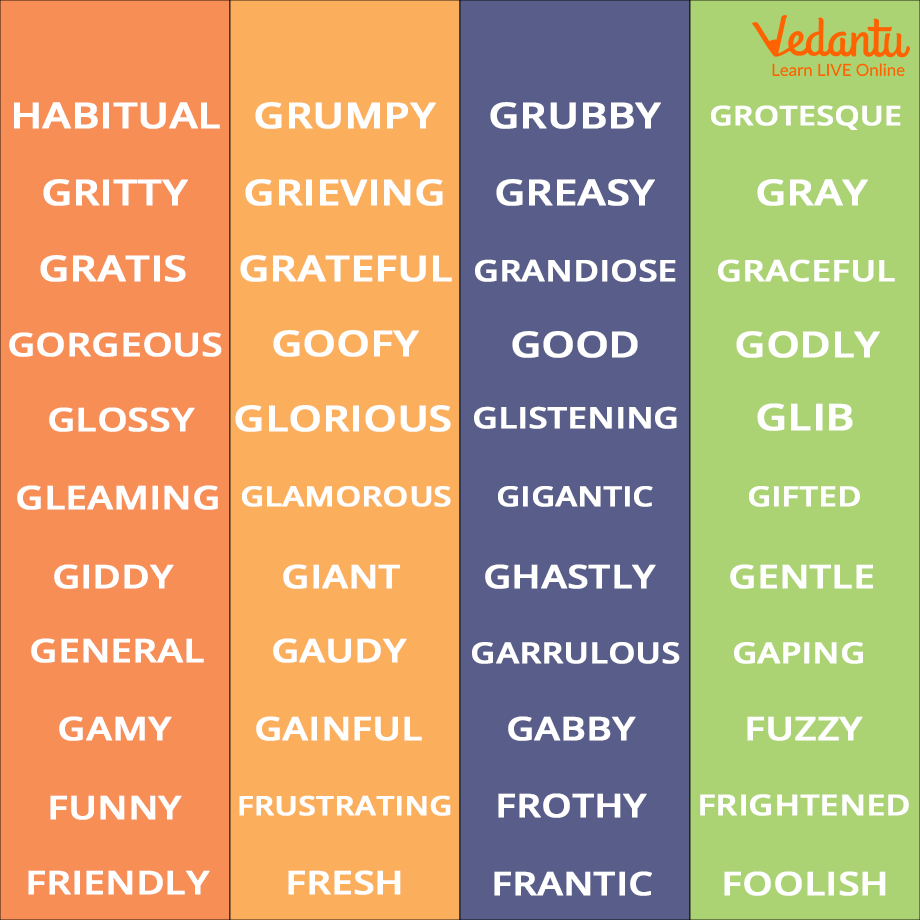
Adjective List
Adjective list for kids
Examples of Adjectives in Sentences
See the use of adjectives in sentences.
The taste of lemon is very sour.
The girl is wearing a beautiful dress.
Fox is a clever animal.
Soldiers are brave people.
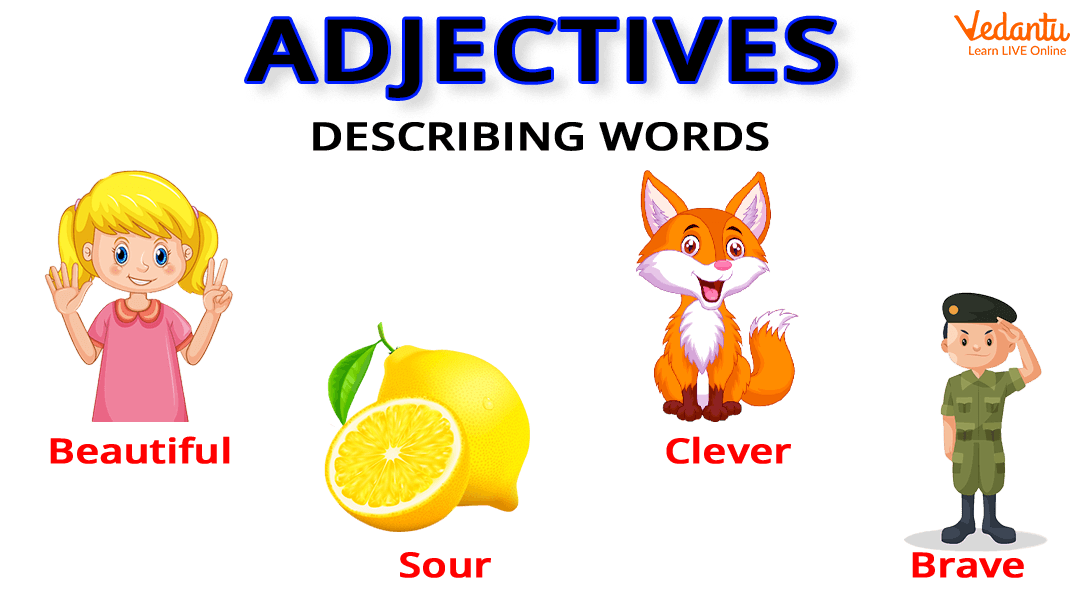
Adjectives Describing Words
Adjectives to Describe Taste
Did you know how you describe any food or taste that you liked? You use the following adjectives to describe the taste.
Adjectives to Describe Touch
See the list of adjectives we use when we want to describe touch. You can use different adjectives to describe touch.
Adjectives to Describe Sound
Depending upon the intensity of sounds, we describe them. They can be a whisper or blaring and anything in between.
Adjectives to Describe Colour
Yes! There are some adjectives in English that are used to describe colours. This world is full of colours. Let’s explore the list of adjectives that describe colours.
Adjectives to Describe Size and Shape
The list of adjectives are as follows, that are used to describe the size and shape of something.
Adjectives to Describe Time
There are a lot of adjectives that are used to describe time. The list of some adjectives describing time is given below.
Adjectives to Describe an Amount
The examples of some adjectives are given below, that are used in English to describe an amount.
Adjectives to Describe an Emotion
The emotions of people are important and they need to be described. Some adjectives are given below, that are used to describe emotions.
Adjectives To Describe Appearance
The lists of some adjectives are provided here that describe appearance.
Adjectives to Describe Situations
Some descriptive adjectives are as follows, that are often used when talking about situations.
Adjectives list A-Z
Conclusion
Hence, the above article is useful for the children to learn about adjectives. The list of adjectives is provided for different situations when we use adjectives. Hence, kids will get an idea of where and how to use adjectives.
Test your Knowledge of Adjectives
1. Identify the Adjective:
In the sentence "The small, furry dog slept quietly," which words are adjectives?
2. Choose the Correct Adjective:
Choose the most suitable adjective to complete the sentence: "She wore a __________ dress to the party."
a) big
b) quickly
c) joyful
d) sing
3. Fill in the Blanks:
Fill in the blanks with appropriate adjectives: "The __________ cat climbed the __________ tree with great agility."
4. Comparative and Superlative Forms:
Write the comparative and superlative forms of the adjective "happy."
5. Adjective Order:
Arrange the adjectives in the correct order in this sentence: "The (colour/size/quality) (adjective) (noun)." For example: "a large blue beautiful vase."
6. Identify the Type of Adjective:
In the sentence "He gave a generous donation to the charity," identify the type of adjective used.
7. Use Adjectives in Sentences:
Create a sentence using the adjectives "elegant," "old," and "wooden."
8. Adjective-Noun Agreement:
Choose the correct adjective to match the noun: "The __________ (friendly/friend) teacher helped the students."
9. Replace the Adjective:
Replace the adjective in the sentence with a synonym: "The movie was very interesting."
10. Adjective Phrases:
Identify and underline the adjective phrase in the sentence: "The house, filled with colourful paintings, stood on the hill."
Find Out if you Got them Right from the Answers Below.
1. Identify the Adjective:
Small, furry
2. Choose the Correct Adjective:
a) big
3. Fill in the Blanks:
The playful cat climbed the tall tree with great agility.
4. Comparative and Superlative Forms:
Comparative: happier
Superlative: happiest
5. Adjective Order:
Example: "a large beautiful blue vase."
6. Identify the Type of Adjective:
Generous (descriptive adjective)
7. Use Adjectives in Sentences:
Example: "She admired the elegant old wooden chair."
8. Adjective-Noun Agreement:
The friendly teacher
9. Replace the Adjective:
Example: "The movie was very engaging."
10. Adjective Phrases:
"The house, filled with colourful paintings, stood on the hill."
Review your Understanding of Adjectives for Children
Exercise 1: Identify the Adjective
Instructions: Underline the adjective in each sentence.
The sky is blue.
She has a fluffy cat.
The tall tree touches the clouds.
My new shoes are shiny.
The cake is delicious.
Exercise 2: Add an Adjective
Instructions: Add an adjective to each sentence to make it more interesting.
The dog barked at the stranger.
I saw a butterfly.
The car drove down the street.
She wore a dress.
The boy ran to the park.
Exercise 3: Match the Noun with the Adjective
Instructions: Match the noun in the first column with the best adjective in the second column.
Exercise 4: Use the Right Adjective
Instructions: Choose the correct adjective to complete the sentence.
The water is (hot, loud).
She has a (cold, purple) hat.
The (shiny, rough) diamond sparkled in the light.
He is a (happy, tall) boy.
The music was (funny, loud) at the concert.
Exercise 5: Create Your Own Sentences
Instructions: Write a sentence using each of the following adjectives.
Sunny
Brave
Huge
Tasty
Fast
Check the answers below:
Exercise 1: Identify the Adjective
The sky is blue.
She has a fluffy cat.
The tall tree touches the clouds.
My new shoes are shiny.
The cake is delicious.
Exercise 2: Add an Adjective
The big dog barked at the stranger.
I saw a colourful butterfly.
The fast car drove down the street.
She wore a beautiful dress.
The young boy ran to the park.
(Note: The added adjectives can vary; these are just examples.)
Exercise 3: Match the Noun with the Adjective
Exercise 4: Use the Right Adjective
The water is hot.
She has a purple hat.
The shiny diamond sparkled in the light.
He is a happy boy.
The music was loud at the concert.
Exercise 5: Create your own Sentences
Since this exercise involves creating original sentences, here are some examples:
Sunny: It was a sunny day at the beach.
Brave: The brave firefighter rescued the cat.
Huge: The elephant is huge and strong.
Tasty: The pizza was tasty and cheesy.
Fast: The rabbit is fast when it runs.
Takeaways from this Page
Adjectives provide detailed descriptions and add depth to language by specifying qualities, quantities, and characteristics of nouns.
Understanding different types of adjectives—descriptive, quantitative, demonstrative, and possessive—helps in using them effectively to convey precise meanings.
Adjectives in English often follow a specific order when used together, such as quantity, quality, size, age, shape, colour, origin, material, and purpose, which enhances clarity in writing and speech.
Adjectives change form to compare different items (comparative) or to denote the highest degree of quality (superlative), which is essential for making comparisons and highlighting extremes.
Using a variety of adjectives enriches writing and speech, making descriptions more vivid and engaging.
FAQs on Adjectives List with Meaning Types and Practical Examples
1. What is an adjective in English grammar?
An adjective is a word that describes, modifies, or gives more information about a noun or pronoun. It tells us what kind, which one, or how many.
For example:
- She wore a red dress. (What kind?)
- I have three books. (How many?)
- That is my car. (Which one?)
2. What is an adjectives list?
An adjectives list is a collection of descriptive words used to modify nouns and pronouns. It helps learners expand vocabulary and improve sentence formation.
Common examples from an adjectives list include:
- Happy, sad, angry (feelings)
- Big, small, tall (size)
- Beautiful, ugly (appearance)
- Old, new (age)
3. What are the different types of adjectives?
The main types of adjectives in English grammar describe different qualities, quantities, and relationships of nouns.
Common types include:
- Descriptive adjectives – happy, blue, tall
- Quantitative adjectives – some, many, few
- Demonstrative adjectives – this, that, these, those
- Possessive adjectives – my, your, their
- Interrogative adjectives – which, what, whose
4. How do you use adjectives in a sentence?
Adjectives are used before a noun or after a linking verb to describe the noun clearly.
They can appear:
- Before a noun: She has a bright smile.
- After a linking verb (is, seem, become): The sky is blue.
5. What is the difference between comparative and superlative adjectives?
A comparative adjective compares two things, while a superlative adjective compares three or more things.
Formation rules:
- Add -er for comparatives: tall → taller
- Add -est for superlatives: tall → tallest
- Use more/most for longer adjectives: beautiful → more beautiful, most beautiful
6. What are examples of descriptive adjectives?
Descriptive adjectives are words that describe the quality, color, size, shape, or condition of a noun.
Common examples include:
- Size: large, tiny, enormous
- Color: red, green, blue
- Quality: kind, honest, brave
- Shape: round, square, flat
7. Can you give a list of positive adjectives to describe a person?
Positive adjectives describe good qualities or personality traits of a person.
Examples of positive adjectives:
- Kind
- Honest
- Friendly
- Generous
- Confident
- Hardworking
8. What is the correct order of adjectives in English?
The correct order of adjectives in English usually follows a specific pattern before a noun.
The common order is:
- Opinion
- Size
- Age
- Shape
- Color
- Origin
- Material
- Purpose
9. What are common mistakes when using adjectives?
Common adjective mistakes include wrong order, incorrect comparison forms, and confusing adjectives with adverbs.
Typical errors:
- Wrong order: a red big car ❌ → a big red car ✅
- Wrong comparison: more taller ❌ → taller ✅
- Adjective vs. adverb: She sings beautifully (not beautiful)
10. Why are adjectives important in English writing and speaking?
Adjectives are important because they add detail, clarity, and vivid description to sentences.
They help to:
- Create clear images in the reader’s mind
- Make writing more engaging and expressive
- Provide specific information about nouns
