









What Is Reforestation Definition Process Benefits and Ecological Impact
Reforestation is the practice of restoring or replacing forests that have been damaged or destroyed for the benefit of people. Both the terms "reforestation" and "afforestation" denote the same thing; afforestation is simply another word for reforestation. Forests occasionally have the potential to regenerate because of the nearby trees or because of the dispersal of seeds. However, severely damaged forest areas cannot regrow unless native plant species are introduced.
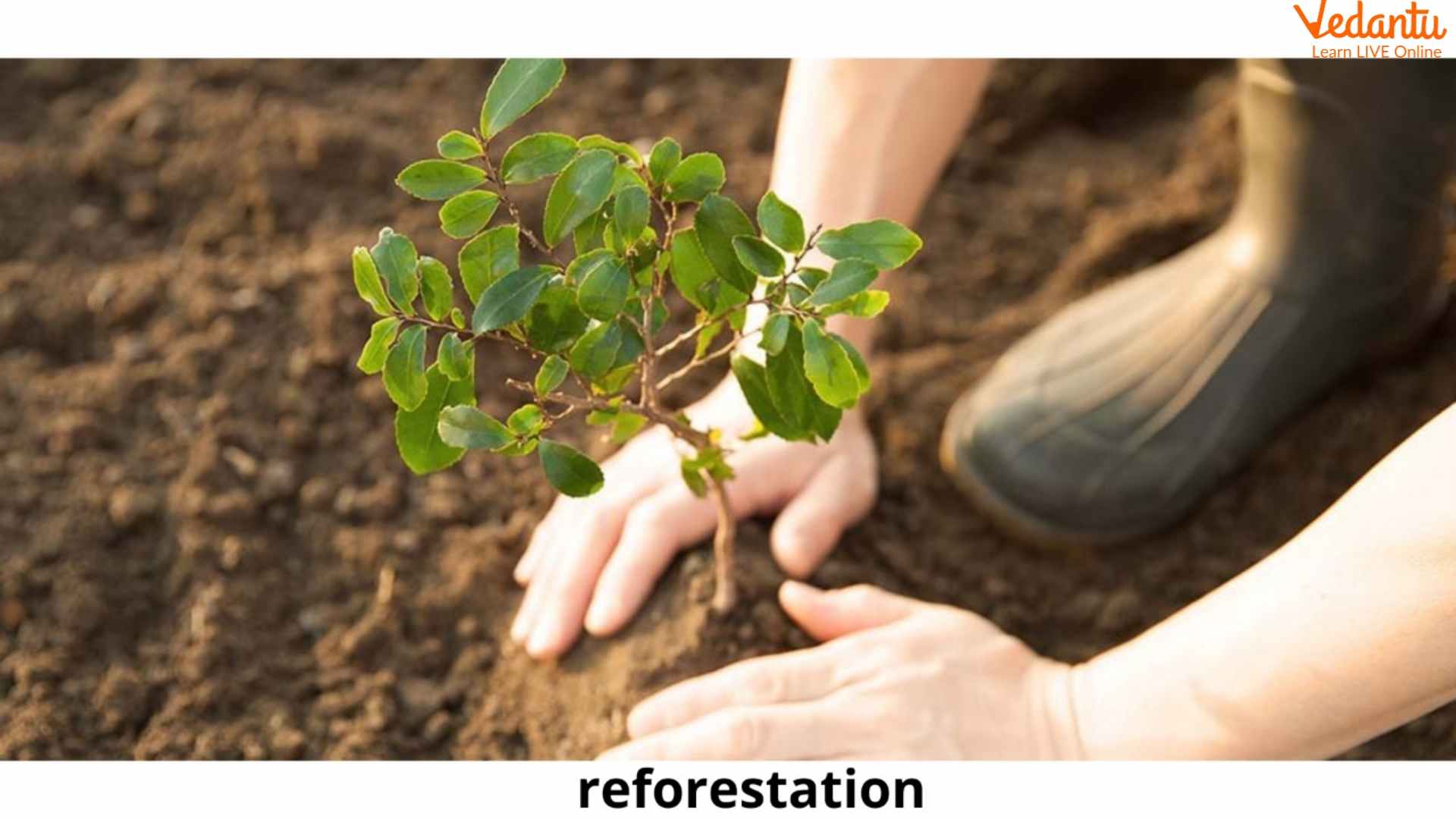
Plantation for Reforestation
What is Reforestation?
Reforestation is the process of replacing trees in places that have been damaged by both natural and human-made disturbances, such as logging, mining, agricultural clearance, and construction. Natural disturbances include wildfires, drought, pest and disease infestations, and wildfires. This might entail anything from encouraging natural regeneration in a degraded region to planting ecologically suitable tree seedlings in the wake of forest fires.
Reforestation can take place naturally or under human management. An area is simply left unaffected by human activities in natural reforestation. Plants that are planted in the ground or transported there by the wind and water movement sprout and develop. According to a succession of plant species that are typical of that region, the forest eventually returns.
Reforestation Definition
Reforestation is the process of re-establishing forests after they have been destroyed using local tree species. Afforestation, the process of re-establishing woods that formerly existed but have been cleared, is another name for reforestation. The recovering forest may help the ecosystem, protect endangered species, replenish key resources, and even help the attempt to prevent global warming by removing carbon dioxide from the atmosphere.
Why is Reforestation Important?
The function that trees play on our world explains the significance of reforestation. New woods are crucial to protect farms and houses from wind and to stop desertification of soil erosion. The coastal area is strengthened and stabilised by trees along riverbanks or shorelines. The native habitat of rare species, some of which are found nowhere else, is the woods. In order to restore the tree cover, it's crucial to both regenerate the damaged or destroyed areas and plant new ones.
How are we implementing Reforestation?
Numerous groups are striving to conserve and restore forests using a variety of techniques, such as educating people about the value of forests, replanting, and the expansion of protected areas. Additionally, governments throughout the world are working to enact tight regulations for the preservation and regrowth of forests. A sustainable and balanced ecology can only be achieved via worldwide cooperation.
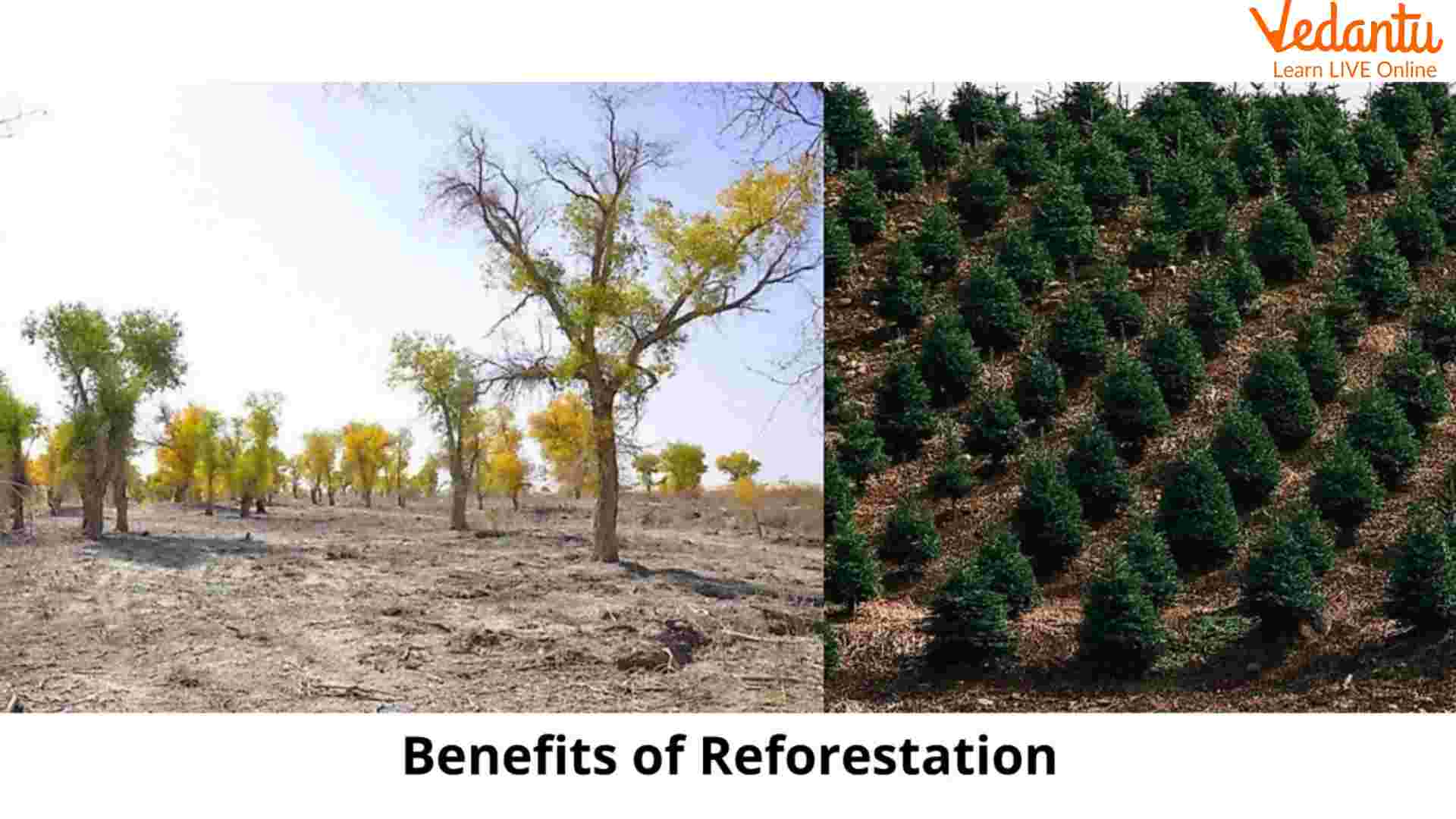
Benefits of Reforestation
Fixes atmospheric carbon dioxide in their leaves, trunks, and roots, assisting in carbon sequestration.
Absorbs air pollutants into the leaves and bark to remove them.
Grows roots that hold the soil together to stop soil erosion.
More than 80% of the world's terrestrial biodiversity depends on it for habitat.
Reduces the temperature of the surrounding air by up to 8 degrees Celsius, acting as natural air conditioners.
Lessens the effects of climate change and global warming
Helps to safeguard threatened species.
Our drinking water through their roots to filter.
Prevents landslides and floods by soaking up water and gradually releasing it through transpiration.
Conclusion
The continuation of modern human culture is universally dependent on forests and the things they produce. We typically do not even think it is even worthy of further inquiry to modify our civilization such that it does not depend on the forest (to the forest's disadvantage) and its accompanying advantages. As a result, it is crucial that we develop methods for managing the forest sustainably so that it can give all of its potential advantages.


FAQs on Reforestation and Its Environmental Importance
1. What is reforestation and how is it related to chemistry?
Reforestation is the process of replanting trees in deforested areas, and it is closely related to carbon cycle chemistry and photosynthesis. In chemical terms, trees remove CO2 from the atmosphere and convert it into organic compounds through photosynthesis. This process:
- Reduces atmospheric carbon dioxide levels
- Stores carbon in biomass as carbohydrates
- Helps regulate greenhouse gas concentrations
2. What is the chemical equation for photosynthesis in reforestation?
The balanced chemical equation for photosynthesis is 6CO2(g) + 6H2O(l) → C6H12O6(s) + 6O2(g). In this reaction:
- Carbon dioxide and water react in the presence of sunlight and chlorophyll
- Glucose (C6H12O6) stores chemical energy
- Oxygen is released as a by-product
3. How does reforestation reduce carbon dioxide chemically?
Reforestation reduces carbon dioxide by chemically converting CO2 into organic carbon compounds through photosynthesis. During this process:
- CO2 molecules are fixed into glucose
- Carbon atoms become part of plant tissues (cellulose, lignin)
- Carbon is stored long-term in wood and soil
4. What is carbon sequestration in reforestation?
Carbon sequestration is the chemical process of capturing and storing atmospheric CO2 in plant biomass and soil. In reforestation:
- Trees absorb CO2 via photosynthesis
- Carbon is stored as organic molecules like cellulose
- Some carbon becomes part of soil organic matter
5. How does reforestation affect the oxygen cycle?
Reforestation increases atmospheric oxygen because photosynthesis produces O2 as a by-product. From the equation 6CO2 + 6H2O → C6H12O6 + 6O2:
- Six molecules of oxygen are released per glucose molecule formed
- O2 supports respiration and combustion reactions
- It helps maintain atmospheric gas balance
6. What role does the nitrogen cycle play in reforestation?
The nitrogen cycle supplies essential nutrients like NO3- and NH4+ needed for plant growth during reforestation. Chemically:
- Nitrogen fixation converts N2(g) into ammonia (NH3)
- Nitrification forms nitrate ions (NO3-)
- Trees absorb these ions to synthesize proteins and nucleic acids
7. How does soil pH affect reforestation success?
Soil pH affects nutrient availability because it controls the chemical solubility of minerals. In reforestation:
- Optimal pH (about 6–7) maximizes nutrient absorption
- Acidic soil (low pH) may increase toxic Al3+ levels
- Alkaline soil (high pH) can reduce availability of Fe and P
8. What is the difference between afforestation and reforestation in environmental chemistry?
Reforestation restores trees in previously forested areas, while afforestation plants trees in areas that were not forests before. Chemically, both processes:
- Remove atmospheric CO2 through photosynthesis
- Increase carbon storage in biomass
- Influence greenhouse gas balance
9. How does reforestation help reduce the greenhouse effect?
Reforestation reduces the greenhouse effect by lowering atmospheric concentrations of CO2, a major greenhouse gas. Chemically:
- CO2 absorbs infrared radiation
- Photosynthesis converts CO2 into stable organic carbon
- Less CO2 means reduced heat trapping
10. What happens chemically when forests are burned instead of restored?
When forests are burned, stored carbon is chemically oxidized back to CO2 through combustion reactions. A simplified example is C(s) + O2(g) → CO2(g). During deforestation fires:
- Organic carbon reacts with oxygen
- Large amounts of CO2 are released
- The carbon cycle shifts toward atmospheric accumulation
