









Factors Affecting Dipole Moment Of Haloalkanes With Order And Examples
Alkyl halides also known as haloalkanes or halogen alkanes are chemical compounds that are derived from alkanes that contain one or more than one halogens. Alkyl halides or haloalkanes are made by substitution or replacement of a hydrogen atom in an open-chain hydrocarbon with halogen atoms (Fluorine, chlorine, bromine, or iodine). Dipole moment depends on the difference between the electronegativity order of carbon and halogen compounds.
Definition of Dipole Moment
Dipole moments occur when there's a separation of charge. When atoms in a molecule share electrons unevenly, a dipole moment is formed. This happens when one atom is more electronegative as compared to a different atom or when one atom includes a lone pair of electrons and also the difference of electronegativity vector points within the same approach.
They can occur between 2 ions in an ionic bond or between atoms in a chemical covalent bond. The higher the difference in electronegativity, the higher the dipole moment. The gap between the charge separation is also a significant factor in the scale of the dipole moment. The dipole moment may be a measure of the polarity of the molecule.
Dipole Moment of Haloalkanes
Dipole moment decreases with a decrease in the electronegativity of the halogen compound. Although Cl is less electronegative than F, the dipole moment of the C-Cl bond is higher than the C-F bond. This is often due to the smaller C-F bond length that dominates the impact of greater electronegativity.
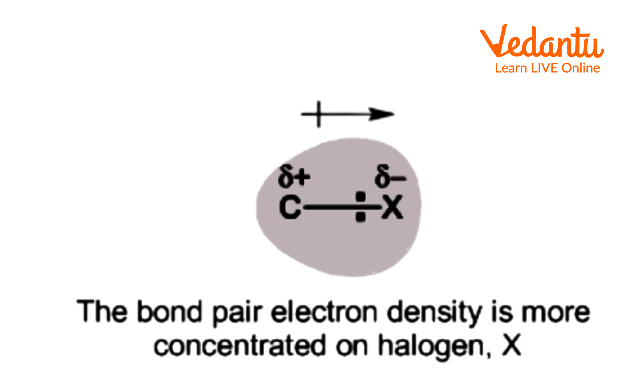
Dipole Moment in Halogen Compounds
Electronegativity of the alkyl halides :
F>Cl>Br>I
Bond length increases with the increase in the size of the halogen group.
C-F<C-Cl<C-Br<C-I
Order for bond dipoles:
\begin{align}
& C-Cl>C-F>C-Br>C-I \\
& 1.56D>1.51D>1.48D>1.29D \\
\end{align}
Molecular dipole depends on the geometry of the molecule.
The Dipole Moment of RX Depends on:
the sizes of the partial charges.
the distance between the charges.
the polarizability of the unshared electrons present on halogen.
Properties of Alkyl Halides
Physical Properties of Haloalkanes
Haloalkanes are colourless, odourless, and hydrophobic.
They are heavier than alkanes.
Density is directly proportional to the mass of the compound, therefore down the homologous series, density will increase, also fluoro derivatives are less dense than chloro derivatives; chloro derivatives are less dense than Bromo derivatives, and so on.
The boiling point of chlorides, bromides, and iodides is relatively more than those of the hydrocarbons of comparable molecular mass. The boiling point reduces with the increase in branching.
Properties of Haloarenes
All halogen compounds are less ignitable than hydrocarbons. The inflammability decreases with a rise in halogen groups.
In haloarenes halogen groups are connected to carbon atoms, hence dipole moment develops between them. The dipole moment will increase because the number of halogen atoms increases.
Due to the double character of the C-X bond in aryl halides, the C-X bond is shorter in length and stronger than in the alkyl halides, hence, their boiling points are more than in alkyl halides. Boiling points will increase because the number of halogen atoms increases in rings.
Density order for halo arenes increases as follows:
Ar-I>Ar-Br>Ar-Cl>Ar-F
Interesting Fact
A large variety of halogen-containing compounds are found in nature and plenty of those are utilised in drugs and technology.
Some haloalkanes (those containing Cl or bromine) have negative effects on the surroundings like ozone depletion. The foremost widely renowned family among this group is the chlorofluorocarbons (CFCs).
Important Questions
1. Arrange propane, 1-chloropropane, and isopropyl chloride in order of increasing boiling points.
Ans: First, calculate the molecular masses of the given compounds :
\begin{align}
& MolecularMas{{s}_{\left( C{{H}_{3}}C{{H}_{2}}C{{H}_{3}} \right)}}=\left( 12\times 3+8\times 1 \right)=44 \\
& MolecularMas{{s}_{\left( C{{H}_{3}}CH\left( Cl \right)C{{H}_{3}} \right)}}=\left( 12\times 3+7\times 1+1\times 35.5 \right)=78.5 \\
& MolecularMas{{s}_{\left( C{{H}_{3}}C{{H}_{2}}C{{H}_{2}}Cl \right)}}=\left( 12\times 3+7\times 1+1\times 35.5 \right)=78.5 \\
\end{align}
Since the boiling point will increase with a rise in molecular mass, propane has the lowest boiling point among them. Further, the boiling point decreases with branching; thus, isopropyl chloride contains a lower boiling point than 1-chloropropane.
CH3CH2CH3<CH3CH(Cl)CH3<CH3CH2CH2Cl
2. Para-Dichlorobenzene has a higher melting point than those of o- and m-isomers. Explain.
Ans: The para-isomer is more symmetrical and fits closely within the crystal lattice. This results in stronger intermolecular forces of attraction than those of ortho- and meta-isomers. Thus, a larger value of energy is needed to melt the para-isomer than the corresponding ortho- and meta-isomers.
Summary
Halogens are group 17 components within the periodic table and are electronegative (F, Cl, Br, I, At). Fluorine (F) is the most electronegative element. The group 17 components need only 1 electron to complete their outer shell. The dipole moment of alkyl halides and aryl halides varies according to the electronegativity order of halide compounds. Down the group, the electronegativity of halogen compounds decreases, and therefore the dipole moment also decreases.


FAQs on Dipole Moment Of Haloalkanes And Its Molecular Polarity
1. What is the dipole moment of haloalkanes?
The dipole moment of haloalkanes is the measure of polarity arising mainly from the C–X bond (carbon–halogen bond) due to electronegativity difference between carbon and halogen. It is represented by μ = q × d, where q is the magnitude of charge and d is the distance between charges.
- Halogens (F, Cl, Br, I) are more electronegative than carbon.
- This creates a partial negative charge (δ−) on X and partial positive charge (δ+) on carbon.
- As a result, haloalkanes are generally polar molecules.
2. How is the dipole moment of haloalkanes calculated?
The dipole moment of haloalkanes is calculated using the formula μ = q × d, where q is charge separation and d is bond length.
- Measure or determine the polarity of the C–X bond.
- Multiply the magnitude of partial charge by the bond distance.
- For polyhalogen compounds, calculate the vector sum of individual bond moments.
3. Why are haloalkanes polar molecules?
Haloalkanes are polar because the carbon–halogen bond is polar due to a significant electronegativity difference between carbon and the halogen atom.
- Electronegativity of halogens: F > Cl > Br > I.
- Electron density shifts toward the halogen, creating δ− on X and δ+ on carbon.
- This charge separation produces a measurable dipole moment.
4. What is the order of dipole moment in alkyl halides?
The general order of dipole moment in methyl halides is CH3Cl > CH3F > CH3Br > CH3I.
- Although fluorine is most electronegative, the C–F bond is shorter, reducing charge separation distance.
- C–Cl bond has an optimal balance of electronegativity and bond length.
- Down the group, bond length increases but electronegativity decreases.
5. How does electronegativity affect the dipole moment of haloalkanes?
Electronegativity affects dipole moment by controlling the magnitude of charge separation in the C–X bond.
- Greater electronegativity difference increases bond polarity.
- Fluorine causes strong bond polarity due to high electronegativity.
- However, dipole moment also depends on bond length and molecular geometry.
6. Why does CH3Cl have a higher dipole moment than CH3F?
CH3Cl has a higher dipole moment than CH3F because the longer C–Cl bond increases charge separation distance.
- Fluorine is more electronegative than chlorine.
- But the C–F bond is shorter, reducing the value of μ = q × d.
- The C–Cl bond provides a larger effective dipole.
7. How does molecular symmetry affect the dipole moment of haloalkanes?
Molecular symmetry can reduce or cancel the net dipole moment due to vector addition of bond moments.
- If bond dipoles act in opposite directions, they cancel.
- In symmetric molecules like CCl4, the net dipole moment is zero.
- In asymmetric haloalkanes like CH3Cl, dipoles do not cancel.
8. What is the dipole moment of polyhalogen compounds like CH2Cl2?
The dipole moment of polyhalogen compounds like CH2Cl2 is the vector sum of all individual bond dipoles and is non-zero due to its asymmetric tetrahedral structure.
- C–Cl bonds are polar.
- The tetrahedral geometry prevents complete cancellation.
- Hence, CH2Cl2 is a polar molecule.
9. What factors affect the dipole moment of haloalkanes?
The dipole moment of haloalkanes depends mainly on electronegativity, bond length, and molecular geometry.
- Electronegativity difference between carbon and halogen.
- Bond length (distance between charges).
- Molecular symmetry and vector addition of bond dipoles.
- Inductive effects of alkyl groups.
10. Why is the study of dipole moment important in haloalkanes?
The study of dipole moment in haloalkanes is important because it helps determine molecular polarity, structure, and reactivity.
- It confirms molecular geometry and symmetry.
- It explains physical properties like boiling point and solubility.
- It helps predict reaction behavior such as nucleophilic substitution.
