








2027 NEET vs JIPMER vs AIIMS: Exam Patterns, Eligibility, and Selection Explained
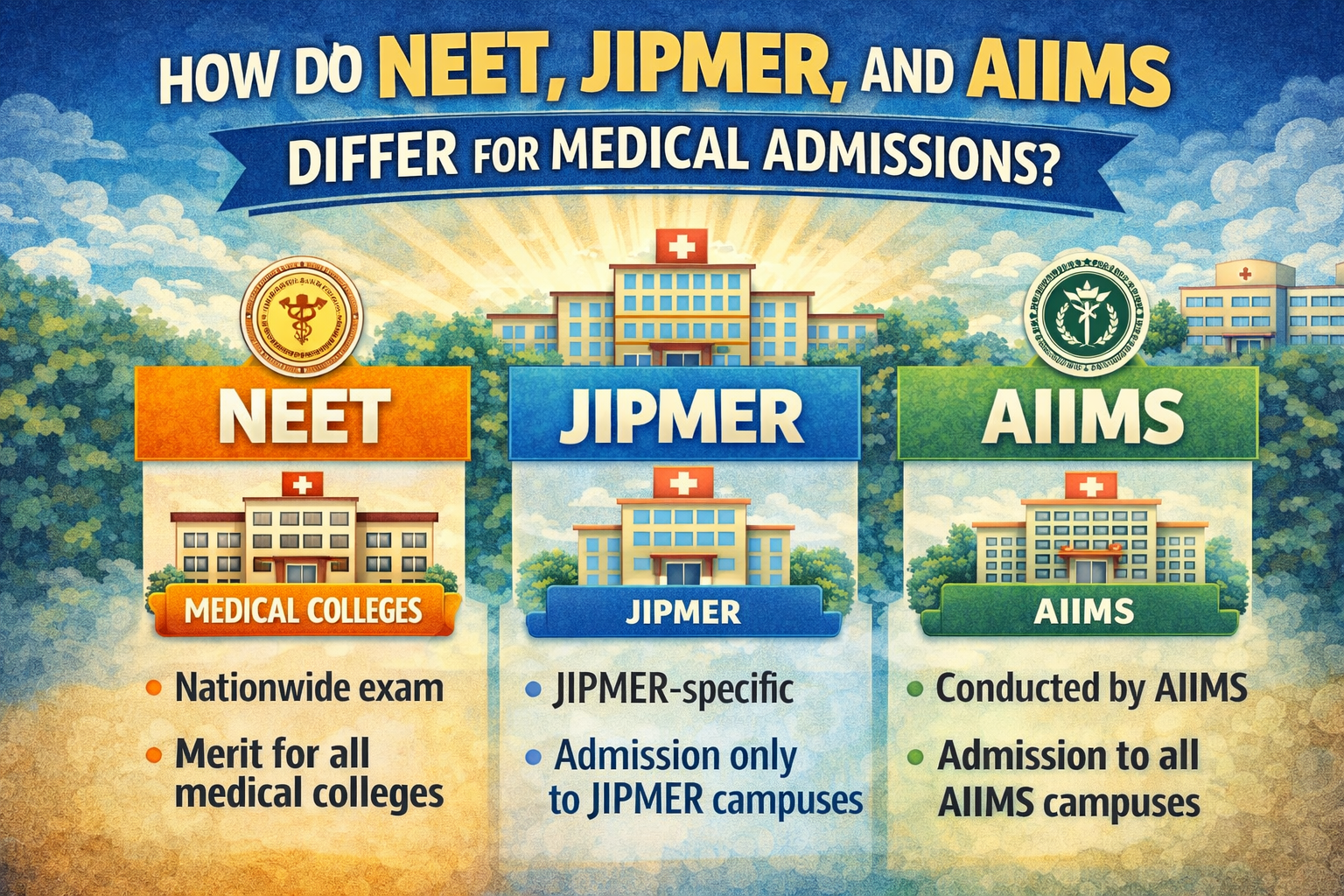
For NEET 2027 aspirants, understanding what are the differences between NEET, JIPMER and AIIMS is essential for informed preparation and college choices. The landscape of medical entrance exams in India has changed over the years, and both AIIMS and JIPMER are now included under the single NEET-UG examination. However, it’s important to know their historical differences, current status, and what it means for your MBBS admission journey.
Historical Overview: NEET, AIIMS, and JIPMER Entrance Exams
Before 2020, medical aspirants in India undertook separate entrance exams for different prestigious institutions. The All India Institute of Medical Sciences (AIIMS) and Jawaharlal Institute of Postgraduate Medical Education and Research (JIPMER) each conducted their own national-level exams apart from NEET (National Eligibility cum Entrance Test), which was used for the majority of MBBS/BDS admissions across the country. This meant students could aim for multiple top institutes through different exam patterns and selection processes.
What Is The Difference Between NEET, AIIMS, and JIPMER?
The main distinction in earlier years was that NEET, AIIMS, and JIPMER each had their own exam papers, question patterns, and selection systems. Here’s how they were different:
Exam Pattern: AIIMS and JIPMER had different paper structures and types of questions compared to NEET. AIIMS included Assertion-Reason and GK questions, JIPMER had English language and logical reasoning, while NEET was focused on Physics, Chemistry, and Biology.
Number of Seats: AIIMS and JIPMER offered a limited and highly sought-after number of seats, while NEET was used for the vast majority of MBBS seats in India (except for the AIIMS and JIPMER institutes at the time).
Difficulty Level: The AIIMS exam was considered particularly challenging among the three, followed by JIPMER, then NEET.
Application Process: Separate forms, eligibility, and counseling for each exam.
Comparison Table: NEET, AIIMS, and JIPMER Before the Merger
This table captures the core difference between AIIMS and JIPMER entrance exams and NEET before the exams were unified.
Current Status: Unified NEET for MBBS in 2027
Since 2020, the Government of India has merged AIIMS and JIPMER MBBS admissions into NEET-UG. From 2027 and onwards, there is no separate entrance test for these institutes. All MBBS admissions—including AIIMS (Delhi and all branches) and JIPMER (Puducherry and Karaikal)—are conducted through NEET-UG scores only. The specific selection happens via NEET counseling rounds.
This means the question “what are the differences between NEET JIPMER and AIIMS” is now only relevant for understanding historical context or when comparing past exam strategies with the current unified process.
How Do NEET, AIIMS, and JIPMER Differ in 2027?
For NEET 2027 aspirants, there is no difference in the exam you take for MBBS admission at AIIMS, JIPMER, or any other medical college. Key points to note:
NEET-UG is now the single national exam for MBBS seats across India.
AIIMS and JIPMER seats are allotted based on NEET-UG ranks, not a separate exam.
The previous AIIMS and JIPMER question patterns no longer apply.
The only ‘jipmer and neet difference’ now is the location and reputation of the medical college, not the entrance process.
So, if you’re wondering “is JIPMER better than AIIMS”, the answer depends on your personal preferences, academic goals, and desired campus—not on entrance exam structure.
What NEET 2027 Aspirants Should Focus On
With the unified exam, you must direct all your effort into mastering the NEET-UG syllabus. Here are some important preparation reminders:
Strictly follow the NEET syllabus, focusing on NCERT-based concepts in Physics, Chemistry, and Biology.
Practice time management and mock tests using NEET exam patterns only.
Aim for a high NEET score to qualify for the most competitive seats at AIIMS and JIPMER campuses.
Understand the counseling process and check closing ranks for the previous years to set realistic targets.
To explore preparation across all major institutes, you can read our detailed guidance on how to prepare for NEET, AIIMS, and JIPMER in a focused timeframe.
If you’re interested in how this merger has affected students, there’s a useful discussion here on the disadvantages of merging AIIMS and JIPMER with NEET.
Student Takeaway: Choosing Between AIIMS and JIPMER in 2027
Your NEET rank in 2027 will decide your chances for admission into AIIMS, JIPMER, or any other government or private medical college. With no exam pattern differences, students should compare these institutes based on:
Academic reputation and placement opportunities
Infrastructure and faculty
Location and campus life
Personal preferences for specializations and research exposure
Ultimately, your NEET exam preparation strategy is what matters most for admission to these prestigious colleges. For inspiration and actionable insights, check out the NEET preparation tips shared by toppers to help you fine-tune your study plans.
While “what are the differences between NEET, JIPMER, and AIIMS” was once a crucial question, for NEET 2027 aspirants it’s all about excelling in the single NEET-UG exam and making informed college choices during counseling. Focus on strengthening your concepts, practice consistently, and ensure your preparation is aligned with current NEET standards to keep all top medical colleges—including AIIMS and JIPMER—within your reach.
FAQs on How Do NEET, JIPMER, and AIIMS Differ for Medical Admissions in 2027?
1. What are the main differences between NEET, JIPMER, and AIIMS exams?
The main differences between NEET, JIPMER, and AIIMS exams are in their exam patterns, selection process, and question formats.
2. Is the syllabus the same for NEET, JIPMER, and AIIMS?
The core syllabus for NEET, JIPMER, and AIIMS is similar, focusing on Physics, Chemistry, and Biology based on the Class 11 and 12 curriculum.
JIPMER and AIIMS sometimes included additional sections or questions, such as General Knowledge or Reasoning.
3. Do NEET, JIPMER, and AIIMS have different exam patterns?
Yes, NEET, JIPMER, and AIIMS traditionally had different exam patterns regarding question numbers, types, and marking schemes.
4. Which exam is required for medical college admission: NEET, JIPMER, or AIIMS?
NEET is currently the primary entrance exam for admission to most medical colleges, including those that previously used JIPMER or AIIMS exams.
5. Were there unique sections in the AIIMS or JIPMER entrance exams?
Yes, the AIIMS exam included sections like General Knowledge and Aptitude, while JIPMER sometimes had questions on English and Logical Reasoning.
6. How should students prepare for the differences in these medical entrance exams?
Students should focus on thorough understanding of the Class 11 and 12 NCERT syllabus and stay updated on any unique section requirements for each medical exam.
7. Has the exam structure for AIIMS and JIPMER changed over time?
Yes, over time, the separate AIIMS and JIPMER entrance exams have been merged into the NEET exam for medical admissions.
8. Are the eligibility criteria different for NEET, JIPMER, and AIIMS?
Earlier, there were slight variations in eligibility, but now NEET eligibility criteria apply to all medical college admissions in these institutions.
9. Did the marking scheme vary between NEET, JIPMER, and AIIMS?
Yes, the marking scheme and distribution of questions varied between NEET, JIPMER, and AIIMS exams before their unification under NEET.
10. Why is it important to know the differences between NEET, JIPMER, and AIIMS?
Understanding the differences helps students plan their preparation and become familiar with past exam trends and unique requirements.
