




How to Answer Grade 3 Reading Comprehension Story Questions
Read the story and answer the questions that follow.
The Kite That Could Fly
Leo and Mia were best friends and loved building things together. The town's annual Kite Festival was just a week away, and they decided to build the most amazing kite ever. They gathered colorful paper, two strong, light sticks, a long ball of string, and some old ribbons for the tail.
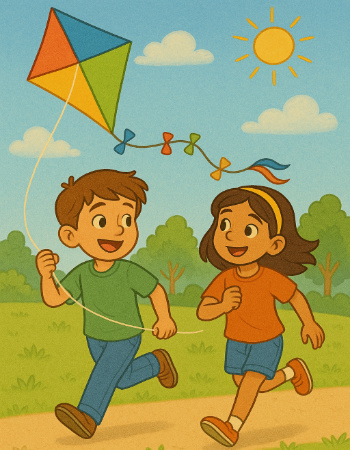
They spent the whole afternoon in Leo’s backyard. They carefully cut the paper into a diamond shape and tied it to the sticks. "It looks perfect!" Mia exclaimed. They took it to the park for a test flight. Leo held the kite high while Mia ran with the string. But the kite just wobbled and nose-dived to the ground. They tried again and again, but the result was the same. They felt very disappointed.
"Let's not give up," said Leo. "I read that a good tail helps a kite to be stable." They went back and tied all the colorful ribbons to the end of the kite, making the tail much longer and a little heavier. They returned to the park, feeling hopeful. This time, when the wind caught the kite, it soared! It climbed higher and higher, dancing in the blue sky. Leo and Mia cheered, feeling incredibly proud of their creation.
Questions
1. Tick the correct option. What were Leo and Mia preparing for?
(a) A birthday party
(b) The school's annual day
(c) The town's Kite Festival
2. Fill in the blank with a word from the story.
The kite just ___________ and nose-dived to the ground on the first try.
3. Answer the following question in one sentence.
Why did Leo and Mia feel disappointed at first?
___________________________________________________________________
4. Write True or False for the following statements.
(a) Leo and Mia used plastic bags to make their kite. __________
(b) A longer tail helped the kite to fly properly. __________
5. Choose the correct word to complete the sentence.
Leo and Mia felt very ( sad / proud ) when their kite finally flew high.
6. What materials did the friends use to build their kite?
_________________________________________________________________
7. Rearrange the following actions in the correct order as they happened in the story.
(a) The kite soared high in the sky.
(b) Leo and Mia gathered materials to build a kite.
(c) The kite failed to fly and nose-dived.
(d) They added long, colorful ribbons to the kite's tail.
Correct Order: _____, _____, _____, _____
8. Match the words in Column A with their meanings in Column B.
9. What character trait did Leo and Mia show when their kite did not fly?
(a) Laziness
(b) They did not give up
(c) Fear
10. Find a word from the passage that is the opposite of 'short'.
___________________
Answer Key
1. (c) The town's Kite Festival
2. wobbled
3. Leo and Mia felt disappointed because their kite would not fly and kept nose-diving to the ground.
4. (a) False, (b) True
5. proud
6. They used colorful paper, two strong sticks, a long ball of string, and some old ribbons.
7. Correct Order: (b), (c), (d), (a)
8. (a) - (iii), (b) - (iv), (c) - (i), (d) - (ii)
9. (b) They did not give up
10. long
Class 3 English: Reading Comprehension Worksheet with Engaging Children’s Story
This Class 3 Reading Comprehension Level P2 Children’s Story worksheet helps students read short stories actively and answer questions confidently. By practicing with fun examples, learners build a strong foundation in English. The topic supports vocabulary development and understanding story structure, both important skills in the subject. Parents notice improved reading ability and better focus, making comprehension practice both enjoyable and meaningful for every child.
Sharpening Understanding Through Children's Stories
With this worksheet, Class 3 students dive into story reading and learn to spot main ideas and important details. The topic—Reading Comprehension Level P2 Children’s Story—lets children in English classes practice finding answers and thinking about what they read. Regular practice prepares students for story-based questions and helps them enjoy books more. Parents and teachers see growth as learners become more curious and skilled readers.
FAQs on Grade 3 Reading Comprehension: Children’s Story with Questions
1. What is included in a Class 3 reading comprehension children’s story worksheet?
A Class 3 reading comprehension children’s story worksheet typically includes several engaging elements for practice:
- A short story or passage
- Multiple choice questions
- Short answer questions
- Vocabulary tasks
- Questions about character traits
- Answer key
2. What is reading comprehension for grade 3?
Reading comprehension for grade 3 means understanding and responding to texts suitable for children aged 7–9. Students learn to:
- Identify main ideas and key details
- Explain character traits and motivations
- Answer literal and inferential questions
- Improve vocabulary and reasoning
3. How can I use this worksheet at home?
To use a Class 3 reading comprehension worksheet at home, print the PDF and have your child:
- Read the story carefully
- Answer each question independently
- Discuss answers and check responses using the answer key
4. Does this include an answer key?
Yes, most Grade 3 children’s story comprehension worksheets include an answer key.
- Parents and teachers can use it to check answers easily.
- Helps students learn correct responses and reinforce understanding.
5. Is this worksheet printable?
Yes, the worksheet is printable.
- Download the PDF file
- Print at home or school
- Suitable for offline homework or classroom activities
6. What age group is it best for?
This comprehension worksheet is best for students aged 7–9 years in Class 3 (or Grade 3).
It matches the syllabus level and cognitive skills expected for this group.
7. What is grade 3 level reading?
Grade 3 level reading includes stories and passages that:
- Use simple and compound sentences
- Have clear structure: beginning, middle, end
- Feature relatable characters, events, and vocabulary
8. What is story reading comprehension?
Story reading comprehension means understanding, analyzing, and answering questions about a story.
- Students identify main ideas, learn new words, and interpret character actions
- This skill improves overall reading, writing, and thinking abilities
9. How to answer reading comprehension questions?
To answer reading comprehension questions:
- Read the story carefully
- Underline important details
- Read each question and find the answer in the text
- Write clear, complete sentences or tick the correct choice
10. Can I use this worksheet digitally on a tablet?
Yes, you can use this reading comprehension worksheet on a tablet:
- Open the PDF using a compatible app
- Read and write answers digitally using annotation tools
