






Practice Questions on 2D and 3D Shapes for Class 3
Section A: Multiple Choice Questions (MCQs)
1. Which of the following shapes has exactly 5 sides and 5 corners?
(a) Triangle (b) Square (c) Pentagon (d) Hexagon
2. A globe looks like which of these 3D shapes?
(a) Cube (b) Sphere (c) Cylinder (d) Cone
3. How many faces does a cube have?
(a) 4 (b) 6 (c) 8 (d) 12
4. A shape with all sides of equal length and all angles equal is called a:
(a) Regular polygon (b) Irregular polygon (c) Circle (d) Oval
5. Which of these is an example of a line segment?
(a) A ray of sun (b) The edge of a ruler (c) A railway track (d) A laser beam
Section B: Fill in the Blanks
1. A triangle has _________ vertices.
2. A circle has _________ straight sides.
3. A rectangle has _________ pairs of equal sides.
4. The point where two sides of a shape meet is called a _________.
5. A cone has one flat face and one _________ face.
Section C: True or False
1. All sides of a rectangle are always equal. (True / False)
2. A cylinder has 3 faces. (True / False)
3. A square is a type of rectangle. (True / False)
4. A sphere can roll easily. (True / False)
5. A line has a fixed length. (True / False)
Section D: Match the Columns
Match the shape to its number of edges.
Your Answer: 1-___, 2-___, 3-___, 4-___
Section E: Short Answer Questions
1. Look at the shape below and count its sides and vertices.
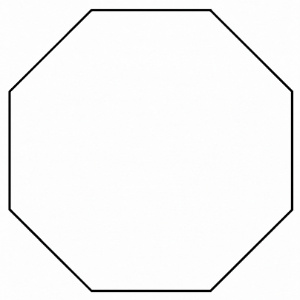
Number of sides: _________
Number of vertices: _________
2. Name two objects from your classroom that are shaped like a cuboid.
1. ____________________ 2. ____________________
3. Identify the types of lines shown below (Parallel, Perpendicular, or Intersecting).
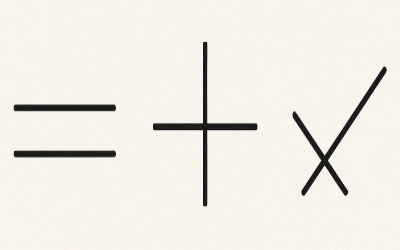
a) _______________ b) _______________ c) _______________
4. A rectangle has a length of 6 cm and a width of 4 cm. What is its perimeter?
Perimeter = ____________________ cm
5. Count the number of squares to find the area of the shape below.
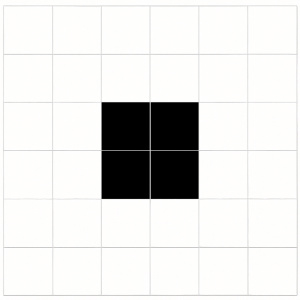
Area = ____________________ square units
Section F: Identify and Draw
1. Circle the shape that has a line of symmetry.
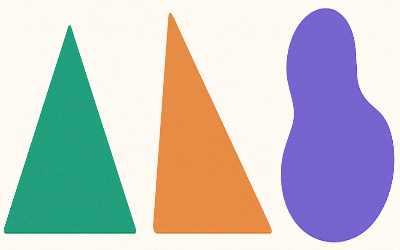
2. Draw all the lines of symmetry for the shape given below.
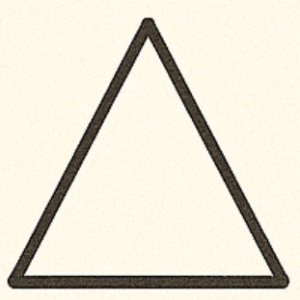
3. Draw a shape that has no corners and no straight sides. What is its name?
Name: ____________________
Answer Key
Section A: Multiple Choice Questions (MCQs)
1. (c) Pentagon
2. (b) Sphere
3. (b) 6
4. (a) Regular polygon
5. (b) The edge of a ruler
Section B: Fill in the Blanks
1. 3
2. 0 (or zero)
3. 2 (or two)
4. vertex (or corner)
5. curved
Section C: True or False
1. False
2. True
3. True
4. True
5. False
Section D: Match the Columns
1-D, 2-A, 3-B, 4-D (Note: Cube and Rectangular Prism both have 12 edges)
Section E: Short Answer Questions
1. Number of sides: 8, Number of vertices: 8
2. (Sample answers) Duster, Book, Lunchbox, Pencil box
3. a) Parallel, b) Perpendicular, c) Intersecting
4. Perimeter = 20 cm (6+4+6+4)
5. Area = 9 square units
Section F: Identify and Draw
1. The isosceles triangle should be circled.
2. Two lines of symmetry should be drawn: one vertical through the middle, one horizontal through the middle.
3. Student should draw a circle or an oval. Name: Circle / Oval.
Geometry in Maths – Class 3 Worksheet with Practice Questions
With this Class 3 Maths Geometry worksheet, learners discover different shapes found in their everyday lives. They practice recognizing circles, triangles, and rectangles, and learn about corners and sides.
This hands-on approach helps students use their geometry vocabulary with confidence. Parents and children see how the Topic fits into real math skills, answering questions like “What is geometry in Maths?” while building strong basics for future study.
Build Confidence with Drawing and Naming Shapes
Students in Class 3 enjoy drawing and naming shapes in this engaging Maths worksheet on Geometry. This activity improves spatial thinking and helps children spot patterns in the world around them.
The worksheet encourages students to talk about sides and corners, which are important for understanding this subject and topic. By connecting names to shapes, learners grow more confident and ready for new geometry challenges.
FAQs on Class 3 Maths Geometry Worksheets for Grade 3
1. What are the basic geometric shapes for Class 3?
The basic geometric shapes for Class 3 include both 2D and 3D shapes. These are:
- Circle
- Square
- Rectangle
- Triangle
- Cube
- Cuboid
- Sphere
- Cylinder
These shapes help students identify, compare, and understand fundamental geometry concepts.
2. What are geometric shapes for Grade 3?
Geometric shapes for Grade 3 include both flat (2D shapes) and solid (3D shapes). Examples are:
- 2D: Circle, square, rectangle, triangle
- 3D: Cube, cuboid, sphere, cylinder
Students learn to recognise, name, and describe these shapes as part of the Class 3 Maths Geometry syllabus.
3. How do you teach geometry to a 3rd grader?
To teach geometry to a 3rd grader:
- Use colourful worksheets with clear instructions
- Include shape-identification and matching activities
- Ask students to draw and count sides, corners, and faces
- Incorporate simple questions about 2D and 3D shapes
- Practice lines of symmetry and basic properties for easy understanding
4. What is a 2D shape example?
An example of a 2D shape is a rectangle. Other common 2D shapes for Class 3 geometry include:
- Circle
- Square
- Triangle
2D shapes are flat and only have length and width.
5. Which shapes are in 3D?
Common 3D shapes for Class 3 include:
- Cube
- Cuboid
- Sphere
- Cylinder
These solid shapes have length, width, and height, and are important in Grade 3 Maths Geometry.
6. What are lines and curves in geometry?
In geometry for Class 3:
- A line is a straight path that extends endlessly in both directions.
- A curve is a smoothly flowing, bending line without sharp corners, like part of a circle.
Understanding lines and curves helps students learn to draw and recognise shapes.
7. How can I use this worksheet at home?
Parents can use Class 3 Maths Geometry worksheets at home by:
- Printing or downloading the PDF worksheets
- Letting children solve shape identification, matching, and drawing tasks
- Checking answers with the included answer key
This supports extra practice and concept reinforcement for kids.
8. Does this include an answer key?
Yes, most Class 3 Maths Geometry practice worksheets provide an answer key. This allows students and parents to quickly check solutions and supports self-assessment.
9. Is this worksheet printable?
Yes, the Class 3 Maths Geometry worksheet is printable. Users can easily download it as a PDF for offline practice, homework, or extra revision at home.
10. What age group is it best for?
Class 3 Maths Geometry worksheets are best for students aged around 8 years old. They are suitable for third graders learning basic geometric shapes and properties.
11. What skills are built by this activity?
Practising with Class 3 Maths Geometry worksheets builds:
- Visual recognition of shapes
- Spatial reasoning
- Shape matching and naming
- Understanding properties of 2D/3D objects
These are essential skills for maths success.
12. Can I use this worksheet digitally on a tablet?
Yes, the Class 3 Maths Geometry worksheet PDF can be used digitally. You can open it on a tablet and practice shapes without printing, making it convenient for both home and classroom learning.
