






How to Solve Number Patterns: Easy Examples and Tips
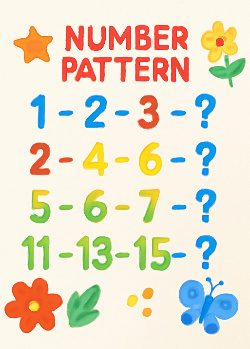
Section A: Fill in the Missing Numbers
Look at the numbers in each row. Find the pattern and write the missing number in the blank space.
1. 3, 4, 5, ____, 7, 8
2. 10, 12, 14, ____, 18, 20
3. 5, 10, 15, ____, 25, 30
4. 20, 30, 40, ____, 60, 70
5. 11, ____, 9, 8, 7
6. 25, 23, 21, ____, 17
7. 45, 40, 35, ____, 25
8. 88, 87, ____, 85, 84
Section B: Multiple Choice Questions
Read the number pattern and circle the correct number that comes next.
1. What is the next number in the pattern: 1, 3, 5, 7, ____?
a) 8
b) 9
c) 10
2. What is the next number in the pattern: 40, 45, 50, 55, ____?
a) 56
b) 65
c) 60
3. What is the next number in the pattern: 33, 32, 31, 30, ____?
a) 29
b) 28
c) 31
4. What is the missing number in the pattern: 60, 70, ____, 90, 100?
a) 75
b) 80
c) 85
Section C: True or False
Read each statement and decide if it is true or false. Write 'True' or 'False' on the line.
1. The pattern 2, 4, 6, 8 is counting down by 2s. __________
2. The next number in the pattern 15, 14, 13 is 12. __________
3. The missing number in the pattern 5, 10, ____, 20 is 15. __________
4. The pattern 1, 2, 4, 5 has a clear rule of counting by 1s. __________
Section D: Match the Pattern to its Rule
Draw a line to match the number pattern in Column A with the correct rule in Column B.
Section E: Short Answer Questions
Read the question carefully and write your answer on the line provided.
1. Look at this pattern: 4, 8, 12, 16. What is the rule for this pattern?
________________________________________________
2. Start at the number 20. Count down by 2. Write the next three numbers.
______, ______, ______
3. Create your own pattern starting with the number 6. Write the first four numbers.
6, ______, ______, ______
Answer Key
Section A: Fill in the Missing Numbers
1. 6
2. 16
3. 20
4. 50
5. 10
6. 19
7. 30
8. 86
Section B: Multiple Choice Questions
1. b) 9
2. c) 60
3. a) 29
4. b) 80
Section C: True or False
1. False
2. True
3. True
4. False
Section D: Match the Pattern to its Rule
1. → c. Count up by 1s
2. → d. Count up by 2s
3. → b. Count up by 5s
4. → a. Count down by 10s
Section E: Short Answer Questions
1. The rule is to count up by 4s (or add 4).
2. 18, 16, 14
3. (Answers will vary. Example patterns: 6, 7, 8, 9 or 6, 8, 10, 12)
How This Worksheet Helps You Learn?
Class 1 Maths Number Patterns Worksheets are designed to help Grade 1 students recognise and extend number sequences. This printable worksheet encourages pattern recognition and logical reasoning, using clear instructions and age-friendly numbers. By working through these Class 1 number patterns worksheet PDFs, children build a strong mathematical foundation for patterns, counting, and problem-solving.
These number pattern practice sheets for kids offer activities such as “complete the pattern” and “fill in the blanks,” helping young learners understand how sequences form. With a colourful, engaging design and pattern activity questions, students enjoy learning while gaining valuable early numeracy skills.
Usage Tips for Parents/Teachers
- Use the worksheet for daily maths warm-up or revision practice at home or school.
- Guide your child to observe each number pattern and encourage them to explain their thinking.
- Check answers together using the answer key—celebrate your child's effort as they complete each question.
- Display finished worksheets on the wall or fridge for motivation and reinforcement.
Related Links for Class 1 Maths Number Patterns Worksheets
Click on any topic to download printable worksheets with different practice sets and answer keys. These worksheets help your child practice the lessons the right way.
What You Learned
On this page, you explored how Class 1 Maths Number Patterns Worksheets help children practice pattern recognition, sequencing, and logical thinking. This free printable worksheet offers activities ideal for home or classroom, building early numeracy skills through easy-to-follow number patterns. Download the Class 1 number patterns worksheet PDF to reinforce concepts in Grade 1 maths, making learning fun, effective, and accessible for all students.
FAQs on Number Patterns Worksheets for Class 1 Maths Practice
1. What are number patterns for Grade 1?
Number patterns for Grade 1 are simple sequences of numbers that follow a specific rule, helping children learn about order and prediction in maths. These patterns are designed to be fun and build foundational logical skills.
- Increasing Patterns: Numbers get bigger by adding the same amount each time (e.g., 2, 4, 6, 8).
- Decreasing Patterns: Numbers get smaller by subtracting the same amount (e.g., 10, 8, 6, 4).
- Repeating Patterns: A set sequence of numbers repeats itself.
These activities often involve skip counting and help with pattern recognition.
2. How do you teach number patterns?
Teaching number patterns to a Class 1 student is best done through simple, hands-on activities and visual aids. Using a number patterns worksheet is an excellent way to provide structured practice.
- Start with visual patterns using shapes or objects before moving to numbers.
- Use a number line to show jumps for skip counting by 2s or 5s.
- Ask questions like “What comes next?” to encourage predictive thinking.
- Practice with activities like 'complete the pattern' and 'fill in the blanks' to reinforce learning.
3. What is an example of a number pattern?
A simple example of a number pattern for a Class 1 student is counting by 2s. This pattern helps children understand even numbers and simple addition.
Here are a few common number pattern examples:
- Counting by 2s: 2, 4, 6, 8, 10, ___ (The rule is to add 2)
- Counting by 5s: 5, 10, 15, 20, ___ (The rule is to add 5)
- Counting backwards by 1: 9, 8, 7, 6, ___ (The rule is to subtract 1)
- Odd Numbers: 1, 3, 5, 7, 9, ___ (The rule is to skip one number)
4. What skills do number patterns build?
Working with number patterns helps young learners develop several crucial early mathematical and cognitive skills. These skills form the foundation for more advanced maths concepts.
- Logical Reasoning: Children learn to identify rules and apply them to solve problems.
- Problem Solving: Finding a missing number or extending a sequence is a basic form of problem-solving.
- Counting Skills: Reinforces forward, backward, and skip counting abilities.
- Pattern Recognition: This is a key skill used in maths, science, and even reading.
- Foundation for Algebra: Understanding patterns is an early step toward understanding algebraic thinking.
5. How can I use this worksheet at home?
You can easily use this number patterns worksheet for Class 1 at home for extra practice, homework, or holiday revision. Simply download the free PDF, print it out, and give it to your child.
- Set aside a quiet time for your child to focus on the pattern questions.
- Read the instructions together and complete the first example.
- Encourage your child to say the numbers out loud to help them hear the pattern.
- Use the answer key to check their work and provide positive feedback.
6. Is this worksheet printable?
Yes, this Class 1 maths number patterns worksheet is designed to be easily printable. It is available as a free printable number patterns worksheet PDF, making it convenient for parents and teachers to download and print for use at home or in the classroom.
7. Does this include an answer key?
Yes, our pattern worksheet for Class 1 often comes with answers to help parents and teachers quickly check the solutions. Having a pattern worksheet with answers allows for immediate feedback, helping children learn from their mistakes and build confidence.
8. How does this worksheet reinforce concept retention?
This worksheet reinforces concept retention by providing focused, repetitive practice on a single skill. By repeatedly engaging with different number sequences, students strengthen their ability to recognise and apply pattern rules.
- Active Recall: Filling in missing numbers requires students to actively recall the pattern rule.
- Visual Reinforcement: The clear layout and fun images help visual learners connect with the concept.
- Hands-on Practice: The act of writing the numbers down helps solidify the learning in a child's memory.
9. Can I use this worksheet digitally on a tablet?
Yes, you can use this worksheet digitally on a tablet or computer. Since it is a PDF file, you can open it in any PDF reader or annotation app that allows you to write or draw on the document. This is a great paper-free option for tech-savvy families.
10. How do I find the missing number in a pattern for Class 1?
To find the missing number in a pattern, a Class 1 student should first figure out the 'rule' of the sequence. This involves looking at the numbers that are already there and seeing how they are related.
- Step 1: Look at two numbers next to each other.
- Step 2: Ask, “Are the numbers getting bigger or smaller?”
- Step 3: Figure out how much is being added or subtracted. For example, in the pattern 5, 10, ___, 20, the rule is to add 5.
- Step 4: Apply that rule to find the missing number. In this case, 10 + 5 = 15.
