




What do the zeros of a function represent?
Answer
 Verified
552k+ views
Hint: In this problem, we can see about the zeros of the functions. We should know that the zeros of the functions represent the x values that result in y being zero. It also represents the intercepts, when being graphed and it represents the roots of a function. Here we can see about it with an example.
Complete step-by-step solution:
Here we can see about the zeros of a function.
We should know that the zeros of the functions represent the x values that result in y being zero. It also represents the intercepts, when being graphed and it represents the roots of a function.
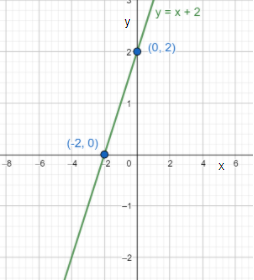
In graphs, we have an intercept, where at x-intercept, y is 0 that is the function of x and at y-intercepts x is 0, that is function of y.
We can now take a function,
\[y=x+2\]
Here we can find the x-intercept, where y is 0, we get
\[\begin{align}
& \Rightarrow x+2=0 \\
& \Rightarrow x=-2 \\
\end{align}\]
Where, the \[f\left( x \right)=0\].
We can now find the y-intercept, where x is 0, we get
\[\Rightarrow y=2\]
Where, the function of y is 0.
Note: We should always remember that the zeros of the functions represent the x values that result in y being zero. It also represents the intercepts, when being graphed and it represents the roots of a function. In graphs, we have an intercept, where at x-intercept, y is 0 that is the function of x and at y-intercepts x is 0, that is function of y.
Complete step-by-step solution:
Here we can see about the zeros of a function.
We should know that the zeros of the functions represent the x values that result in y being zero. It also represents the intercepts, when being graphed and it represents the roots of a function.
In graphs, we have an intercept, where at x-intercept, y is 0 that is the function of x and at y-intercepts x is 0, that is function of y.
We can now take a function,
\[y=x+2\]
Here we can find the x-intercept, where y is 0, we get
\[\begin{align}
& \Rightarrow x+2=0 \\
& \Rightarrow x=-2 \\
\end{align}\]
Where, the \[f\left( x \right)=0\].
We can now find the y-intercept, where x is 0, we get
\[\Rightarrow y=2\]
Where, the function of y is 0.
Note: We should always remember that the zeros of the functions represent the x values that result in y being zero. It also represents the intercepts, when being graphed and it represents the roots of a function. In graphs, we have an intercept, where at x-intercept, y is 0 that is the function of x and at y-intercepts x is 0, that is function of y.
Recently Updated Pages
Master Class 11 Social Science: Engaging Questions & Answers for Success

Master Class 11 English: Engaging Questions & Answers for Success
Master Class 11 Maths: Engaging Questions & Answers for Success
Master Class 11 Chemistry: Engaging Questions & Answers for Success
Master Class 11 Biology: Engaging Questions & Answers for Success
Master Class 11 Physics: Engaging Questions & Answers for Success
Trending doubts
Differentiate between an exothermic and an endothermic class 11 chemistry CBSE
One Metric ton is equal to kg A 10000 B 1000 C 100 class 11 physics CBSE
Difference Between Prokaryotic Cells and Eukaryotic Cells
There are 720 permutations of the digits 1 2 3 4 5 class 11 maths CBSE
Draw a diagram of a plant cell and label at least eight class 11 biology CBSE
Two of the body parts which do not appear in MRI are class 11 biology CBSE